Wednesday, November 16, 2022

2022 Photo Contest Winners: Macro Iris Photos

Every year the American Iris Society (AIS) sponsors a photo contest to celebrate irises, their use in garden and natural settings, and the people who grow and hybridize them. 

We are pleased to announce the following winners of the 2022 AIS photo contest:

 Iris Photos - MACRO

First Place – “’Yummy Accent’s’ Beefriend”

photo by Michelle Shriber, Ogden, UT

Second Place – “Red Iris”

photo by Oscar E. Gutierrez, Fredericksburg, VA

Honorable Mention – “Sorbonne”
photo by Greg Glotzbach, Yorkville, IL

Honorable Mention  “Gift 30 Years Ago”

photo by Greg Glotzbach, Yorkville, IL

First Place Youth – ““Howla Pena” 

photo by Wyatt Willis, Dyersburg, TN

During this contest, photographers submitted entries in categories listed below, which vary from year to year. Next, a panel of three to five judges reviewed submissions and voted for adult and youth winners for each category. Additional information about the annual photo contest can be found on the AIS website.

Visit other World of Irises blog posts to see 2022 award-winning photos in each category:

  1. Irises in a landscape or garden
  2. Irises in a field
  3. A person or people at iris events or tours with irises
  4. Close-up of an iris or irises
  5. Iris photos – macro
  6. Photos of pets, wildlife, or garden art with the irises (link available after 11/23)

Monday, November 14, 2022

Siberian/Species Iris Convention 2022

 by Jeff Bennett


A clump of irises at the Siberian/Species Iris Convention in May 2022

Every year, local societies, regions, and national societies have shows, conventions, meetings, and treks. As we found out with Covid, you don’t always know how long it will be to attend the next one. Your local show is the easiest to attend as you can generally drive to it and be home the same day. A regional meeting may require one overnight stay while a national convention will require a flight and at least three nights stay for most attendees. Since I had not been able to attend a national convention yet (due to Covid) and this year I was busy getting my own beds ready for a local regional meeting three weeks after this year’s national convention in New Mexico, I decided to attend the 2022 Siberian/Species Iris Convention. The convention was held May 27-29, 2022 near Seattle, Washington. The King County Iris Society was the host of this event and they did a wonderful job planning years in advance for us to visit three display gardens with guest irises to view and evaluate and vote on.

On our first evening, we had a presentation from Ken Walker on “Iris Species Across the World”. Ken shared his superior knowledge of where species of irises come from with the attendees. His trips to these locations to visit irises in their native habitat were very informative. By showing a map, he was able to show just where certain species were from which in turn helped us understand the requirements we must provide if we are to succeed at growing them here in the USA. Elevation, precipitation, and hi-lo temperatures are all factors to consider. I enjoyed Ken’s ability to explain the growing conditions encountered while on his treks.

Saturday morning we boarded the bus to take us to our first tour location: Highline SeaTac Botanical Garden. This 11-acre garden was established to preserve two gardens that were slated for demolition to expand runways of the airport. Both gardens were physically moved to this new location starting in 1996. Elda Behm’s Paradise Garden was moved to the location in 1999-2000 after a master plan was developed. In 2005, the Seike Japanese Gardens were also moved to this location with the help of the city and many volunteers. The Seike Japanese Gardens and Nursery were also in the airport’s path.

Photographing irises in bloom at Highline SeaTac Botanical Garden 
Rhododendrons in full bloom
Siberian iris 'Silliousness'

The garden is a lush and flowering garden that is free to the public. Ferns, rhododendrons, and lots of irises were in bloom to greet us. The group immediately started taking pictures of the mostly Siberian irises on an overcast day which was perfect for viewing and picture taking. The timing for bloom at this garden was just right in my opinion. The snack table had delicious pastries to pick from while we enjoyed the garden.

The next tour spot was the Bellevue Botanical Garden. It is in the city of Bellevue, Washington. The gardens were opened to the public in 1992. Starting out with 7.5 acres, the garden now encompasses 53 acres and has a visitor center. It also offers classes, webinars, and lectures. The garden itself is very similar to Highline SeaTac Garden in the types of plants on display: hostas, rhododendrons, grasses, dogwoods, and everything that loves the moisture that the Pacific Northwest provides from above. Everything is in meticulously manicured beds along meandering pathways that are very accessible to all abilities for viewing. Again we saw lots of irises in bloom in the public beds and the guest beds. Some of the guest irises had to be protected with wire barriers from rabbits that were nibbling on the shorter foliage of some irises. There was even a sale area with a good sampling of plants to purchase on the honor system. Varieties of Japanese and pseudata irises were offered for sale. Of course, I purchased some, like candy for a kid. Definitely, a place to visit when in the Seattle area.

Iris laevigata 'Variegata'
Siberian iris 'Juniper Leigh'

We returned to our hotel, plants in hand, to rest and refresh until dinner. By the way, the food provided for our dinners was top-notch. Great flavor and choices to please everyone. Carol Warner was our speaker this evening. She is the owner and hybridizer at Draycott Gardens in Maryland. She was able to share pictures of her gardens and how to use beardless irises in them. Her matter-of-fact presentation of her years of experience designing and planting pleasing displays of mixed plantings was inspirational. One thing that stood out for me was how great an iris 'Caesar’s Brother' is. 'Caesar’s Brother' is a Siberian iris that is over 90 years old. It has withstood the test of time and can be grown almost anywhere. I will vouch for that as it grows well in my California garden, ncreasing and flowering every year even though we don’t get long cold periods that Siberians like.

Convention irises with multiple bloom stalks
Convention attendees during judges' training conducted by Carol Warner
Siberians in bud

Sunday morning we boarded buses again for our final tour spot to Cascadia Iris Gardens in Lake Stevens, Washington. Patrick and Margaret Spence have been growing irises at this location since 2012. Situated on over five acres with approximately three acres for their plantings of irises, peonies, lilacs and almost any unusual plant Patrick can sneak in the driveway. His passion for plants was clearly evident during the tour he gave of his garden plantings. He knows the history of every plant there and is truly a connoisseur of all things green. As things would have it, we had a little bit of rain here, but not enough to fluster these visitors. Beautifully grown Siberians and species irises were just about a week away from full bloom. The clumps of 20-30 stalks were just waiting for a sunny day to come forth. In a normal year, they would have been in full bloom; but as we know, this was not a normal year for weather. Cooler and wetter than normal conditions slowed things down just a bit. Nevertheless, we had a beautiful display of healthy irises to appreciate.

Siberian iris 'Summer Sky'
Iris species cross seedling SP13-1-1
Patrick Spence (center) conducting a tour
Iris clumps at Cascadia Iris Gardens

Carol Warner gave a judges' training on Siberian irises. I definitely learned some tips in this training. So much so that I wanted to go back to the previous gardens to look at more details, now that I know.

The convention ended that evening with another great dinner and a “redistribution”. Since a raffle is considered gambling in the state of Washington, the way to “earn” irises is to redistribute them to those that want them. I REALLY enjoyed the redistribution as those that were there can tell you why. An auction of irises was also held and many bidders were vying for many species and cultivars of hard to find irises.

The convention ended that night, but a special invitation went out to attendees to visit two open gardens. Debby Cole graciously opened her garden for viewing. It’s amazing how many Pacific Coast irises you can grow in limited space. Debby does a wonderful job in her hillside plantings.

Debby Cole's Yard
Iris clump in a garden bed
 Pacific Coast iris in bloom

Bob Seaman's Leonine Iris Gardens was also an open garden on this day. This property is filled to the edge with mainly Pacific Coast irises. Due to the cooler spring temperatures, the PCIs were blooming very well still. I’ve never seen so many varieties of PCIs in bloom in one place. Definitely, a place to visit during bloom season in May when the gardens are open for viewing.

Leonine Iris Gardens
A stone garden path with labeled irises
Pacific Coast iris 'Escalona'
Overview of Leonine Iris Gardens

So all in all, go to a convention, regional meeting, or a show and see different types of irises in bloom. Especially in a climate very different from your own. You will then understand what they are supposed to look like when well-grown. You also meet some wonderful people that share your love of irises and realize how much passion is put into creating new irises for us. Looking forward to spring and the next convention.

Wednesday, November 9, 2022

2022 Photo Contest Winners: Close Up of an Iris or Irises

Every year the American Iris Society (AIS) sponsors a photo contest to celebrate irises, their use in garden and natural settings, and the people who grow and hybridize them. 

We are pleased to announce the following winners of the 2022 AIS photo contest:

Close-Up of an Iris or Irises

First Place – “Sherified”

photo by Erin L. Chien, Creve Coeur, Missouri


Second Place – “Walking Iris”

photo by Kathy Oldham, San Ramon, California


Honorable Mention – “Twin White & Light Purple”

photo by Randy Melton, Fredericksburg, Virginia


Honorable Mention  “Edith Wolford”

photo by Patricia A. Land, Bear, Delaware 

Honorable Mention – “Titan’s Glory”

photo by Patricia A. Land, Bear, Delaware

First Place Youth – “Hidden Innocence”

photo by Lynsie J. Nebeker, Twin Falls, Idaho

Second Place Youth – “Elizabethan Age”

photo by Lynsie J. Nebeker, Twin Falls, Idaho

During this contest, photographers submitted entries in categories listed below, which vary from year to year. Next, a panel of three to five judges reviewed submissions and voted for adult and youth winners for each category. Additional information about the annual photo contest can be found on the AIS website.

Visit other World of Irises blog posts to see 2022 award-winning photos in each category:

    1. Irises in a landscape or garden
    2. Irises in a field
    3. A person or people at iris events or tours with irises
    4. Close-up of an iris or irises
    5. Iris photos – macro
    6. Photos of pets, wildlife, or garden art with the irises (link available after 11/23)

Tuesday, November 8, 2022

Proportion, Proportion, Proportion

 by Tom Waters

There is no excellent beauty that hath not some strangeness in the proportion.

                —Francis Bacon

It seems like devotees of the dwarf and median irises, myself included, are always talking about proportion. All the parts of the stalk, we are told, must be in proportion: the height and width of the flowers, the height and thickness of the stalk, even the leaves. Indeed, the American Iris Society’s Handbook for Judges and Show Officials gives measurements and ratios to define proper proportion for each class.
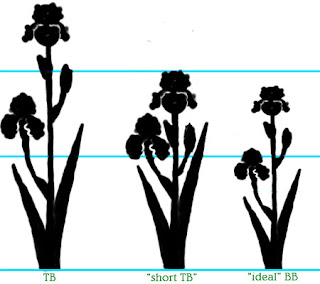

I’d like to raise a philosophical issue about proportion, and how it relates to two iris classes in particular, the border bearded (BB) and miniature dwarf bearded (MDB). These two classes face a similar problem: most BBs are produced by crossing tall beardeds (TBs), and most MDBs are produced by crossing standard dwarf beardeds (SDBs). Since the genetic background of these classes comes mostly from a different, taller class, it is not unusual to find flowers that are large, even when the height of the stem is short. Purists are very bothered by this situation, but short irises with large flowers seem to be popular with iris lovers and even judges. Are the many people who enjoy large-flowered BBs and MDBs just wrong? Should they know better?
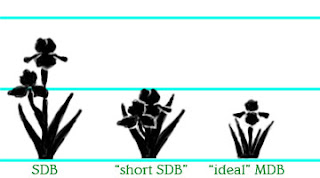

The philosophical issue is this: is “good proportion” objective? Is there some numerical ratio of stem, flower, and foliage that is aesthetically optimal? Or is it just in the eye of the beholder? If it is just a personal, subjective preference, then the admonitions in the Judges' Handbook start to seem a bit arrogant and elitist. The classic example of a subjective judgment becoming judging gospel is the case of haft marks. In the mid-20th century, haft markings were the “fault” that everyone seemed obsessed with in TB irises. Yet, what if I think haft marks are interesting or pretty? Is this any different than preferring yellow to blue, or preferring plicatas to selfs? The condemnation of haft marks reflects the struggles of hybridizers. In those early years, it was very difficult to breed a true, clean, self-colored iris. Haft marks seemed to always turn up and distract from the desired purity. So the frustration felt by hybridizers was transformed into an esthetic standard that was promoted as something objective and universal. Once clean selfs were achieved, then people could start to enjoy haft marks for being “something different”!

Many, many “rules” that are enshrined in the Judges' Handbook are relics of the personal goals and frustrations of earlier generations of hybridizers, even though they are presented as objective aesthetic truths. I think proportion is one of those things. I say this despite the fact that I, personally, dislike large-flowered BBs and MDBs. If a BB blooms in my garden with TB-sized blooms and thick, coarse stalks, it does not stay here another year, no matter how pretty the color or form. However, in all honesty, I have to describe this as a personal preference.

Allium karataviense

If there were some objective, universally valid, proportion of bloom to stalk that looks best to everyone, then we would expect it to apply to all kinds of plants. But in fact, we enjoy flowers with all different ratios of bloom size to stem height, without thinking twice about it. Consider two alliums I grow: A. karataviense produces enormous globular flower heads right at ground level. I enjoy it immensely. A. caeruleum produces small, airy blue flower heads on tall slender stalks. I enjoy it also. These two could not be more different. And neither has the proportion of a “good” bearded iris. In fact, I think an iris proportioned like either of the alliums would inspire revulsion in a typical iris judge.


Allium caeruleum


It may seem like I am now arguing for a free-for-all approach to proportion. If it is all subjective, why should we worry about a BB with TB-sized flowers or an MDB whose bloom is twice as wide as the height of the entire stem? Perhaps judges should focus on more objective things, like plant vigor and bud count, and let people enjoy different proportions, just as we enjoy different colors?

No, that is not the approach I favor, although I think the argument should be made from time to time to provoke thought and debate. I believe there is a good reason for harping on proportion in the dwarf and median irises, but I don’t think it has anything to do with some objective, universal standard of beauty.

'Solar Sunrise' (Black, 2019),
a BB whose proportion I like.


What then? If small-flowered BBs and MDBs are not objectively superior to large-flowered ones, why should we care at all? I think the answer lies in something else: class identity. Consider this: although they fall in the same height range, miniature tall bearded (MTBs) are “supposed” to have smaller flowers and more slender stems than BBs. If one proportion is more attractive, shouldn’t all classes aspire to that same proportion?

To most median aficionados, the answer is obvious: each class has its own aesthetic ideal. We like the fact that BBs look different from MTBs. They are like two different styles of music. In our minds, we may have a picture of the ideal, the prototype, as it were, for each class. It is these mental prototypes that give each class its identity, its center of gravity in the great sea of diversity that hybridizers have produced for us.

So I think what we are complaining about when we complain about out-of-proportion BBs or MDBs is the erosion of the identity of the class, the weakening of the mental prototype. The reason I have singled out BBs and MDBs is that the irises in these classes are mostly “spill-overs” from TBs and SDBs, respectively. There is a relentless pull on these classes to merge together with the larger classes that give rise to them. If a BB is just a TB that is short, why not call it a TB?
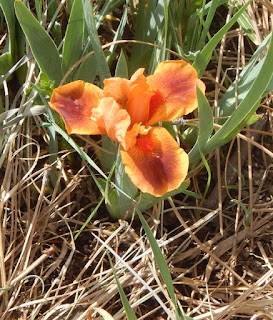
'Icon' (Keppel, 2008)
an MDB whose proportion I like.

Some have sought to strengthen the identity of these classes through breeding. Lynn Markham’s BBs
were produced intentionally to reinforce the distinct identity of the class. Ben Hager used a similar strategy to reinforce the identity of the MDB class. These were valiant efforts, but they were not sufficient to turn the tide. So many people are crossing TBs that the “accidental” BBs that emerge from TB crosses far outnumber the “intentional” BBs that are produced by the small number of breeders who are interested in the class as an end in itself. Exactly the same is true of the MDB class.
I wish I could end on some profound revelation or recipe for solving the conundrum of these classes, but I don’t think there is one. What it comes down to is simply this: do we (the entire iris-loving public, hybridizers, and judges) care enough about the identity of these classes to insist on maintaining their integrity? Perhaps we don’t. It’s not obvious that we “should”, after all. If we like the irises we’re growing, even when they depart from that mental prototype, maybe that is fine. Collective opinion is not something that can be easily predicted or controlled. It just is what it is.

But if nothing else, perhaps we can shift the language of the conversation a little. Instead of talking about “good” or “bad” proportion, perhaps we can talk instead of class identity. That seems more accurate and to the point.