Monday, May 23, 2022

It was a Challenging Year, but the Iris Bloom Made it all Worthwhile.

by Gary Salathe

The Louisiana iris Conservation Initiative (LICI), of which I am a member of the board of directors and a volunteer, managed to get 6,000 wild Iris giganticaerulea (a species of Louisiana iris) planted in refuges and nature preserves between last year’s bloom and February of this year. We needed to utilize local volunteers for this effort because COVID-19 pandemic prevented out-of-state college students from coming in to help. Before the pandemic our marsh restoration projects allowed the college students to fly into Louisiana from across the country in organized trips to accrue service credit hours by volunteering for local projects.

Our iris conservation projects rescue rhizomes that are threatened with destruction, and then we relocate them to area refuges and nature preserves. In the process, we are restoring irises to areas where they once were plentiful. 
 
Over the last two years many more volunteer events were required because we were using local volunteers. The groups of six to eight older volunteers from the local area require more time to accomplish what 15 to 20 out-of-state college students could do in a single outing.
 
Local volunteers working on a LICI iris rescue in July 2021.

Another challenge we had in meeting our iris planting goal was due to our taking on a major tree-replanting project at a US Fish & Wildlife Service refuge. The refuge is also home to one of our largest iris restoration projects. The tree-planting project not only diverted our attention from rescuing and planting irises, but took up huge blocks of our volunteers’ time. However, a big positive was that we played a key role in reforesting an important area of the refuge after our volunteers killed off thousands of Chinese tallow trees. The tallow tree is an invasive tree species that out-competes native trees and crowds out the Louisiana irises.

What also added to the difficulty of matching the 8,000 Louisiana irises we rescued and planted in the 2020-2021 season was the fact our area was hit by very powerful Hurricane Ida on August 29, 2021. We ended up spending a lot of volunteer hours helping to get many of the refuges' boardwalks back in shape after they were damaged by the hurricane. The good news is that the irises at only one of our projects were significantly set back by the hurricane. The rest recovered in time for this spring’s iris bloom.

An example of the damage that Hurricane Ida did to one of our iris restoration projects is shown by these photos of the Louisiana irises at the Bayou Sauvage refuge in New Orleans. Right: before Hurricane Ida; left: the same area one month after the hurricane. We went in and planted 2,500 irises this past winter to help replenish the irises lost there to the hurricane.

As the iris bloom began, we switched hats from being iris rescuers to being amateur iris public relations specialists. One of our partners on many projects, Common Ground Relief, worked with us to create the second annual interactive Google map of where to go see wild irises in bloom. We ranked the 16 sites on the map from the best to the very good. We then published a Facebook posting of the map that ended up reaching over 47,000 people. Over 17,000 people actually clicked on the map. The map and the excitement it created resulted in numerous news reports about the locations found on the map in area newspapers, social media, and TV news shows. The end result was more people than ever going out to the sites - most of which were our iris restoration projects - to see the irises in bloom. It was a huge win for all involved, including the landowners that saw attendance pick up at their sites.

Since late January the college student groups have begun to return. We have already completed our first iris rescue and have two groups coming at the end of June that we hope will fill up the remaining containers at our iris holding area with irises for this fall and winter's plantings. We've had many new sites request irises and we still want to add more to our existing projects, so we have set a goal to get at least 8,000 irises rescued and planted during the 2022-2023 iris rescue and planting season. 

College students from Iowa State University are shown in March planting irises into containers at the LICI iris holding area in New Orleans. The irises were rescued by them that morning as the first LICI iris rescue for the 2022-2023 season.

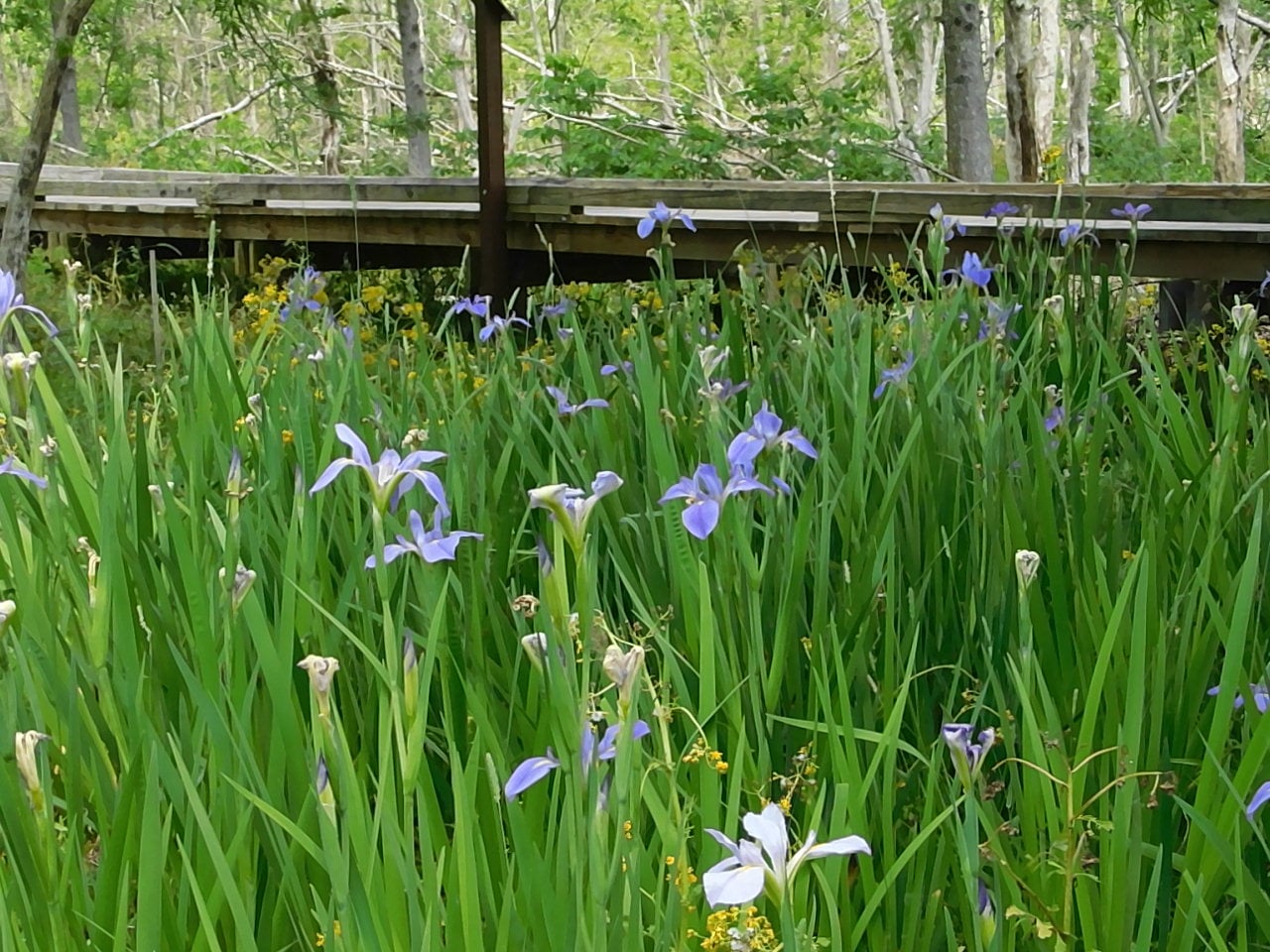
For the rest of this blog posting, I’m just going to let pictures tell the story of the blooming irises at area refuge boardwalks and hiking trails during this spring’s bloom. Most of these sites were the locations of our iris restoration projects.

Enjoy!

 LICI volunteer Mike Glaspell once again took some great photos at the Lockport, Louisiana boardwalk this year during the iris bloom there.

 LICI board of directors member and volunteer, Paul Christiansen, sent in some really nice photos of the blooming irises at our Bayou Sauvage refuge project. 

The naturally occurring Louisiana irises on the Boy Scout Road trail in the Big Branch National Wildlife Refuge once again did not disappoint.

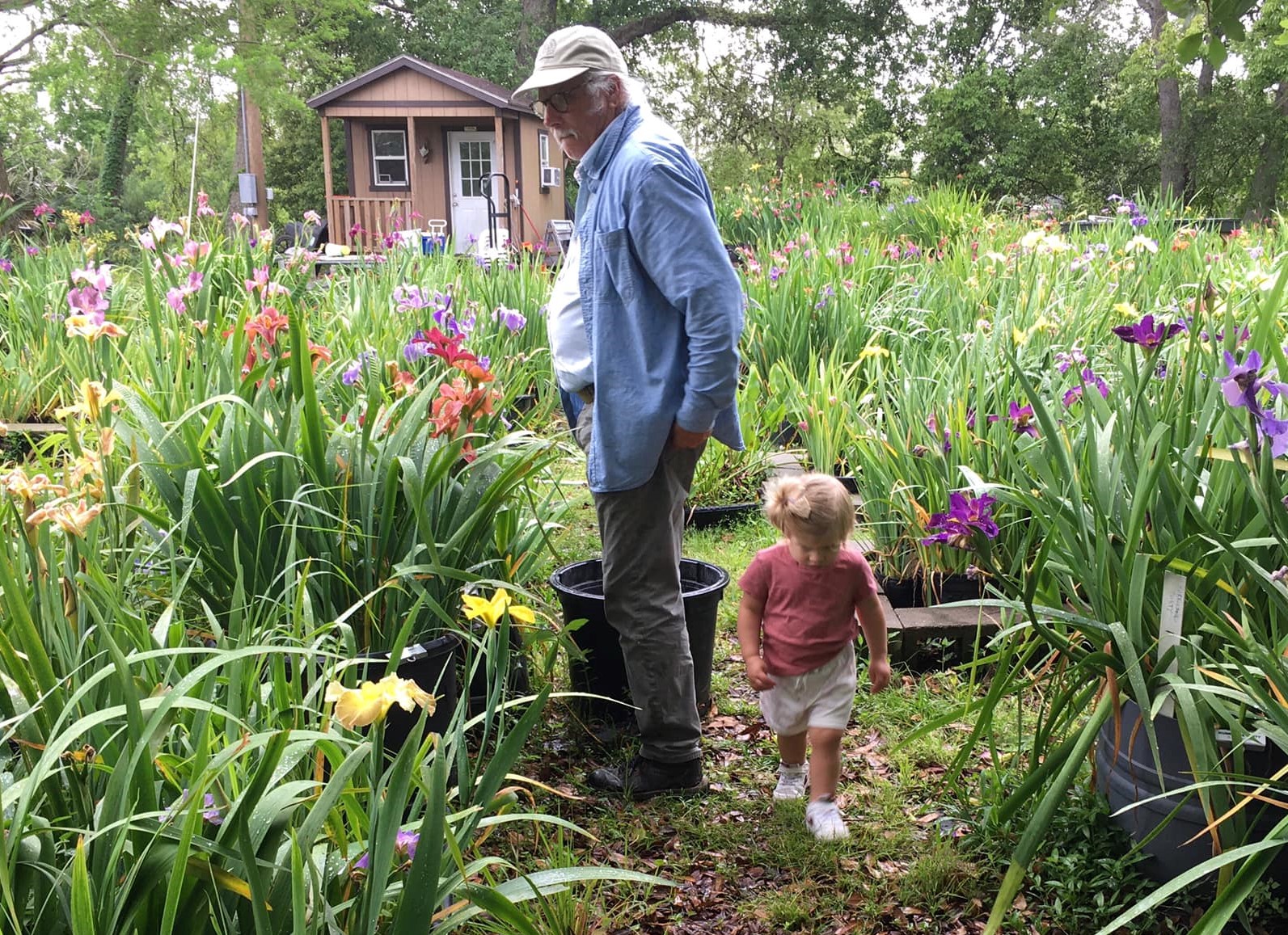
OK, I know this isn't a photo from one of LICI's projects, but I wanted to stick it in here because it had more meaning to me than any iris project I worked on this year.  It shows me introducing my 18-month-old newest granddaughter, Hazel, to Louisiana irises at the Greater New Orleans Iris Society's iris nursery during 
the bloom there in April.

LICI's friend and volunteer, Henry Cancienne, took his annual tour of iris locations across south Louisiana again this year, sending us pictures almost every day. This photo was taken just before sunrise at the Bayou Teche National Wildlife Refuge boardwalk. 

Irises blooming at the Town of Jean Lafitte boardwalk. The irises there took the biggest hit from Hurricane Ida, but still managed to produce some blooms as they struggled to come back.
 
The irises at our project at the Cajun Coast Visitor Center in Morgan City, Louisiana are in their second year. They are beginning to put on real show in the swamp at the entrance to the visitor center.

A personal highlight from this year's iris bloom (next to introducing my granddaughter to Louisiana irises) was getting to meet US Department of the Interior Secretary Deb Haaland during the crawfish boil held in her honor at the Bayou Sauvage Ridge trail boardwalk pavilion on Saturday, April 9, 2022. Her tour of the boardwalk was timed perfectly with the peak bloom of the irises in our project there.

The irises blooming in our project at the Louisiana Wildlife and Fisheries Joyce Management Area's Swampwalk boardwalk did not disappoint. It confirmed that we made a good decision declaring it #1 on our map of places to see wild blooming irises.

The irises at our Grand Isle, Louisiana iris restoration project accomplished the job we hoped they would; they brought people into this hard-hit area helping businesses come back from the direct hit they took from Hurricane Ida.

Our new project at the Pelican Park Recreation District in Mandeville, Louisiana is not very impressive - the first year bloom never is. I included this picture because what is impressive and very exciting to us is that the director has given us permission and encouragement to fill the entire shoreline of this detention area with our rescued irises as far as you can see in the photo. The plan is for them to grow them out for our future iris restoration projects.

The irises at our project in the Mandalay National Wildlife Refuge are doing great and are expanding.

The irises in the "Iris Grove" at the Northlake Nature Center near Mandeville, Louisiana are expanding again after being knocked back by high water in 2021.

The irises in our project at St. Bernard State Park are only in their second year, but they really put on a show this spring when they bloomed. This is another one of our projects that has real potential.

Ordinarily, I would not have included this project in this year's list.  It's on the banks of Bayou Teche in City Park in the town of New Iberia, Louisiana. It's only the first year, so by my standards, the bloom was not that big of a deal.  However, I included it because the local folks from the town that are helping us with this project reported that it created quite a stir in the local community, plus our volunteers were very excited about the bloom.  All I can say is that they need to wait until next year's bloom, because we plan on bringing in a few hundred more irises this year.

We did not plant any of the irises shown in this picture, but I guess you could say it's an iris project we are particularly proud of that we did this year. We helped the National Park Service count and map Louisiana irises that we found growing in the middle of the Chalmette Battlefield.  Info can be found here

Louisiana irises blooming at our project in Fontainebleau State Park near Mandeville, Louisiana.

The irises we planted at Sankofa Wetland Park and Nature Trail in New Orleans are doing well in their second year.

 
The LICI Facebook page can be found here

You can email Gary Salathe at: licisaveirises@gmail.com

Although LICI “is a bare-bones deal”, as Gary likes to say, he is quick to add that they can always use donations to their cause. They have a “Donate” button at the top of their website home page here. They are currently raising money for maintenance and supplies at the LICI iris holding area.

Monday, May 16, 2022

This N That

by Mel and Bailey Schiller

Time has run away from us these past months, and I realized it is our turn for a World of Irises blog post. Last week was a blur. We replanted around five acres of iris rhizomes and hired some help to get the job done. It was amazing to complete in seven days what normally stretches over months!

With that hard task behind us, we would like to share some of the reselect seedlings from the past season. Some of these hopeful varieties could be registered and introduced in the future. 

-
C188-1
(‘Seeking Attention’ x Y105-B)

Oh yeah! This bloom is the epitamy of why Bailey hybridizes. Broken coloured flat seedling....the only goal in his mind! This seedling is a good start in the right direction. 

  H63-B

The seedlings re-selected are awesome for their first bloom: excellent branching, height, colour, bud count, and growth habit. We won't have a lot of work to do if they keep growing and blooming like this! 

H14-F
(‘Chaos Theory’ x ‘Fiasco’)

Bailey is making wonderful progress on diversifying flat, novelty irises. The colours that are starting to come through are amazing—this is one to watch!

H163-3

This seedling has intrigued us since its maiden bloom. The standards are a particular draw with the odd blotchy placement of the unusual spots. This past season we have used this particular iris in our hybridizing. We hope to germinate seeds.

 
I118-1
(‘Shaman's Magic’ x ‘Onlooker’)

We have also taken a fancy to arilbred irises. We love them and are striving to introduce our very own into this range. This particular cross only had the one bloom this past season, but we look forward to seeing more of this one next season. 

F8-4
(‘Dark Matter’ SDB x ‘Leopard Print’ SDB)

This little cutie looks like it may shape up to be a broken coloured SDB. We noticed it blooming and it gets to stay for another season.

Last season we experienced the unbelievable loss of my son and Bailey's brother. This season has been a blur and photos have not been the best quality. We hope for a much better season all around in 2022. 

We are also organizing seeds and cross tags from 2021. We managed to successfully produce over 180 crosses that will be planted into germination boxes over the next couple of weeks.  It is still incredibly warm here with next to no rain in sight. The seed will be going straight into boxes and we will water them daily from there. They stay outdoors to get exposure to cold temperatures, frost and hopefully some natural rainfall. 

In 2022, our work at Smokin Heights will be part of the National Iris Convention. It is being held in South Australia and our garden will be on tour Sunday. (Albeit the garden is open every weekend through October for those wishing to pay us a visit.) We sincerely look forward to your company.

Here in the Southern Hemisphere, winter is on its way sooner or later. We look forward to opening Facebook and seeing all the wonderful posts of iris photos from all over the Northern Hemisphere. We are blessed that telecommunications have advanced so far so we can share experiences between countries. 

Happy blooming season everyone!


c
 

Monday, May 9, 2022

First Flowers From "Dark Rose with Gold Signal" Seeds

by Kathleen Sayce

Rain was due on the night of May 1, so I went out before dark to take photos of first flowers that opened that day and the day before from one seed lot that was described in the Society for Pacific Coast Native Irises seed list a couple of years ago as having a pod parent with dark rose and gold signal flowers. 

The seeds were from Debby Cole's garden on Mercer Island near Seattle. These were the first flowers I have seen from this seed group. 

More than two decades ago, I had plans to select for new Pacifica iris with weather-resistant petals and clear, well-saturated colors that were adapted to my local climate. In the intervening years, I found that said climate is not conducive to hand pollination, or at times any pollination at all, of Pacifica irises. To put this simply, it's usually too wet and windy to hand pollinate Pacificas when modern hybrids are in flower. 

I tried small protective covers of twin-wall polycarbonate, weighted down with bricks to keep the wind from pulling them off and sailing them around the yard. Nope, still too windy; and often, the rain is horizontal, even in April and May. Flowers blow off stems, petals melt, or pollen simply does not germinate on the styles. 

These days, I get seeds from the SPCNI seed catalog and enjoy the fruits of other gardens instead. So here's what I have so far in 2022:


First up is a gold signal, rose veins and apricot base color combination that is quite lovely. The petals are not overly frilled and have a nice substance. I will be checking this and others in the wet weather to come to see how they hold up. 


The next flower is a lovely medium rose, dark rose veins on the falls, gold signal. It too has nice substance. What will the rain do to this one?


Darker rose, wider petals, and much darker rose veining to the petal tips, an interesting signal with a white outer area and a gold inner area. This iris is intriguing for the complexity of the falls, and its darker rose color. 


The last one is a good example of what goes astray between one's intentions in hybridizing and reality.  While I was trying to focus on the dark falls, I knocked this flower off the stem! Luckily, there is another flower on the same stem, and another stem still developing. While the coming storm won't help me see how it survives rain, the next few flowers may. 

It has smaller petals than the other three with nice substance to them, as irises with simpler petals seem to have.  There is also an interesting hint of paler color on the developing style arms--we'll have to wait for the next flowers to know for sure. 

So there you have it:  four out of eighteen pots, all with different flowers!


Thursday, May 5, 2022

IRISES: The Bulletin of the AIS - Spring 2022 Edition

By Andi Rivarola

A warm welcome to those who are seeing IRISES, the Bulletin of The American Iris Society for the first time. If you are a member of The American Iris Society I hope you enjoy this new issue.

The Spring 2022 issue of the AIS Bulletin is now available online, accessible via the Emembers section of the AIS website. The print copy has been mailed via the U.S. Post Office. On the cover, border bearded iris and Dykes Medal winner, 'Brown Lasso' (Eugene Buckles by David Niswonger, 1975).

This time, I also included the beautiful back cover (image below) because it is indeed a picture of 'Chubby Cheeks' (Paul Black 1985, SDB), winner of the AIS Board of Directors Award.

Note: to access this area of the website, you must have a current AIS Emembership. (AIS Emembership is separate from the normal AIS membership.) Please see the Electronic Membership Information are of the AIS website for more details.


The French Iris Society (SFIB, Societe Francaise des Iris et Plantes Bulbeuses) is back in business after the pandemic, and is requesting guest irises for their 2024 International Iris Competition. More information on page 10.

Remembering Friends is on pages 11 - 13, always offers lasting memories of those friends in the iris world who contributed to make AIS the successful organization it is today. This month, Jim Morris captures the lives of giants. 

Section Happenings has a lot of information about AIS Sections, this issue, with write ups by the Median Iris Society, the Spuria Iris Society, the Dwarf Iris Society, the Species Iris Society, the Novelty Iris Society, the Tall Bearded Iris Society and the Reblooming Iris Society. Find them on pages, 16 through 18.

The AIS Board of Directors Award was given to 'Chubby Cheeks' in November of 2021. What a well deserved honor for little mighty Cheeks. Read all about it on pages 19 - 21. 

A beautiful report about the 2021 AIS Honorary Award Recipients can be found on pages 22 - 25.

A gorgeous, curious and fabulous read, Novelty Irises: a Lace Story, by Syvain Ruaud from France. Originally published right here on World of Irises, is on pages 26 through 29.

Air root pruning Irises (and Dallies) is on pages 30 and 31, includes fantastic images. 

There's a lot more to see and read in this edition of IRISES, either in digital or print formats. 

Not a member of the American Iris Society? Please see our website for information about becoming one: http://irises.org/

Happy Gardening!