Monday, September 13, 2021

Growing Irises Out East: When It’s Time To Dig In


by Heather Haley and Alleah Haley

Heather’s first iris dig as a homeowner. 


If you grow irises long enough, they will need some care and attention. Many resources suggest digging and dividing irises, but few thoroughly describe doing either. Heather frequently sees questions about this on the Iris Lovers Facebook group. Since our family has been digging and dividing recently, it seems like a worthy topic to write about. 


Why do we dig and divide irises?

Irises reproduce asexually by forming new baby plants (called increases) on the sides of an older rhizome. Informally, we refer to the older rhizome as the “mother” and the smaller offspring as “daughters.” The mother plant provides a food source for daughters while they remain attached to her. 


Left alone, irises will form “clumps,” and their exponential growth habit produces crowded conditions after several generations. A favorite example is ‘Peggy Sue’: a lovely reblooming iris that produces two healthy increases each year like clockwork. After one year, she had two daughter rhizomes. After two years, 4 granddaughter rhizomes appeared. After three years, there were 8 great-granddaughters. After four years, 16 great- great granddaughters formed a complete circle around their ancestors. It was impressively dense and nearly a foot and a half in diameter.


Can you spot the original mother rhizome?


If irises grow undisturbed for a long time, rhizomes begin to grow on top of one another. If clumps are REALLY crowded, you might even see a daughter forming ON THE TOP of its mother. 
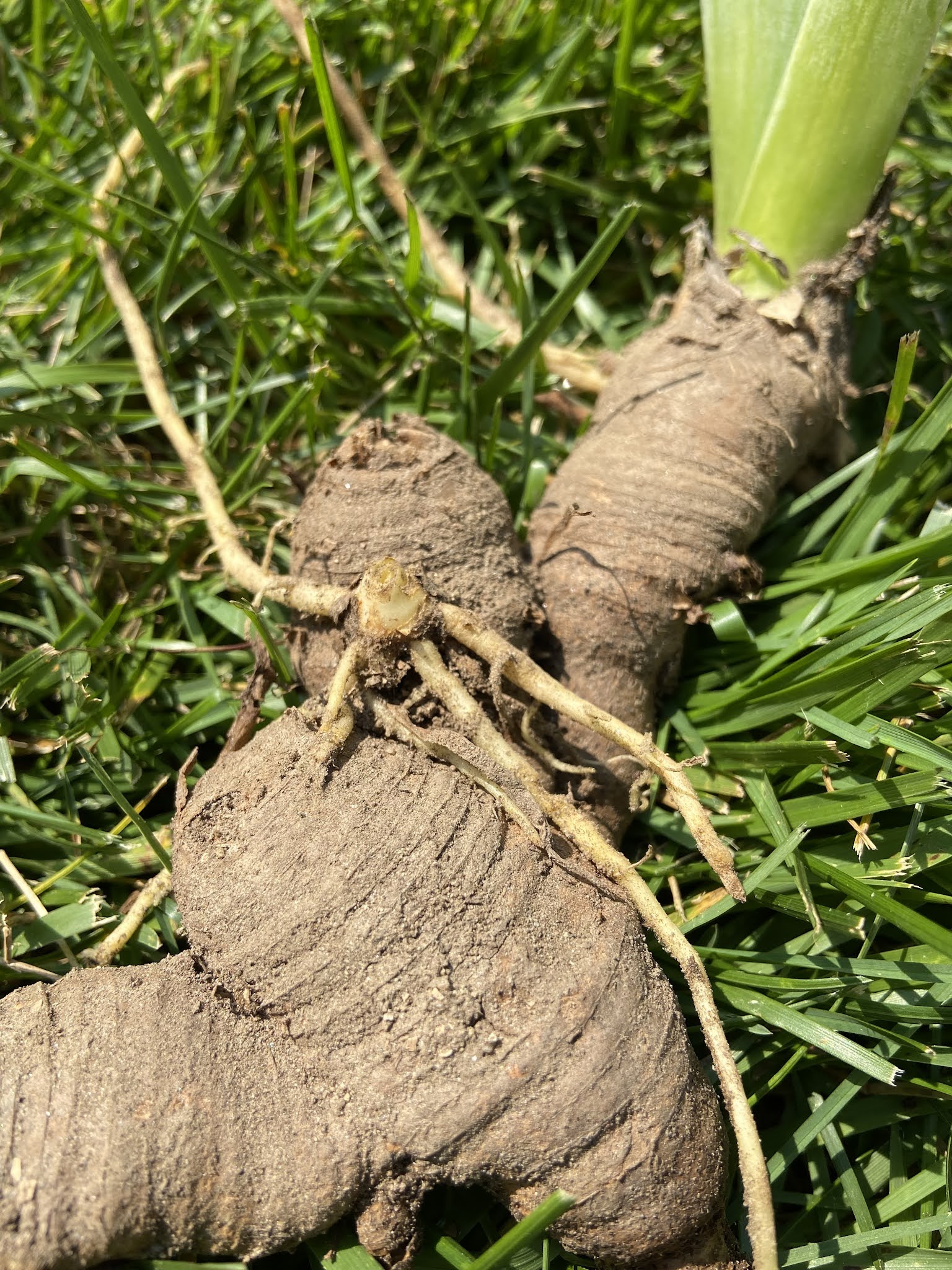

A new rhizome forming on top of a clump.

Genetics and growing conditions determine how many healthy increases a mother rhizome will make, and how many of her daughters survive. For this reason, it’s hard to say exactly how often your irises need to be dug and divided. For the popular tall-bearded type, the recommendation is every three or four years. 


When do you we dig and divide irises?

At Heather’s farm in Ramseur, North Carolina we try to dig, divide, and replant irises from mid-June to mid-September. In the heat of the summer, most irises go through a window of dormancy. During this time, irises can be removed from soil without disturbing processes vital to their growth and reproduction. We time digging to occur at least six weeks after bloom because irises use that time to set structures needed to bloom in the future. We try to finish replanting at least six weeks before first frost because irises need to grow new roots before temperatures get too cold. 


However, North Carolina can be extremely hot and humid in the summertime. Several years back, Heather got heat rash (also known as prickly heat) during July when trying to get a new iris bed established and planted in full sun. She couldn’t garden for several weeks after that and swore never to do it again—no matter how crispy and dry her iris rhizomes look. 


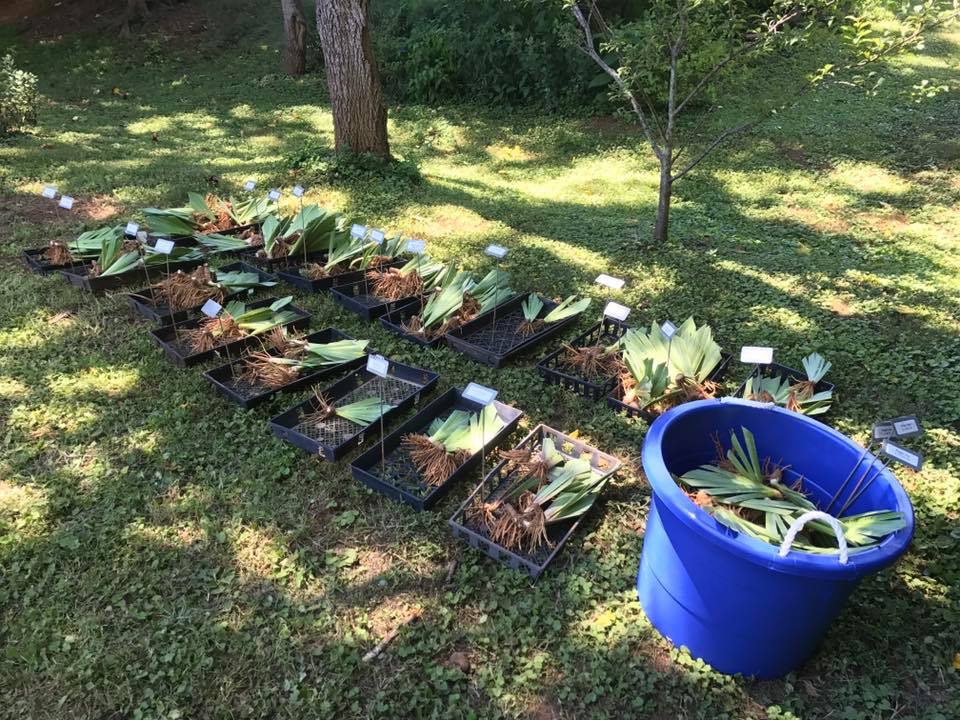
Now older (and wiser?), Heather avoids working in iris beds when conditions are too hot and humid for sweat to evaporate. We tend to dig iris clumps in the morning, quickly toss then into containers, and put containers of irises in the shade to divide, trim, and label. Shade is provided by a pop-up tent, carport, covered porch …the last being a joy of growing irises "Out East." Ensure access to cold beverages and a nice breeze—supplied by a construction-type battery-operated fan if Mother Nature doesn’t supply it.


What could be better than leisurely processing irises the way past generations would shell peas?

How do you dig irises?
Digging and dividing irises is a lot like riding a bike. With enough practice, your body will intuitively know what to do. However, if you have never seen it done it can be quite confusing. 

Our friend Bonita Masteller digging a clump for our local iris club sale.

First we look close to the clump, and take a good look at it while trying to imagine where the roots are underground and how daughters are attached to their mothers. If irises were planted too close together, it can be hard to discern where one clump ends and another one begins. Using your fingers to pull soil away from the clump can help you see and feel connected rhizomes and plan accordingly. 


In California, Alleah preferred to use an ergonomic digging fork in her sandy soil and raised beds. Heather likes digging with the fork, but also uses a sharp rounded shovel to dig irises in her clay soil. The irises don’t seem to mind either one, so feel free to use whatever medium-to-long handled digging tool is in reach. 


Favorite tools for digging irises

Place the tool about 6 inches away from the clump and press it deep into the ground. Next, push the handle down firmly to lift the clump of irises up. Don’t worry if this separates mother and daughter rhizomes; it was probably going to happen anyway. Place the tool in a new location and repeat until rhizomes can be picked up easily. Pulling on rhizomes can damage their leaves or roots so we avoid using too much force. 


If plants and soil seem stuck together, dropping or throwing a clump root-side down onto the ground from waist-height is quite satisfying and effective. We dig one variety at a time and place its permanent tag upside down in a large plastic pot or similar container. Irises of that variety are placed in the pot, and gently stacked for further processing.


Avoid stabbing irises with your tools, stepping on them, or throwing soil where it doesn’t belong. Don’t ask how this happens… digging can be really tiring. If at all possible, train a young person to help you dig. They might get really excited about plants which can withstand being torn apart and thrown on the ground and want to grow their own. Both Alleah and Heather got interested in irises by helping to dig them. It works! You very well could inspire a youth to become a member of the American Iris Society


How do you divide irises?

This is Heather’s favorite part. Mother and daughter rhizomes look like ginger root and can be snapped apart in a similar fashion. Some people cut rhizomes apart, but we avoid this because a knife should be cleaned between cuts. If a rhizome is soft or really long, we may cut it with pruning shears or on a cutting board with a kitchen knife which is designated for permanent garden use.  


How do you replant irises?

Stay tuned for our next blog post… Growing Irises Out East: It’s Planting Time!


Getting irises ready for planting at Heather's farm


For comments: 

How do you dig your irises?


Monday, September 6, 2021

Part Three - My Continuing Journey in the Iris World

By Maggie Asplet

I have arrived at the end of describing my journey—well the 2019 journey anyway.  When I left America in 2019, no one knew we would not be able to travel again until who knows when.

In March of 2020, going into lockdown was a double-edged sword. In addition to facing the pandemic, I received sad news from the Ministry of Primary Industries (MPI). MPI is a government department that regulates seed coming into New Zealand. They informed me that that seeds (sorted and shipped by Thomas Johnson) from crosses I made at Mid-America Gardens in Salem, Oregon were destroyed just two days before lockdown. A MPI staff member made an error: they accidentally kept 13 packets of seed they were not letting me have, but destroyed remaining 86 packets of good seed. So, we did a lot of hybridizing work but nothing came out of it other than some wonderful memories.

This being said, it leads beautifully to another part of why I enjoy my trips to Salem and the surrounding area: opportunities to attend their American Iris Society Regional Meetings.  A great time to catch up with friends and learn new things.

Judging at a Regional Meeting

Judging cut irises at Chad's Harris' place, Mt. Pleasant Iris Farm. Some aspects of the judging was different from what I am used to at home in New Zealand.

As part of this regional meeting, we attended judging of cut flowers in what was a round-robin type situation.  Very interesting to judge the same flowers as they travel from one venue to another.  Also interesting to have some challenges amongst them.  Not were all what they seemed and we were expected to be able to find the different or odd one out.

Judging and judging schools were also done in the nurseries we visited.  These first pictures are taken at Mt. Pleasant Iris Farm.

On the left is Patrick & Margaret Spence and the right are some other attendees of the Regional Meeting.  Judging School is about to take place.

The irises that we saw at Mt. Pleasant Iris Farm were very different from the bearded irises at Mid-America.  Chad grows some wonderful "other" irises, and the grounds and garden are always in immaculate condition (see below). 

View of the iris field at Mt. Pleasant Iris Farm

The following pictures are some of the stunning Miniature Tall Bearded (MTB) irises that I absolutely adore.  They are just so perfect, a finer flower on finer stems.

Lynda Miller's MTBs - 'Cascade Trails' & 'Bingo Marker'

Chad Harris' MTBs - 'Candy Basket' and 'Black Cherry Sorbet'

There were a number of other types of irises on display at this time.  The name of each is listed with them.

'Who's On First' by R. Hollingworth 2008 - Spec-X

'Aaron's Blue' by Gabrielle Lecomte 2018 - Iris setosa


From Chad's farm we travelled to Atiken's Salmon Creek Garden, the home and nursery of Terry & Barbara Aitken. We saw more than just irises there, as most gardeners do love other plants.  


First, I'll share a lovely selection of MTB's, some of which are just so stunning and I would love to grow them here in the southern hemisphere.

Name is written on the images

Although they look great here, trust me, they look even better in the garden.

All the iris nurseries we visited grew other plants besides irises. Terry also has some beautiful orchids, perhaps another "passion" of Terry's.

Sorry, I don't have the names of these but they were just stunning.

If you have an opportunity to attend a regional meeting, I thoroughly recommend that you do so. It is a great time to make friends, learn more about irises, laugh heaps, have AIS members give you (me) a hard time.  I didn't mind, usually because I gave it straight back.

For us in New Zealand, we hold an event each year and it is now up to the region concerned to call it a convention, a safari, or whatever they choose.  Last year, the event was cancelled. Let's hope it can happen this year. One of the other things that happens in New Zealand are special events, like when I blogged about the Hawkes Bay groups' "Day Out".  Again a great time for sharing.

I will leave you with some beautiful images the AIS Regional "Day Out". These arrangements were on our tables during dinner that night.


Hopefully 2022 will be kind and I will be able to return the Portland. I am so missing my trips over to Oregon.  Stay safe everyone.

Tuesday, August 31, 2021

The American Iris Society Announces the 2021 Payne Medal Winners

'COLUMBIA DEEP WATER' and 'DALLE WHITEWATER'

The Payne Medal is restricted to Japanese irises (JI). It is named in honor of W. Arlie Payne (1881-1971). W. Arlie Payne was at first especially interested in peonies, but in the late 1920's, he "discovered" Japanese irises. He started hybridizing Japanese in irises in 1932. Over the next three and a half decades, he raised many thousands of seedlings. One of the most exceptional aspects of his breeding program was that it was developed in the early years using only six cultivars of the Edo type. Payne took line breeding to a new level of intensity. The American Iris Society awarded Arlie Payne its coveted Hybridizers Medal in 1964. When he died at the age of 90, in 1971, he was universally revered as the world's premier breeder of Japanese irises.

Editor’s Note: Due to the pandemic last year, the American Iris Society Board of directors suspended garden awards. As a result, and only for this year, two medals will be awarded in each area. Previous awards winners can be found at https://wiki.irises.org/Main/InfoAwards.

'COLUMBIA DEEP WATER' (Chad Harris)

'Columbia Deep Water' (Chad Harris, R. 2012) Seedling 02JC1. JI (6 F.), 48 (122 cm). Late bloom. Style arms multiple pale blue-violet (RHS 91B), flared upright crests of dark blue-violet (90A); Falls iridescent red-violet with deep blue-violet (88A) undertones, faint neon powder blue-violet (93B) rays radiating from signal to within 1/2" of fall edge; signal bright yellow (5A). 'Night Angel' X 'Frosted Intrigue'. Mt. Pleasant 2013.

'DALLE WHITEWATER' (Chad Harris)

'Dalle Whitewater' (Chad Harris, R. 2010) Seedling 02JC3. JI (6 F.), 48" (122 cm), Late bloom. falls heavily sanded pale blue-violet (RHS 92B), pale ray pattern of pastel blue-violet (92D) extending into faint 1/2" light purple (90C) band, signals off-yellow, slight green cast (3A); style arms multiple upright white, edge and crest medium blue-violet (92A); rolling ruffles. 'Night Angel' X 'Frosted Intrigue'. Salmon Creek 2011.

The World of Irises blog will be posting classification medal winners as soon as the hybridizers are notified. The entire list of winners, including award of merit and honorable mention, will be published in the AIS website, the AIS Encyclopedia, and later in the AIS Bulletin, IRISES.

Monday, August 30, 2021

The American Iris Society Announces the 2021 Nies Medal Winners

'IBEX IBIS' and 'STEELY DON'

The Nies Medal is restricted to spuria irises. It is named in honor of Eric Nies (1884-1952). Eric Nies was born in Saugatuck, Michigan, but soon after Nies moved to California, he became interested in irises of all types. He obtained his first spuria irises from Jennett Dean, who operated one of the first iris specialist nurseries in the U.S. Spurias were his special interest. His first cross was with I. orientalis with 'Monspur' He interbred seedlings from this cross, and in the second generation there was a virtual explosion of color: blue, lavender, brown, bronze and cream. During his lifetime, Nies was recognized as the foremost breeder of spuria irises in the world. Marion Walker took over his seedlings and breeding lines after he died in 1952.

Editor’s Note: Due to the pandemic last year, the American Iris Society Board of directors suspended garden awards. As a result, and only for this year, two medals will be awarded in each area. Previous awards winners can be found at https://wiki.irises.org/Main/InfoAwards.

'IBEX IBIS' (Brad Kasperek)

'Ibex Ibis' (Brad Kasperek, R. 2012) Seedling #SPH-350. SPU, 45 (114 cm). Midseason bloom. Standards and style arms light medium lavender; falls bright medium yellow center darkening to gold at the crest of style arm, light medium lavender rim; slight fragrance. Parentage unknown. Zebra Gardens 2012.

STEELY DON (J. T Aitken)

'Steely Don' (J. Terry Aitken, R. 2012) Seedling #05SPU-2A. SPU, 54" (137 cm). Midseason bloom. Standards steely blue-grey outside, washed inside with white at midribs blending to blue at rim; style arms steely blue-grey; falls pale lemon-yellow, light steely blue-grey veins and petal edges. 'Missouri Clouds' X unknown.

The World of Irises blog will be posting classification medal winners as soon as the hybridizers are notified. The entire list of winners, including award of merit and honorable mention, will be published in the AIS website, the AIS Encyclopedia, and later in the AIS Bulletin, IRISES.