Monday, June 4, 2018

In Praise of Regelias

by Tom Waters

The Regelias are a group of irises native to central Asia, their range extending from near the Caspian Sea to the mountainous regions bordering Tibet. Their nearest relatives are the oncocyclus, which are found further west and south from western Iran to the Mediterranean. Regelias and oncocyclus together comprise the aril irises.

First, a few comments on the name "Regelia". The name honors German botanist Eduard August von Regel, who was director of the botanical garden in St. Petersburg, Russia, late in the nineteenth century. Russian plant explorers of that time were very active in central Asia, seeking out new species and bringing them to attention of European botanists and gardeners. The proper pronunciation of the name is thus Reh-GEH-li-a, although most English speakers have taken to using the pronunciation Reh-JEE-li-a instead. The name should be capitalized, since it comes from a personal name. Spell-checking software likes to change the name to "regalia", which refers to Royal trappings, a blunder that one should be alert for.

Regelias are similar to oncocyclus in having a large cream-colored aril attached to the seed, in going completely dormant in summer, and in preferring arid conditions. Whereas oncocyclus iris have only one bloom per stalk, Regelias usually have two. Regelias have beards on the inside of the standards as well as the falls! Whereas many oncocyclus have large globular blooms with prominent signals, Regelias have more svelte, elongated flowers, often with conspicuous veining. The two groups are interfertile, and there are advanced-generation hybrids between them.

There are eight or more species of Regelias. Historically, the three species grown in European and American gardens were the diploid Iris korolkowii and the tetraploids I. stolonifera and Iris hoogiana. More recently, I. afghanica and I. lineata are also sometimes obtainable. W. R. Dykes regarded Iris hoogiana as the most beautiful of all irises, because of its satiny sheen and elegant form.
Iris hoogiana
Iris stolonifera

'Vera' (RH)


There are hybrids between the Regelia species, called Regelia hybrids (RH). Two widely known Regelia hybrids are 'Vera' (uncertain parentage, derived from Iris stolonifera, probably crossed with Iris korolkowii), and 'Bronze Beauty Van Tubergen', a stolonifera/hoogiana hybrid registered by the Aril Society International in 2001, but in commerce since the mid-twentieth century.


All Regelias are adaptable to a wider range of climatic conditions than their oncocyclus relatives. Here in northern New Mexico, mine persist better than daffodils, and get the same care. Cold winters present no problem whatsoever, as they are native to continental mountainous regions. Dampness and humidity in summer can cause problems, as the plants are dormant then and susceptible to rot.

Regeliocycli

'Bronze Beauty Van Tubergen' (RH)
Once it was understood that the Regelias and oncocyclus irises could be crossed readily, hybridizers became interested in such hybrids, mostly as way to breed the Regelia adaptability into the often troublesome oncocycli, which are notoriously particular and difficult to grow in many climates. The firm of Van Tubergen produced a number of regeliocyclus hybrids in the early 20th century, many of which indeed proved quite durable and are still enjoyed today. Most of these were produced by crossing Iris korolkowii with oncocyclus species, and showed both Regelia veining and oncyclus dotting and signals. In current usage, the term "regeliocyclus" (RC) refers to a hybrid with both Regelia and oncocyclus ancestry that is predominantly Regelia in appearance. In practice, regeliocycli are aril hybrids with 1/2 Regelia ancestry or more.

'Dardanus' (Van Tubergen, not registered) (RC)
Regeliabreds

When hybridizing interest in arils blossomed in the 1940s and 1950s, the attention was almost exclusively on the oncocyclus. Regelias were thought of as "poor relations" that were not always welcome at the table. The prevailing opinion at the time was that they might be useful in breeding arilbreds that were easier to grow, or to facilitate breeding oncocyclus with bearded irises, but it was the "onco look" that was the holy grail of arilbred breeders, and signs of Regelia ancestry were frowned upon.

'Stars Over Chicago' (H. Danielson, 1973)
Henry Danielson was among the first to produce and promote arilbreds of purely Regelia ancestry, launching a popular series of regeliabreds with 'Genetic Artist' (H. Danielson, 1972). These regeliabreds (RB) were derived mostly from I. stolonifera and I. hoogiana. Rather than the globular oncocyclus look expected of arilbreds at the time, they tended toward elongated, open form, showing off the often dramatic colors of the insides of the standards. Although I. stolonifera itself tends to brownish and muted violet tones, its arilbred descendants often combine gold or yellow color with lavender or electric blue flushes in the center of the falls and standards, with similarly colored beards. These unconventional arilbreds were welcomed enthusiastically by some, but reviled by others as garish departures from the oncocyclus ideal.

In the 21st century, French hybridizer Lawrence Ransom picked up the torch of regeliabred breeding, using the Regelia hybrid 'Vera' to produce the siblings 'Eastern Blush' (2002) and 'Eastern Dusk' (2010). 'Eastern Dusk' then gave the distinctive horned arilbred 'Poisonous' (Ransom, 2010).

'Poisonous' (RB-)
Ransom also produced a delightfully varied series of regeliabred arilbred medians, again using 'Vera' as the Regelia parent, with mixed SDB pollen. These "Vera girls" include the widely grown 'Vera-Marina' (Ransom, 1998) and 'Vera-Ruby' (Ransom, 1996).

A special favorite of mine is an arilbred dwarf regeliabred from I. stolonifera X I. pumila, 'Topaz Talisman' (Jensen, 2015), from long-time Regelia enthusiast Elm Jensen, registered at 10 inches in height.

'Topaz Talisman' (RB)
Regelias and their regeliabred descendants have attracted a devoted following over the years, and have shown their great potential in adding variety, interest, and ease of culture to a collection of arils and arilbreds. Much of their full potential, I believe, is still untested. For decades, they have suffered from unfair comparison with their more popular oncocyclus and oncobred cousins. As more growers and hybridizers move away from the prejudices of the past, the Regelias and regeliabreds may at last come into their own as fascinating and beautiful types of iris in their own right.

Monday, May 28, 2018

"Talking Irises" - THE 2018 TALL BEARDED IRIS BLOOM SEASON: A SPECTACULAR SHOW!

By Susanne Holland Spicker


(picture of the garden bed in 2016)  'GARDEN BRIDE' (Chapman '98) and 'BOLD EXPRESSION' (Ernst '03) are pictured, center

"I have found enduring happiness from the beauty found in the flower garden and from the joy that the love of a garden gives." 
                                                  Doris Day 
                                                                                                                                            
The 2018 tall bearded iris bloom season, although later than usual, has put on a spectacular show in the top of Utah, zone 6. One complaint, however, is that a week of above normal temperatures reduced the  bloom time of the stalks as they sweltered in the heat.  Many later varieties haven't bloomed at the time of this post, but here are a few of my favorites as I took a stroll around the garden beds. I love these varieties because of their beauty, reliability and their fabulous colors.

(top l to r) 'PERSIAN BERRY' (Gaulter '77), 'PLUM PRETTY WHISKERS' (Spoon '03), 'PRIVATE EYE' (Johnson '10), 'EYE FOR STYLE' (Blyth '06), 'MING LORD' (Blyth '06), 'QUEEN'S RANSOM' (Van Liere '12), 'ROMANTIC GENTLEMAN' (Blyth '02) 'OXFORD COUNTESS' (Blyth '07) I love this bed--it has some of my all-time favorites!


  'LEANNA' (Meininger '97)  A favorite plicata


'LENTEN PRAYER' (Schreiner '98), 'TORONTO' (Johnson '01), 'APHRODISIAC' (Schreiner '86), 'GIGOLO' (Keppel '84), 'NAPLES' (Johnson '01). Color galore--this bed has it!

'DAUGHTER OF STARS' (Spoon '01)  Always among the top three to bloom--it was the first tall bearded iris to bloom this 2018 season.


 'DARING DECEPTION' (Johnson '12) Stunning--breath taking beauty!


 'FLAMINGO FRENZY' (Johnson '12) The unusual colored beard is fabulous on this blue-pink beauty


 'EDITH WOLFORD' (Hager '86) Always a garden visitor favorite


 'ABSOLUTE TREASURE' (Tasco '06), 'DESIGNER LABEL' (Ghio '03) Both are exquisite


 'MIDNIGHT TREAT' (Schreiner '06), 'THORNBIRD' (Byers '89) A visual treat--unique


'CENTER ICE' (Ghio '10), 'GITANO' (Keppel '07), 'WINNING EDGE' (Ghio '97). 'PHOTOGENIC' (Ghio '06), 'LOUISA'S SONG' (Blyth '00), 'IN THE MORNING' (Ernst '04), 'LIMERENCE' (Blyth '09), 'MIDNIGHT REVELRY' (Schreiner '05). Outstanding color!


(t l to r) 'CITY LIGHTS' (Dunn '91), 'FOREVER BLOWING BUBBLES' (Ghio '07), 'PLEDGE ALLEGIANCE' (Schreiner '84), 'MILES AHEAD' (Schreiner '10), 'NO COUNT BLUES' (Schreiner '09) A single rhizome of  each of these irises were just planted last summer, and I was thrilled that they all bloomed.


'EMBRACE ME' (Van Liere '08), 'BUBBLING WAVES' (Ghio '06), 'TICKLE 
ME PINK' (VanLiere '11), 'QUEENS CIRCLE' (Kerr '00), 'PROUD TRADITION' (Schreiner '90), 'HEATHERIDGE' (Gatty '85), 'NIGERIAN RASPBERRY' (Kasperek '95), 'SONG OF NORWAY' (Luihn '81), 'CROWNED HEADS' (Keppel '97), 'EVENING TIDINGS' (Schreiner '09), 'ABOVE THE CLOUDS' (Schreiner '01), 'MAGICAL' (Ghio '07), 'RUFFLED BALLET' (Roderick '75), 'SOCIETY PAGE' (Ghio '10).  This established bed never disappoints.                                                                                                            

'CENTER ICE' (Ghio '07), 'PURPLE SERENADE' (Schreiner '05), 'GITANO' (Keppel '07), 'LOUISA'S SONG' (Blyth '00) 'FLORENTINE SILK' (Keppel '05). There are many irises still in the bud still to bloom in the coming days.

'LACED COTTON' (Schreiner '80) A laced iris that always opens up nicely


How has your tall bearded iris bloom season been?  What were your favorite blooms this year?  I'd love to hear from you!

Monday, May 21, 2018

The 2018 AIS Convention - Iris in Louisiana

by Jean Richter

The 2018 national convention of the American Iris Society was a unique experience. As it was held in New Orleans, Louisiana, where bearded iris do not grow happily, there were no bearded iris on display, either as guest iris hosted for the convention or otherwise in the convention gardens. This provided an unprecedented opportunity to focus on a type of iris that is usually not front and center at these events - the most common iris native to North America, the Louisiana iris.

The six convention gardens and associated area visits provided opportunities to see Louisiana iris in a variety of situations - in a working horticultural research station, an historic home and formal gardens, public gardens, naturalized settings, and in the wild.

Our first stop on the garden tours was the Greater New Orleans Iris Society's species preservation project, located near a bayou in suburban New Orleans.  A highlight of this visit was seeing all five of the native Louisiana iris species.

The most rare of the Louisiana iris species is Iris nelsonii, found in only a few small areas of Louisiana.

Iris nelsonii

Very similar to nelsonii but smaller and much more widespread is Iris fulva.

Iris fulva

Iris brevicaulis is one of the most widespread species, occurring from Louisiana to Canada.

Iris brevicaulis

Iris hexagona is found primarily in Florida and nearby states.

Iris hexagona

Iris giganticerulea is quite common in Louisiana and neighboring states.

Iris giganticerulea

Our next destination was Longue Vue, an historic estate with numerous formal gardens. There were plenty of Louisiana iris among these gardens, including one named for the location: Longue Vue (Haymon 2000).

'Longue Vue' (Haymon 2000)

Our next stop was the New Orleans City Park Sculpture Garden, which also featured the first set of guest iris plantings. A highlight at this garden was Watermelon Wizard (H. Nichols 2011), which later won the Franklin Cook Cup for best out-of-region iris at the convention.

'Watermelon Wizard' (H. Nichols 2011)

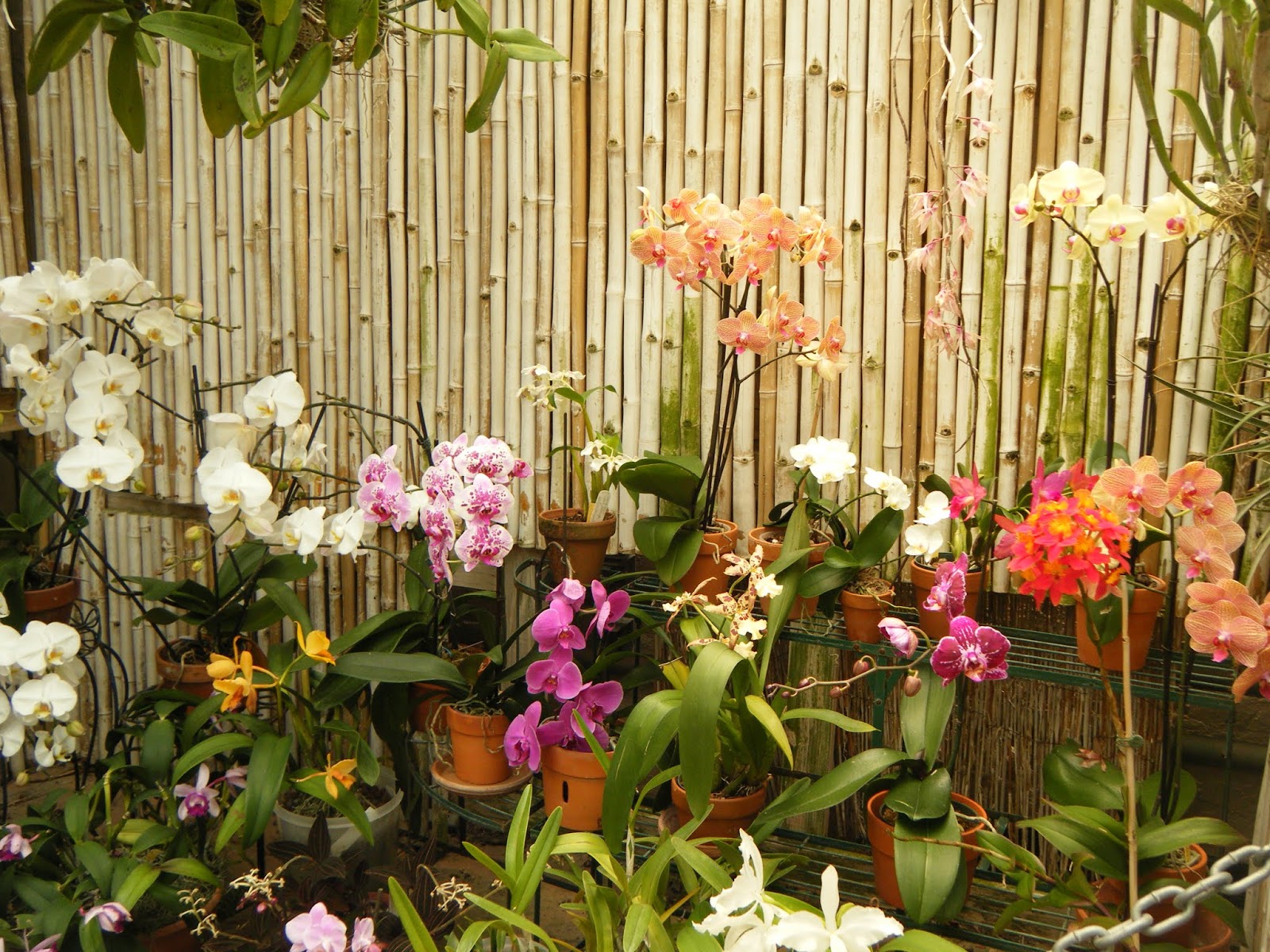
Nearby was the New Orleans Botanical Garden, which among many other exhibits featured an outstanding cactus collection and orchid display.

Orchids at the New Orleans Botanical Garden

The second day of our Louisiana iris adventure found us crossing the 24-mile-long causeway across Lake Pontchartrain to A Louisiana Pond, a neighborhood garden project of Louisiana iris planted at the edge of a flood prevention pond. One of the beds around the pond features an area devoted to the introductions of local hybridizer Patrick O'Connor. This planting also featured another iris native to the area, Iris virginica.

Iris virginica

Iris giganticerulea was also putting on a lovely display near the pond.

Iris giganticerulea

Our next stop was the Hammond Research Station. First established as the Fruit and Truck Experiment Station to serve the strawberry and vegetable industries in the region, the facility currently focuses on landscape horticulture. The Greater New Orleans Iris Society partnered with the station to develop a collection of Louisiana iris on the grounds. Guest iris on display included Patrick O'Connor's House of Blues.

 'House of Blues'

The third day of garden tours found us on the road to Baton Rouge. Our first stop was the Burden Museum and Gardens, an open-air museum dedicated to rural life in bygone times, with many historic buildings depicting everyday life on the Burden plantation. Of great interest to many convention-goers was the walking tour of the nearby swamp, with an opportunity to observe Louisiana iris in their native habitat.


 The last garden on the tour was the Baton Rouge Botanic Garden, which features an Iris Pavilion among its many plantings. One standout guest iris here was Acadian Sky (Musacchia 2017), which went on to win the President's Cup for best in-region guest iris.

'Acadian Sky' (Musacchia 2017)

All in all, it was an excellent convention. I have a greater appreciation for Louisiana iris now, and would certainly return if another AIS convention was held there in the future. Kudos to the convention organizers!


Monday, May 14, 2018

California Dreaming 1--Nola's


By Bryce Williamson

Silicon Valley is, of course, a major metropolitan area and the days of good specialty nurseries have passed in fond memory with land in the valley too valuable for that use. I can and may get nostalgic at a later time about the time when the valley supported a fuchsia nursery, a couple for roses, one for camellias, another for azaleas, and regular good full line garden centers, in addition to supporting at least one or two iris gardens for the walk-in customers, or what we call the “carriage trade.”

George Sutton's 'Coral Point'

However, not all is lost. Turning from the freeway onto Berryessa Road in East San Jose and then left on Piedmont and finally right onto Sierra, a short jaunt up the winding and twisting road leads to the area’s last major iris nursery: Nola’s, part of the Prevost Ranch and Gardens. Along with acres of irises, the Prevost Ranch has 40 head of cattle and horses. It is, as in the case of any trip into the Mount Diablo Mountains, a quick time travel back to a different time and place away from the hustle and bustle of Silicon Valley.

 Nola with Phil Williams from Eagleville, Tennessee

Nola’s Iris Garden is a throwback to different era of iris growing in another way—spread out of several acres and subdivided into rooms, the plants are grown in clumps and drifts. Unlike many current purveyors of irises who dig and replant everything every year, Nola allow her irises to develop into clumps and that can make for a spectacular spring display as the flowering plants run up and down the hillsides.


If Nola’s is unique in the valley in the ways mentioned, it is also unique in another: it is one of the last iris gardens in the US that carries thousands of varieties. If you are looking for something unique or hard to find, this is the place to start.

I was pleased with the large clump of 'Jesse's Song'

Nola’s takes iris orders online. You can find their online catalogue at http://www.walking-p-bar.com/shopsite/.

In the Dykes Winner bed, 'Star Woman' was coming into good bloom.

Prevost Ranch and Gardens - Bearded Irises
4195 Sierra Road San Jose, CA 95132
Phone: 408-258-2611
E-Mail: orders@walking-p-bar.com