by Heather and Alleah Haley
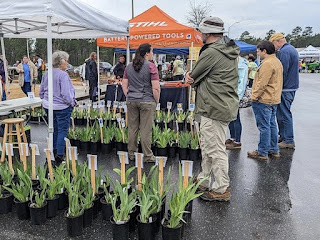 |
| Heather Haley with her mother Alleah, and husband Chris, exhibiting the family's unusual "crop" at the Spring Ag Fest in Pittsboro, North Carolina |
At this time of year, we see a lot of questions about potting up iris rhizomes. Pots can help get irises planted quickly, but purchasing bag after bag of potting soil can get a little frustrating. Thus, our family always looks for ways to pot irises more affordably and sustainably.
When Alleah first began to pot irises, she lived in an area of Northern California known for strong ties to agriculture. Many enthusiastic horticulturists were around, and gardening supplies were readily available. Each spring, Alleah’s local iris society sponsored a large potted iris sale in conjunction with their annual iris show. Most of the preparation for this sale occurred in the fall of the preceding year. Members potted up their surplus rhizomes and kept a watchful eye on them over the winter. Alleah always tried to grow at least 50 one-gallon pots for sale.
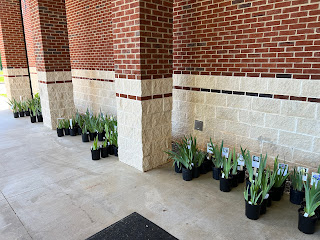 |
| Irises donated and potted in the fall can attract many buyers in the spring |
Alleah also frequently had more irises than her existing garden beds could accommodate. When this happened, she planted the newest iris acquisitions in standard five-gallon nursery pots, or seven-gallon squat pots until raised bed space was available. Alleah likes using the squat pots whenever possible because they offer irises more horizontal growing space. As you might expect, the more irises Alleah grew in pots, the more potting soil she needed.
Before joining Heather in North Carolina, Alleah purchased potting soil from a local landscape supplier. This supplier accepted yard trimmings from the community (for a small fee) and would chip them up to make compost and at least two grades of potting soil. Compost and soil products were then sold back to gardeners by the bag, cubic yard, or partial cubic yard. Alleah typically purchased one cubic yard of the less expensive potting soil, and a front-end loader would dump it straight into the bed of her small pickup truck. Alleah filled pots directly out of the truck bed as she needed them. This way she never had to remove soil from the pickup truck with a shovel or lift heavy bags and dispose of plastic when empty. For less than $50, Alleah could obtain a year’s worth of potting soil. Yay for affordable and sustainable iris potting soil!
Since moving to North Carolina in 2020, Alleah hasn’t found a local source for bulk potting soil. She pots fewer irises at home than she used to and now purchases soil in bags at a big-box store. As a woman on the far side of her 70s, Alleah can’t lift the largest bags anymore nor can she get them loaded independently into or out of a vehicle. She gets by with 32-dry quart plastic bags of “potting mix” from the middle of the price range. For irises, she doesn’t get the “moisture control” kind. The brand Alleah uses has fertilizer added, but at planting, she adds one teaspoon of 10-10-10 granular fertilizer per one-gallon pot, a very slight handful of 10-10-10 for a three-gallon pot, or a full handful of the same fertilizer for a five-gallon pot. If Alleah grows the irises in pots for longer than one year, she fertilizes them about twice a year.
Alleah’s daughter Heather and son-in-law Chris have also gained a good deal of experience growing irises in pots. In 2017, the couple planted 49 extra iris rhizomes in one-gallon pots to determine if they would survive unprotected through the winter. Not only did the plants survive, they even decided to BLOOM.
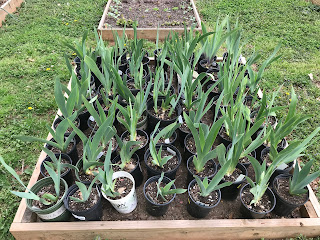 |
| Heather’s first attempt overwintering potted irises in North Carolina … |
 |
| …was a blooming success. The unused herb bed helped delightfully avoid lawnmower damage. |
In 2018, the potted iris experiment expanded to 148 plants after Chris told Heather “You can grow all the irises you want if you can make money doing it.” Chris says he had no idea she would attempt this, but Heather found the prospect was both intriguing and irresistible. The following spring, she completed a strategic business program designed for farmers. Proof-of-concept testing during this program validated that Heather’s strategy for selling potted irises was not only feasible but also financially viable. When she talks irises, the public gets captivated. However, there was one problem: this fledgling backyard nursery business needed room to grow!
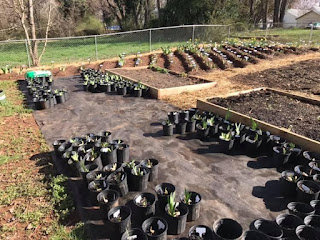 |
| At inception, Heather’s nursery business consisted of 148 potted irises and 1,000 sq. feet of landscape fabric |
Heather and Chris decided to sell their 0.3-acre “city house” and purchase a 7-acre farm. Although moving a household is reasonably manageable, transplanting an entire perennial plant collection without a double mortgage payment is nearly impossible. Luckily for the family iris collection, the transition from house to farm took took place in July—an ideal time for digging irises in North Carolina. To minimize stress (for humans and plants), Chris reminded Heather about the trick they learned from Alleah: when you have more irises than existing beds can accommodate, put them in pots. Heather knew potted irises would survive a mild winter outdoors, and was game for Chris’s suggestion to increase potting speed by keeping clumps together using larger, 3-gallon pots.
Once the potted iris evacuation plan was conceived, it became obvious that buying bags of potting soil wouldn’t work. Even if several pallets worth could be purchased, the city house had no suitable paved surface to drop a pallets on. Mixing their own potting soil from bulk seemed more reasonable, and Heather found recommended ingredients and proportions for iris growing in containers: 45% fir bark, 20% pumice, and 35% peat moss.
As Heather investigated the purpose of each suggested ingredient, she also started exploring what could be obtained locally and affordably. Fir bark wasn’t available for delivery, but hardwood bark was. The nearest big box store didn’t have pumice but did have perlite, vermiculite, and play sand. Peat moss was available, but only leaf mold (a.k.a. leaf compost) was available for bulk delivery.
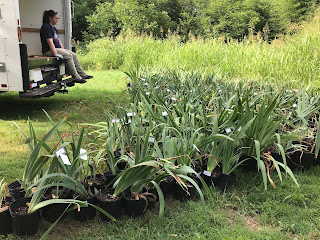 |
| Heather with irises potted up for quick evacuation from a city house in Mebane to the farm purchased in Ramseur |
For their first attempt at making affordable potting soil for irises, Heather and Chris created a mixture that was 40% hardwood mulch (instead of fir bark), 40% peat moss, 10% vermiculite or perlite (instead of pumice) and 10% play sand (also instead of pumice). Although more economical than buying bag after bag of potting soil, what Heather learned about the components of her DIY mixture left her inner scientist greatly unsatisfied.
At the time, Heather was a middle school science teacher. She taught a chemistry unit each year that helped students differentiate between natural and synthetic materials. Later, during an earth science unit, she helped them understand that some of our planet's natural resources are renewable, whereas others are not. For example, hardwood mulch is made of wood, and wood is a natural material that comes from trees. When humans harvest a tree to use its wood, they can plant a new one in its place. If conditions are favorable, the second tree can grow just as large as the first. It is possible to replace the missing tree within a human lifetime--hence, wood is a "renewable resource." Heather told her students that we should choose natural, renewable materials whenever possible because they are more sustainable than non-renewable and synthetic materials.
Although the irises liked the homemade potting mix just fine, Heather knew it contained things that couldn’t be composted or renewed during her lifetime. Both she and Chris are committed to making choices that promote sustainable practices in agriculture and horticulture. They want on-farm decisions to benefit the generations that will follow. Decisions about affordability and sustainability are critical for any business. Especially so for a plant nursery making it’s own potting soil. Would it be affordable to make sustainable potting soil? Would the irises like this? Heather’s inner scientist had hope. Irises are rather resilient.
Starting in 2020, Heather and Chris began conducting large-sale experimental trials for growing iris with more sustainable materials. Half of the containers the family put irises in that year had potting soil prepared with peat moss. The other half were prepared with coconut coir. Coconuts can be harvested and renewed much more quickly than a peat bog, and this seemed to be a step in the right direction. A dry compressed coir brick takes up much less space than a bale of peat. Within a few minutes, the compressed coir can be hydrated and expanded. Pricing from current sources for coconut coir work out to be $7.20-9.40 per cubic foot, versus $6.65-8.93 per cubic foot for peat moss.
 |
| Coconut coir before hydration and expansion |
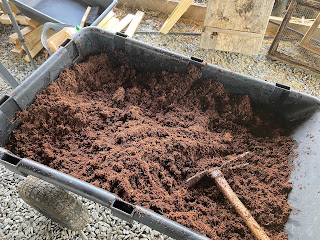 |
| Coconut coir after hydration and expansion |
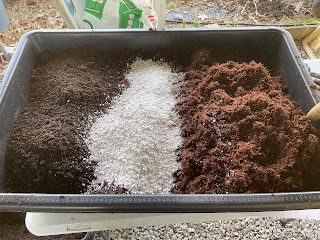 |
| A small-scale iris potting soil prepared in a concrete mixing tub: leaf compost with screened hardwood mulch (1:1, 40%), perlite (20%), and coconut coir (40%). |
Heather and Chris are quite fond of independent garden centers and were delighted to find one selling horticultural perlite in bulk. Unfortunately, working around perlite wasn't so delightful. When preparing iris potting soil with a shovel (or cement mixer) tiny particles of perlite wafted into the air and made members of the family cough. Perlite is a volcanic glass that becomes puffy when heated at high temperatures. It doesn’t seem like a good idea for anyone to breathe tiny bits of glass if this can be avoided. Wetting down the perlite before mixing seemed to help. Still, we worried about what would happen to the puffed glass when it entered a garden or compost pile. This substance doesn't break down quickly, which can be useful for improving drainage and aeration. However, horticultural perlite is created by heating a natural mineral until water trapped inside becomes steam, making the mineral expand (much like popcorn a kernel). This process usually uses a rotating kiln heated with natural gas. Burning natural gas means that putting perlite in our potting soil would make the nursery reliant on a non-renewable resource...this was not satisfactory.
In 2022, our favorite farm supply store started carrying parboiled rice hulls. Although Heather had read about using rice hulls for plant propagation, this was the first time we saw the product in a supply store. Rice hulls are a natural, inedible byproduct from any farm that grows rice for human consumption. The prospect of using a natural-occurring and decomposing(!) material for aeration and drainage in potting soil gets high marks from the sustainability standpoint. Our current source sells domestically grown rice hulls, and pricing runs $3.42 per cubic foot versus $6.24 per cubic foot for horticultural perlite. Less expensive and biodegradable... but do the irises tolerate them in potting soil? So far, things look good. We are entering the second season of phasing out perlite in favor of rice hulls and have noticed no ill effects growing potted irises with them.
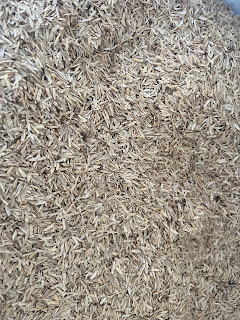 |
| Parboiled rice hulls can be used to improve soil drainage, porosity, and aeration. |
In 2023, the landscape supplier Heather was using for locally-sourced leaf compost in bulk stopped selling it. We can't blame him; our family was the only customer buying it. Another source is available in North Carolina, but all of their delivery trucks are too large to enter existing driveways at the farm. We are evaluating a 1:1 mix of our original supplier's hardwood mulch and what he recommends for filling raised beds. The raised bed mix contains topsoil, sand, and well-rotted compost. We purchase 16 cubic yards at a time, and request products are "mixed in the truck" which we think means a tractor scoop of one product followed by a tractor scoop of the other. This potting soil component costs $1.31 per cubic foot.
We are progressing with sustainability over bagged soil and invested in a cement mixer to make it easier to combine what we need when we need it. But is making more affordable than purchasing a pre-made mixture? Let's take a look:
Bagged Peat Moss/Perlite Potting Soil = $5.61/cu. ft.
Bagged Coconut Coir/Perlite Potting Soil = $11.99/cu. ft.
40% Hardwood Mulch and Raised Bed Soil - 0.4 x $1.31/cu. ft. = 0.524
20% Parboiled Rice Hulls = 0.2 x $3.42/cu. ft. = 0.684
40% Coconut Coir = 0.4 x $7.20/cu. ft. = 2.88
Labor = ($20/hour) x (1 hour/18 cu. ft prepared soil) = 1.11
Bulk 2023 Iris Potting Soil Mixture (0.524 + 0.684 + 2.88+ 1.11) = $5.20/cu. ft.
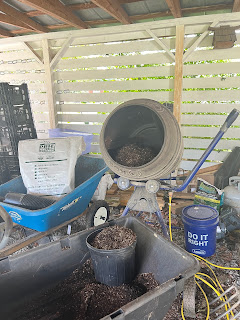 |
For her birthday in 2022, Heather wanted a cement mixer.
It has been a great addition for making potting soil on the farm. |
It took several years for us to find the type of potting soil we wanted, and we are pleased to share the journey and the information we found along the way. If you are interested in potting mixes made with natural ingredients like leaf compost, rice hulls, and coconut coir, be sure to ask the business you purchase garden products from. Suppliers may not realize the need for natural and renewable gardening products unless we ask. Together, we can keep flowers blooming affordably and choose sustainable products that benefit all gardens and future generations.
.jpg)


.JPG)


.JPG)


