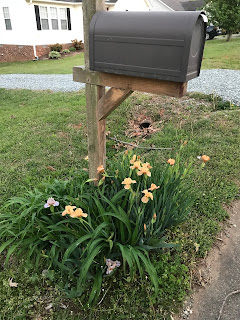
 |
An example mixed-color iris planting
Photo by Heather Haley |
We regularly hear novice gardeners inquire why their irises are changing color. They are convinced that the beautiful colors of the varieties they've planted in their gardens now bloom very differently than before. Experienced iris growers explain this type of change is not possible, even when we're
not sure we're being understood! Once again, here's why iris color doesn't "degenerate."
Irises can reproduce by seed but usually multiply by proliferation from a rhizome. At the base of the plant, eyes develop on the sides of the rhizome which
will give rise to new shoots. These shoots (also called "increases") are exactly identical to the mother plant because the plant cells within each eye automatically contain all the plant's genes. All iris specialists agree on
this and know that the so-called degeneration can be better explained by one of various cultivation incidents.
In a short article published in the French magazine Iris et
Bulbeuses (N°113 - Summer 1994), Jean Cayeux---the famous French hybridizer who
knew irises better than anyone---identified three possible reasons for the
gradual disappearance of the original colors. He began by taking stock of the
most common complaints:
- Fewer colors - A border originally composed of varieties of different colors, but after a few
years only two or three colors appear;
- Single color - Flowers that have also lost their beautiful undulations and the firmness of
their tepals, the new flowers are a blue, medium, anonymous; or
- New colors - Flowers of a mostly dull or faded color replace the initial
brilliant hues.
These findings generally lead to gardeners' conclusion that these are
clear signs of iris color degeneration.
Jean Cayeux set out to demonstrate that the cause of each garden anomaly
has a completely different origin. In the first case, he said that seeing fewer colors is explained by the differences in prolificity and
hardiness of iris varieties. If a plant grows faster and stronger than its
neighbor, it will gradually smother the latter or deprive the other plant of nutrients. Less prolific or weaker plants will stop flowering, and may even lose the ability to reproduce. Eventually, they disappear. In the clutter of
an old planting, or one that's too close together, you won't be able to
distinguish the shoots of the strong plant from those of the weak one; and the
impression of fewer colors will be real: woe betide the weak!
The second, single color complaint called for the following comment: if blue
is gaining ground, it's not an illusion
either. It's due to the reappearance of old diploid irises
(such as Iris germanica or I. pallida). When few pieces of prolific rhizomes remain in
place, they can smother and kill off other irises.
In the third case, the appearance of new colors, paler than the
original, is not strictly speaking degenerative. New colors arise as the product of
"wild" sowing. Iris pollen can be transferred to the ovary of a flower and insemination occurs. If, by misfortune, a naturally inseminated flower is allowed
to mature, the seeds will fall to the ground and viable ones may germinate into a new plant. The
resulting flowers are never genetically identical to their parents.
More often than
not, the production of more or less well-formed, pale offspring suggests degeneration. And,
in a way, it is. To keep hybrids like modern irises in their original colors,
they must not be allowed to reproduce. Only rhizomatous propagation guarantees
the reappearance of the original plant's qualities. Sexually reproduced offspring are, like
those of humans, all different from their parents, and banality wins out.
Another denial: some claim that it's a "secretion"
from the roots that causes irises to degenerate when planted too close
together. This is pure fantasy. If enzymes are indeed produced, they have
no power to bring about genetic modification. Enzymes do, however, have the power
to inhibit the growth of new irises planted on the site of removed varieties.
If you want to put irises back into a bed where they've already been planted,
you'll have to wait a few years for the enzymes left in the soil to dissipate.
Otherwise, the plants will vegetate for a long time before developing normally.
Another radical solution is to replace the tired soil with soil that hasn't
borne irises for a long time!
So let's repeat: irises don't degenerate. The ability of irises to propagate asexually as clones guarantees existence which, under suitable conditions, is
equivalent to eternity! There are still hybrids that appeared in the early days
of iris horticulture, 180 years ago... These include 'Jacquesiana' (Jacques,
1840) and 'Madame Chéreau' (Lemon, 1844).
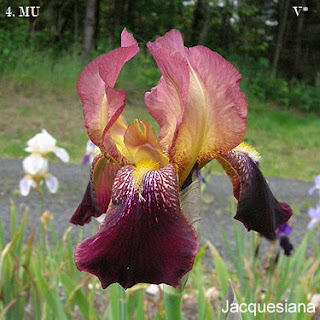 |
Historic tall bearded iris 'Jacquesiana'
Photo from the Historic Iris Gallery* |
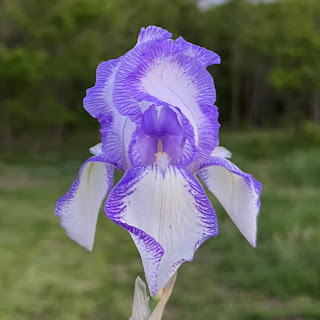 |
Historic tall bearded iris 'Mme Chereau'
Photo by Heather Haley |
Of course, many very old varieties
have disappeared, but this is not due to a weakening of their characteristics,
but to the hazards of their cultivation or to gardeners abandoning them because
more modern varieties have been preferred. On the other hand, some varieties
have been unlucky, such as the very pretty 'Callela' (Muska, 1990), which was
destroyed in its breeder's garden a few years after its appearance. Another
incident that can be fatal is "blooming out". This was the fate of
'Cutting Edge' (1993) in the garden of its breeder Joë Ghio... In this case,
the death of the variety is not certain, since shoots planted in other gardens
may still exist - fortunately! Other natural phenomena can lead to the
disappearance of a variety. These are inevitable mishaps. But they should not
be blamed on degeneration...
 |
Extinct modern iris 'Callela'
Photo by Sylvain Ruaud |
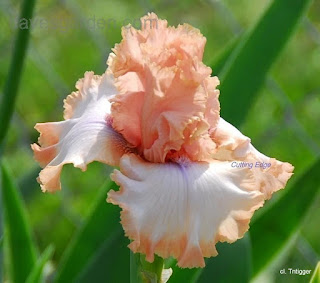 |
Tall bearded iris 'Cutting Edge'
Photo by B Trigger |
In short, then, it must be stated loud and clear that irises do
not degenerate.
*Editor's Note: The Historic Iris Gallery is a project of the Historic Iris Preservation Society. See their frequently asked questions page for additional reasons iris color might "pass by."


