Monday, October 10, 2022

Iris Competition Newcomers

 by Sylvain Ruaud

All those who are interested in irises have noticed that in recent years the results of the competitions held in Europe have given pride of place to varieties developed by native hybridizers. This is a new phenomenon and marks a fundamental evolution of the iris world. Indeed, we were used to all competitions being won by American or Australian varieties. This was true since the end of the Second World War and the resumption of trade. 
At first, there was only the Florence competition in Europe, which soon reached a reputation of excellence. Every year it was the occasion for hybridizers from all over the world to measure themselves against others. 

At the beginning, American varieties reigned supreme, while European breeders were still recovering from the world war and were learning about hybridization on the job. These were only western breeders, British, French, and Italian, few in number and aware of the delay accumulated by their seedlings since the end of the 1930s. This is revealed in the list of winners of the Florin d'Or. The competition started in 1957, and the first European variety to be crowned was 'Rosso Fiorentino' (Specht, N.R.) in 1973! And the following ones were 'Libon' (W. Smid, N. R.) in 1985 then 'Ikar' (A. Volfovitch-Moler, 1995) in 1995, of which it is however excessive to speak about European iris because it is originating from Uzbekistan!  From this moment the successes of European varieties became frequent: nine in twenty years (with a clear Italian supremacy: one counts six Italian varieties among these nine winners). 

'Rosso Fiorentino'

'Libon'


'Ikar'

In Germany, in a competition that is less demanding and judged by a popular jury instead of a professional one, the success of American varieties is obvious, but this is explained by the formal beauty of the varieties presented, which always meets with success in front of a jury that is less sensitive to horticultural qualities. In France, out of eight competitions in almost half a century, there have been only two American victories, which tends to confirm the above assumption! However, in general, European varieties manage to hold their own against irises from America or Australia. In Italy, native varieties, which are always numerous to compete in their own country, have won seven times in twenty years (1999/2018) (1), in France, European varieties have won seven times out of nine, despite a strong external representation (2). In other countries, this analysis is not possible because a competition reserved for local varieties is held at the same time as the international contest.
 
These competitions, which allow local breeders to measure themselves against their colleagues from all over the world and to measure the progress they are making, has brought to the forefront a certain number of newcomers who we can expect to equal or even surpass their elders in the next few years. In France, three new hybridizers have made themselves known. They are Stéphane Boivin, Nicolas Bourdillon and Martin Balland. The first one shone for the first time at the FRANCIRIS© competition in 2015 with 'Aime Bay' (2015). The second was the star of the 2019 competition with 'Beauté de Sologne' (2020). As for the third, he triumphed at the 2019 contest with 'My Red Drums' (2016) and in 2022 'Sylvain Ruaud' (2018) received two secondary awards. Outside of France we can talk about (among others): Pia Altenhofer in Germany, and Simone Luconi, in Italy. 

'Sylvain Ruaud'

The first, who lives in Neuendettelsau, near Nuremberg, in Bavaria, began by distinguishing herself by giving her irises names that do not evoke any reality: they are made up of an assembly of letters. It is a bit to onomastics what abstraction is to painting! But if that were all there was to it, we would not leave the realm of anecdote! The talent of this person is revealed in the success of her results and also in the fact that she is not satisfied with operating in one category of iris. On the contrary, she is interested in all bearded irises, from the smallest to the largest, and her results are brilliant everywhere. She obviously has a particular liking for light brown tones, very fashionable it is true, but my favorite is certainly 'Cattalomak' (2016), delicate purplish pink. She was noticed at the Florence competition, among others with her 'Humpogroll' (2021), rich descendant of 'Zlatovlaska' (Anton Mego, 2009). Let's wait for the continuation of her work.

The second of the selected newcomers is Simone Luconi, who lives in the southeast of Tuscany, in the town of Cortona. He has only registered seven varieties so far, six of which were noticed at the competition in Florence! That is to say that this new breeder must be taken into consideration. We will certainly hear about him in the years to come. To illustrate this opinion, let us appreciate the photo of 'Mimmamaria' (2021) or 'Kalsifer' (2021).
 
These are only two examples of the arrival of new hybridizers in the small European world of irises. Because they are rather numerous. In France in particular, but perhaps even more so in Italy where they do not hesitate to send to Florence their numerous novelties like 'Guarda l'Oceano' by Angelo Bolchi (2022). But the phenomenon is expanding and is manifesting itself in several other European countries, in some of which there were no breeders until now.
 
(1)
1999 'Settimo Cielo' (Valeria Romoli, 1999)
2006 'Recondita Armonia' (Mauro Bertuzzi, 2007)
2010 'Ale Viola' (Stefano Gigli, Not registered.)
2012 'Cheyenne my Dog' (Roberto Marucchi, 2013)
2013 'Vento di Maggio' (Augusto Bianco, 2011)
2018 'Anima Cara' (Angelo Garanzini, 2018)
 
(2)
2000 'Samsara' (Lawrence Ransom, 1997)
2003 'Belle de Nuit' (Richard Cayeux, 1999)
2007 'Solovinyaia Noc' (Nina Miroshnichenko)
2015 'Barbe Noire' (Richard Cayeux, 2012)
2017 'Chachar' (Zdenek Seidl, 2013)
2019 'My Red Drums' (Martin Balland, 2016)
2022 'Nad Oblaky' (Zdenek Seidl, 2019)

Friday, September 30, 2022

Waiting for Rain on the West Coast

by Kathleen Sayce 

The astronomical calendar has rotated into autumn: Rain and cooler weather bring mushrooms, migrating birds and salmon, and new growth for many types of irises.  Here on the West Coast, it’s time to plan fall lifting, dividing, and replanting of Pacifica irises.
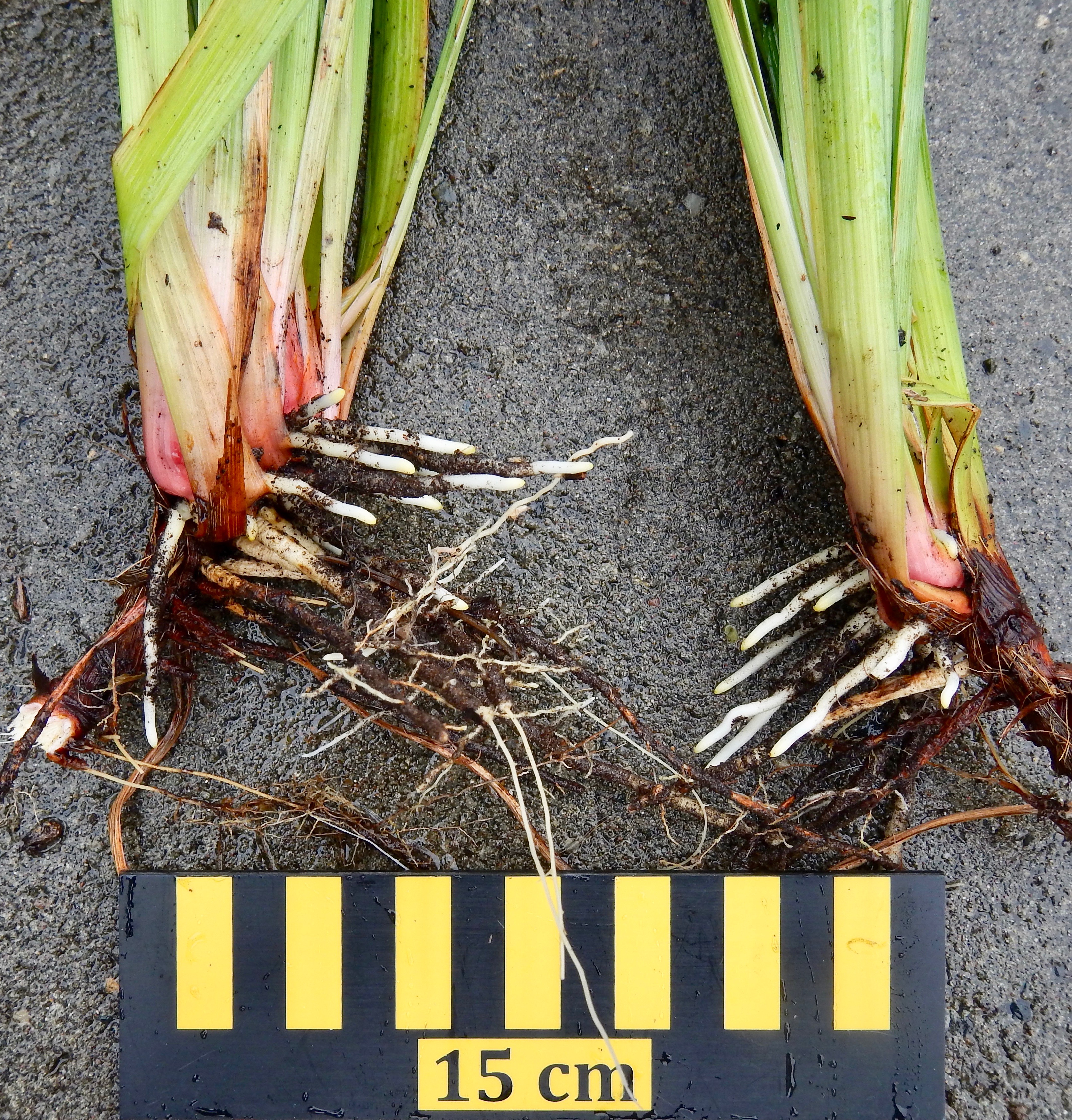
Wait for your plants to show fresh white roots that are at least two inches long. If you have access to irrigation water, water thoroughly a few times in September and October to help encourage Pacifica irises to break summer dormancy. Watering is needed only when replanting, and not weekly thereafter (unless it doesn’t rain for weeks and the soil dries out). 

Monitor weather for rain, and wait for the soil to dampen to a depth of at least six inches (or irrigate your garden). When new iris roots emerge, start planning times to rework and plant flower beds. Better yet, consider scheduling a planting party! Along the coast, this is usually October into November. 

Take time to replenish soil coverings (aka mulches), and amend soils with nutrients and carboniferous materials like compost, ramial, and biochar. Any time you dig a plant hole, add some carbon, work it into the hole, and then replant. My preferred carbon-rich materials and sequence (bottom to top) are: biochar, compost, ramial, wood chips. 

Although I make my own compost, I never have enough. Ants, mice and voles haul seeds around, and seem to like dragging grass seeds and some dicots into my compost piles. If you can get it, compost from methane digesters is seed free. 

When I rework beds, I layer biochar and compost over the open garden bed that is ready to replant. Then I plant into this area, working the carbon materials down and around each hole and the roots. I may also add more compost on top, below the top layers (ramial and wood chips). 

Ramial is a freshly shredded blend of hardwood stems and leaves, like shrub and tree branches. During fall cleanup I shred hardwood branches before leaf fall, and put these chips out as a top dressing on garden beds. This mix breaks down easily without needing extra nitrogen, and helps boost carbon in the soil. It’s almost as good as foliar sprays for plant health. Like compost, I never have enough ramial. 

Biochar is charcoal, pretreated with compost to inoculate it with microorganisms, and is usually ground into a coarse powder. It helps soils retain water and nutrients, and promotes good soil structure. It’s especially a boost for beneficial soil fungi, which helps promote healthy roots in Pacifica iris.
Perennials thrive with wood chip mulches. We have trees, which regularly need limbs removed. I chip them, and turn the resulting wood chip pile to compost. Fungal mycelia appear throughout the wood piles within a few weeks. When I add these chips to an iris bed, fungi are coming with them. Fungi are beneficial for both the soil and my plants. 

If wood chips are too coarse when fresh, run them through a chipper.  (NOTE: I have learned the hard way to wear a mask when chipping—my lungs do not care to inhale wood dust, fine bits of leaves, shredded fungi, or compost fragments. For extra protection, put a bandana over the top of a N95 mask. Eye protection is a good idea too.)

Fine wood chips can also be added to a compost pile. They provide a coarse source of carbon and help break down food scraps for optimal compost texture.
Other soil amendments to add to garden soils during the fall include: eelgrass, dried kelp meal, ground oyster shells, feather meal, and mineral soil amendments. 

Eelgrass mats wash up on the boat ramp at the local port, which gardeners can collect. We have enough rain that we can add it to garden beds, on top of the wood chips, and know the rain will dilute the salt. Otherwise, lay the eelgrass out to compost, let rain wash the pile for a month or two, then spread it.

Winter is coming, but before that season comes fall--the best time to plant, replant and transplant on the West Coast. Enjoy the season!

Monday, September 26, 2022

A Unique Iris Planting in New Orleans, Louisiana

by Patrick O'Connor 

Members of the Greater New Orleans Iris Society have been hard at work curating a unique iris planting in New Orleans City Park. The planting is three-quarters of an acre and provides the space and opportunity for volunteers to maintain an extensive collection of species and hybrid Louisiana irises


We recently created an eight-minute video to support recruitment and membership efforts. It highlights the range of irises and club activities.


Video Link

For more information about Louisiana Irises and the Greater New Orleans Iris Society, please visit our website: http://www.louisianairisgnois.com

Tuesday, September 20, 2022

Growing Irises Out East: A Visit to Draycott Gardens

 by Alleah and Heather Haley

Susan Miller (center) and Alleah Haley (right) during our visit to Draycott Gardens

Earlier this spring, we took a trip into northern Maryland with our dear friend Susan Miller, Vice President of the Eastern North Carolina Iris Society. This area is on the opposite end of American Iris Society Region 4 and was the site of their Spring 2022 Regional Meeting. During this meeting, attendees were invited to visit four host gardens, including Draycott Gardens - home to Siberian and Japanese iris enthusiast Carol Warner and her husband David Bollinger.

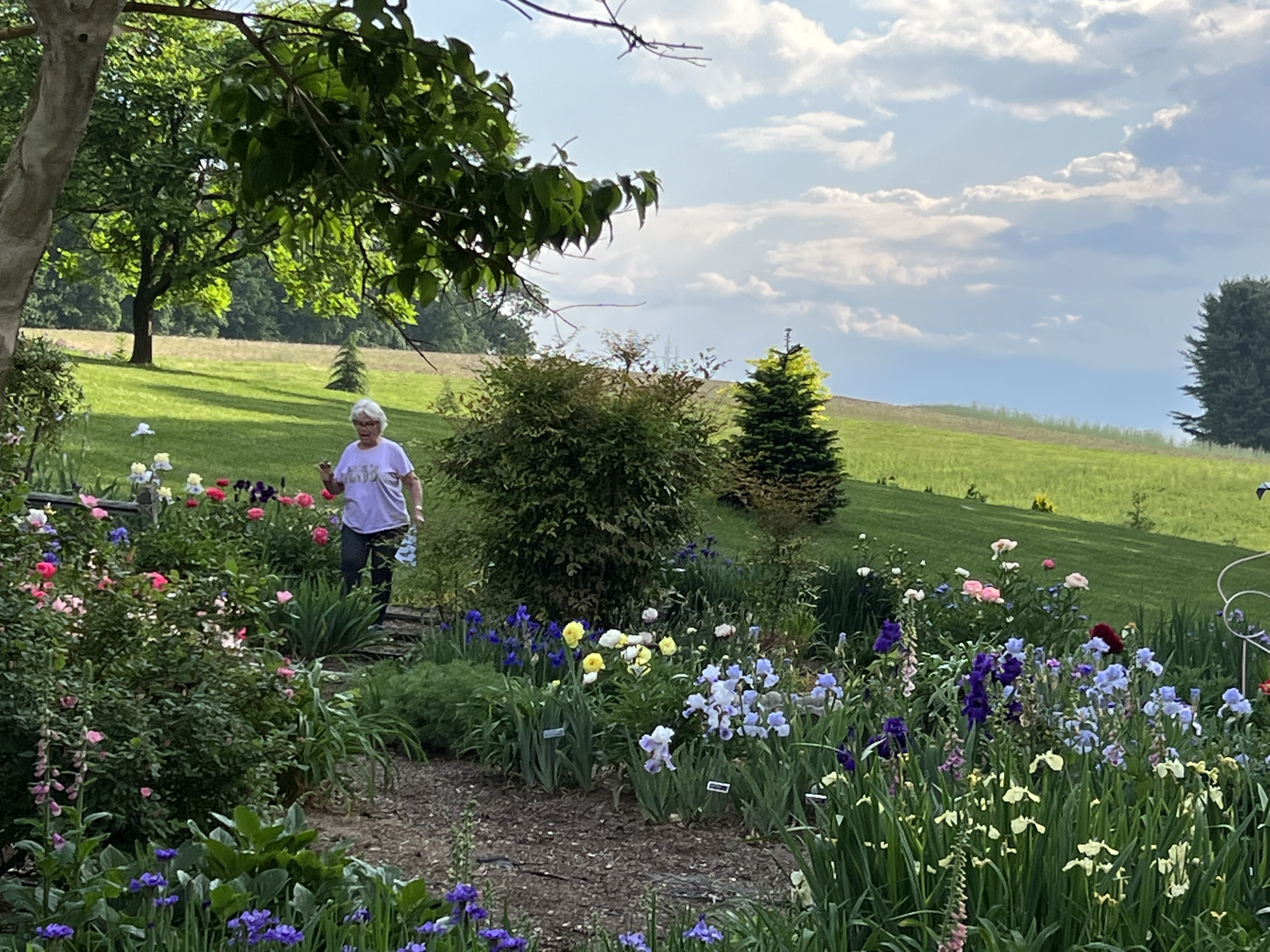
Alleah enjoying irises plantings behind Carol and David's home

Draycott Gardens has been in operation since 1991 and is located in Upperco, an unincorporated community in far northern Maryland (about 10 miles from the Pennsylvania line). Draycott means “peaceful retreat” or “secluded spot” and is the name of a village in central-southwest England, the ancestral home of the Warner family. Carol and David's 10-acre property was part of the farm Carol grew up on.

Although Carol’s mother grew irises, they were uninspiring. Thus, it was not a family connection that piqued Carol's enthusiasm for irises.  After building her house, Carol was gifted a box of irises from a lady she knew and she proceeded to start planting them along the driveway. Breaking up this soil required a pick axe, and Carol thought the irises wouldn't amount to anything. However, this isn't what happened.

The irises along the driveway grew well and came into bloom the following spring in a beautiful array of modern patterns and colors, including pink. PINK! Carol was hooked. Carol belonged to a garden club and her club went to visit the nearby Harp iris garden during bloom season. Owners Maynard and Retta Harp had founded the Francis Scott Key (FSK) Iris Society. They told Carol about the FSK rhizome sale and Carol went to buy irises. She had seen Siberian irises in the Harps’ garden and returned to buy some in the fall. They invited her to become a member of FSK; she did and the rest is history.

One of many flower beds integrating irises with beautiful companion plants 

 
Carol Warner (center) conducting a training session on Siberian irises for regional meeting attendees


Today, Draycott Gardens is home to both bearded and beardless irises--all planted among an impressive array of companion plants, carefully-selected shrubs, and mature trees. Striking were the peonies, rhododendrons, and a huge collection of flowering plants that these former California girls Heather and Alleah couldn’t identify. Carol prefers the beardless irises because they’re more carefree. In her climate, bearded irises have to be sprayed to control leaf spot, and mulching for weed control needs to be limited because of their tendency to rot. Carol’s garden faces the southeast, has sun all day, and has good drainage. With an average of 42 inches of rain and 19 inches of snow each year, she doesn’t have to irrigate.
 
Although Carol's husband David isn't as passionate as she is about gardening, he enthusiastically supports her efforts. David happily keeps grass down with his zero-turn mower, moves soil from one place to another with a small tractor, and uses his considerable computer skills to aid Carol in the various activities that come with owning a commercial iris garden.

More blooms to enjoy among irises growing for resale

During the regional meeting, we arrived at Draycott late, just in time for lunch. We parked in a large grassy area just off the driveway and were quickly waylaid on our gentle climb towards the house. Our trio was immediately enamored by the gorgeous landscaping that welcomed us and delighted by  multiple well-tended beds of bearded and beardless irises growing together in perfect harmony.

Heather was is quick to spot historic iris 'Loreley' (one of her personal favorites)

Alleah is quite fond of historic iris 'Skating Party'
 
A spectacular clump of 'Dividing Line' growing among peonies in bloom

'Little John' is a creation from Region 4 hybridizer Don Spoon


Once we made it to the backyard, we were greeting by even more expertly cultivated beds of bearded and beardless irises... as well as a fantastic cast iron gazebo tucked elegantly into the treeline between the home and business garden beds. 

Carol's delightful metal gazebo
 
Although our family has been growing bearded irises for many years, we are relative newbies to the world of beardless irises. The regional meeting was scheduled too early in the year to see Japanese irises in bloom, but the Siberian irises were out in droves. Carol's iris collection is extensive and varied, and we were thrilled by the assortment of older and newer introductions. Among the Siberians we oohed and aahed over were ‘Roaring Jelly’, 1999 winner of the highest award for Siberian irises, the Morgan-Wood Medal. Standards are lavender grey with red-purple veining; falls are greyish, heavily shaded red-purple with a white signal veined near-black. Marty Schafer and Jan Sacks of Massachusetts are also the hybridizers of ‘Ships are Sailing’ (1998, SIB), which won the Morgan-Wood Medal in 2007. With very large blue bitone flowers and veined yellow-gold signals, ‘Ships are Sailing’ is stunning and especially vigorous.
 
'Roaring Jelly'

'Ships Are Sailing'

We also got to admire Siberian irises like ‘Great Falls Love’ (Dean Cole 2007). This cultivar is a medium blue near self with white signal on the falls; very ruffled and curled. Although 'Great Falls Love' was indeed lovely, Dean Cole’s 2021 Siberian introduction ‘Beespeckled’ absolutely took the cake! This ruffled iris tosses up mottled rose-wine standards with lavender edges, stretches out turquoise-colored style arms; and shows off mottled blue-violet falls with golden yellow signals veined in dark purple. A real standout!

'Great Falls Of Love'

'Bespeckled'
 
Draycott Gardens does not list bearded irises on its website, but they do offer about 250 varieties of beardless irises for sale. Offerings include things Carol has hybridized and chosen to introduce, as well as the creations of Hiroshi Shimizu of Japan and Dean Cole of Gorham, Maine. Shimizu attended a Society for Japanese Irises convention in Carol’s garden several years ago, and they worked out an arrangement for him to ship seedlings (primarily pseudatas – a species cross between Japanese iris hybrids and Iris pseudacorus) to her for evaluation, registration, and introduction. 
 
We were so taken with our visit to Carol’s garden during the regional meeting that we accepted her invitation to return and capture more pictures of it before heading back to North Carolina. During our second arrival, Carol greeted us from her golf cart as she speeded along sprucing up the garden. Later that day she would be playing handbells at her church’s Sunday service, and return to host an “Open Garden” event for friends, church members, horticultural society guests, and folks enticed by garden announcements courtesy of the local radio station. 

Our Sunday visit allowed Susan to capture a delightful moment of Heather (left) and Alleah (right) 
 
A million thanks to Carol and David, for your hospitality, and for sharing the beauty of your farm and gardens with our family and so many others.  For anyone curious about "growing irises out East," a visit to Draycott Gardens is a MUST!