Monday, February 28, 2022

A Growing Iris Resource on YouTube: Part III

by Heather Haley

In this post, I'll continue sharing the story of a growing iris resource on YouTube. The American Iris Society (AIS) uses its YouTube Channel to help organize and disseminate knowledge of the genus Iris, while fostering its preservation, enjoyment, and continued development. Many of the videos available are from the AIS Webinar Series, and their upload was planned for the benefit of all persons interested in irises. 

I am very thankful for the AIS Webinar Series, mostly because it has helped me become more involved in this organization. You see, I absolutely love irises and my heart sings whenever I see one. It doesn't matter if the iris is real, digital, or simply decorating an object. This also happens to other members of my family; our love for irises is practically a genetic trait. The only thing I like more than puttering around irises in a garden is spending time with people whose hearts also sing when they see irises. During 2020, few were able to do this in person because coronavirus disrupted many AIS activities for local affiliates, its regions, and the organization as a whole. By July, I was lonely watching iris blooms fade in my garden. 

Within days, a most intriguing message appeared in my inbox: the AIS was launching a webinar series! Immediately, my heart was singing a familiar song. For the remainder of 2020, my family and I gathered around an iPad on the kitchen table to enjoy presentations described in Part I of this blog postSome we caught live, but we also happily watched webinars we had missed as they became available on YouTube. 

In 2021, the second year of the coronavirus pandemic, AIS faced another year of uncertainty. With a second national convention in peril, all AIS sections and cooperating societies were invited to give presentations in the webinar series. Most of them accepted, and Part II of this blog post described some of them.

Also in 2021, I received a second intriguing message. This one arrived via text message. It read, "We need help at AIS, and I thought of you." I stood in my driveway a little dumbfounded. Up to this point, I hadn't done much for AIS at the national level, and I questioned what on earth made this person think of me. Sure, I helped my mother with a convention booklet a few years back. I volunteered to compose blog posts about irises. I am also (youthfully?) enthusiastic about all things related to irises. Whatever it was, the organization I credit for my family's love of irises needed help. I was willing and eager to assist.

 I learned that the small crew of AIS webinar hosts - Andi Rivarola, Gary White, and Claire Schneider  - were looking for help admitting participants in Zoom and greeting them. I was already familiar with the "pre-game" commentary that hosts engage in 30-minutes prior to each webinar, which always seemed like loads of fun. Before I knew it, I was signing in early to help the webinars run smoothly. It feels great to support the work of AIS, and help hearts sing for irises worldwide.

The following describes the remaining webinars that AIS volunteers prepared, delivered, recorded, and posted to our YouTube Channel during 2021.


Webinar #15 - “Spuria Irises for Every Garden; a Little History, a Lot of Beauty” with Anna Cadd

Anna Cadd was born and raised in Olesnica, Poland and is the current vice president of the Spuria Iris Society. Although she once aspired to become a medical doctor; her inability to kill rats, frogs and rabbits changed her mind. Her interests turned to botany and led to a Masters degree in Biology and a Doctorate in Plant Ecology. In this webinar Anna shares her enthusiasm for spuria irises with a little history and a lot of beauty. 
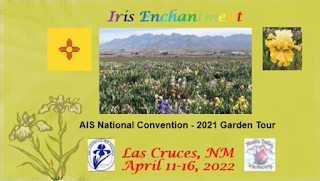

Convention co-chairmen Howie Dash and Scarlett Ayres previewed the gardens for the 2022 AIS National Convention. They shared a walkthrough of each garden in bloom and interviews with the garden owners. If you are interested in this convention or others, visit the AIS website for more information and hyperlinks.
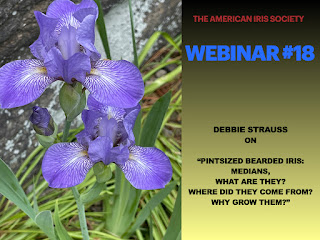
Debbie Strauss lives in Midland, Texas with her husband Dale and is a member of iris societies in Midland, Odessa, Las Cruces, Santa Fe, Dallas, and Hico. Her mother and grandmother grew irises and set the stage for her love of everything iris! Debbie has been an AIS Garden Judge since 1990, and was awarded status as an Emeritus Judge by the AIS Board of Directors in 2020. Debbie shared her expertise on the pint-sized bearded irises referred to collectively as "medians."


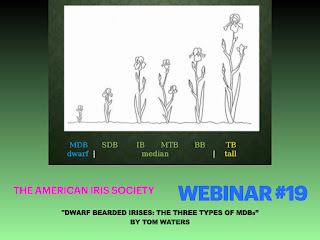
Tom Waters began growing and hybridizing irises in the 1970s. He has served as yearbook editor and president of the Aril Society International, and is currently president of the Dwarf Iris Society. He works as a radiation protection manager at Los Alamos National Laboratory and lives in northern New Mexico with his wife Karen. In this presentation, Tom outlined the origin of the modern miniature dwarfs and discussed differences in flower characteristics and cultural requirements that result from different breeding backgrounds. 
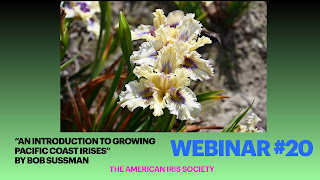

Bob Sussman is president of the Society for Pacific Coast Native Irises and began the Matilija Nursery in 1992. The nursery sells California native plants and has emphasized Pacific Coast irises for the last ten years. Bob's hybridizing efforts focus on developing irises that are well adapted to the warm climate in Southern California. 
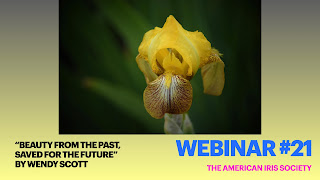

Wendy Scott is the president of the Historic Iris Preservation Society (HIPS) and shared information  about different preservation programs that help preserve the legacy of iris hybridizers. In this webinar, you can learn more about the HIPS Guardian Gardens program, iris rescues, Breeder Collections, Display Gardens, posterity planning, and the purple-based foliage project. 


In my opinion, the only thing better than an iris in bloom is connecting with people who love them just as much as I do.  If you have not done so already, consider joining the American Iris Society, one of its specialized sections and cooperating societies, or a local AIS affiliate. You will receive great information from iris growing experts, invitations to programs like these, and opportunities to share the beauty and thrill of the genus Iris


For Comments: 
What iris groups do you participate in?

Monday, February 21, 2022

Update: Iris douglasiana at Atlanta Botanical Garden

by Kathleen Sayce


Iris douglasiana seedling at Atlanta Botanical Garden

In January 2022, Raleigh Wasser, Horticulture Manager, Atlanta Botanical Garden, sent me a update about their lone Iris douglasiana plant, which is growing in an alpine style bed with excellent drainage. After reading Wasser’s article about the botanical garden’s alpine-style bed in the Rock Garden Quarterly, I wrote a blog post about it in June 2021

World of Irises readers may recall that this plant flowered last spring. The plant went on to produce a pod with about ten seeds last summer. Botanic garden staff collected the seeds and sowed them. 

Raleigh’s update takes up the narrative: “We germinated a douglasiana seed! Just put it in some potting mix and left it in a corner of our greenhouse. Of about 10 seeds this is the only one that germinated.”

I suggested she put that pot outside as winter ends, and perhaps other seeds might germinate. Seeds of Pacific Coast native irises may take one to three years to decide to sprout, even from the same pod. However, getting even one seed to germinate and thrive is wonderful! 


Reminder: Seeds of Pacific Coast native irises do not like to germinate in warm, humid conditions. These seeds are fine outside in the snow and rain, so long as it is not too cold. Zone 7, -10°F is about their lower limit. I suspect the Atlantic Botanic Garden greenhouse where the seedling germinated is cool, not warm. 


This extraordinary Pacific Coast iris and its offspring continue to deliver surprises in its Atlanta, Georgia home.

Monday, February 14, 2022

Novelty Irises: A Lace Story

by Sylvain Ruaud

We can't say that 'Chantilly' (David Hall, 1943) is a very pretty flower. For color, its okay. A light lavender iris, with shoulders clearly marked with yellow that infuses the heart. But for the shape, it is rather mediocre, with recurved and drooping sepals (falls). In fact, what catches the eye are the edges of the floral pieces that are finely curved, like lace. Hence the name, CHANTILLY, which does not refer to cream, but to the famous activity of which the eponymous French city has long been proud. As soon as it appeared, this iris became popular thanks to this frizzled flower edge, original for it's time.

'Chantilly' photo by Mikey Lango

However, the serrated edges were not entirely new in the 1940s, because this aspect had appeared for more than ten years in the seedlings of the Sass brothers. The brothers considered it more of an anomaly. But the visitors to their nursery found it pretty; and Hans Sass eventually decided to register two curly varieties, 'Midwest Gem' in 1936, and then 'Matula' in 1935. Several iris hybridizers seized the opportunity to start development of this ornament. Especially Agnes Whiting, who used 'Matula' extensively to pass on the lace factor to her descendants. She registered several lacy varieties, such as 'Gold Lace', 'Mirabelle', 'Etude' and especially 'Pathfinder' (R. 1948). Tell Muhlestein, on the other hand, used 'Midwest Gem' instead and ended up with 'Gold Ruffles'. Dr. Phillip Loomis went another way to develop the curly edges of his flowers. He found that his pink orchid 'Morocco Rose' (1937) was able to transmit the relevant factor. 

'Pathfinder' scanned from the 1955 Schreiner's catalog 

'Morocco Rose' scanned from the 1937 Quality Gardens catalog

But was David Hall, breeder of 'Chantilly' and great hybridizer, particularly of pink iris, who reached a really and deeply serrated iris. After 'Chantilly' his efforts led to introduction of 'Limelight' (1952) then 'June Bride' (1952). However it was another variety, the medium pink 'May Hall' (1954), not frankly cut, which proved to be the best for the transmission of lace. Although we don't know why, pink irises propagate this phenomenon well. From this variety, breeders like Orville Fay and Nate Rudolph introduced characteristic lacy edges in their irises. This is the case for 'Truly Yours' (Fay, 1949), a soft yellow iris. The yellow becomes white the closer one gets to the edges, which are finely laced. Iris judges did not fail to appreciate the progress of 'Truly Yours' and awarded it the Dykes Medal in 1953. The same award honored 'Rippling Waters' (Fay, 1961) in 1966, a mauve variety with nicely chiseled edges. It has become one of the pillars of modern hybridization. Rudolph's rose-colored irises have identical features; notably, the delicate soft pinks 'Pink Ice' (1962), 'Pink Fringe' (1967), and 'Pink Sleigh' (1970).

'Pink Fringe' scanned from 1977 Schreiner's catalog

'Pink Sleighphoto by Christine Cosi

Of course both origins, 'Chantilly' and 'May Hall', not to mention 'Morocco Rose', have been crossed, directly or via their descendants, to obtain remarkably embroidered petals. Gordon Plough used this route to introduce lacy irises into his lines. Opal Brown did the same. We owe Plough, for example, for 'Butterscotch Kiss' (Plough, 1957), not only very curly, but also marking the appearance of a new hue barium yellow, among yellow irises; 'Rainbow Gold' (Plough 1960), a golden yellow iris which we find in the pedigree of many well-known varieties like 'Bride's Halo' (H. C. Mohr, 1973), 'Milestone' (Plough 1965), 'Starring Role' (D. Palmer, 1973) and 'Trader's Gold' (Plough, 1982). Opal Brown got 'Buffy' (1969) and its offspring 'Queen Of Hearts' (1974). 'Queen Of Hearts' the latter just missed the Dykes Medal in 1981.

'Starring Role' photo by Mary Hess, Bluebird Haven Iris Garden

'Queen Of Hearts' photo by Sylvain Ruaud

Schreiners Gardens also reacted to lacy possibilities by crossing 'Midwest Gem' and 'Chantilly'. From this union were born, a few generations later, quality curly varieties like 'Lime Fizz' (Schreiner, 1969) and the famous, splendid, ultra-curly 'Grand Waltz' (Schreiner, 1970).

'Grand Waltzphoto by Christine Cosi

Serrated edges are now very common in large irises. Common features also include widely-branched stems, soft undulations, and sepals (falls) that widen at the base. 'Grand Waltz' (Schreiner 1970) is no stranger to this expansion. Its' children and grandchildren are numerous and often reproduce the ornaments of their illustrious ancestor. One of the most cut out is—without question—the famous 'Laced Cotton' (Schreiner, 1980) which could very well have been added to the American Dykes Medals awarded to the products of the firm of Salem, Oregon. It missed the supreme distinction in 1986. Paradoxically, 'Song Of Norway' won the most votes from accredited judges. It is a stiff variety and rather stingy in curls! 'Laced Cotton', a pure white self, is entirely bordered in very fine serrations, and this character interested a great number of hybridizers. 

'Laced Cotton' photo by Christine Cosi

Schreiner's subsequent crosses not only produced 'Queen Of Angels' (1995) with its jagged edges, but also 'Carte Blanche' (1996) and 'Arctic Age' (1999). 'Mystic Lace' (Aitken, 1990) takes from 'Laced Cotton' the delicate curls of its petals, and from 'Mystique' (Ghio, 1975) its pretty indigo blue gradient. 'Pure As The' (Innerst, 1989) is also an abundantly frizzled white. 'Rhonda Fleming' (Mullin, 1993) is a superb bright mauve flower with a white center, both frizzled and wavy; 'Lady Bird Johnson' (Mahan, 1996) combines the of qualities of refined pale blue color and perfect shape with frizzling and waviness. The same goes for the lavender blue 'Fancy Stuff' (O. Brown, 2001). 

'Queen Of Angels' photo by Christine Cosi

'Mystique' photo by Mary Hess, Bluebird Haven Iris Garden

'Pure As Thephoto by Klaus Burkhardt

Outside of the United States, 'Laced Cotton' has been used extensively. It is the star parent of the Slovak Ladislaw Muska who has produced many interesting embroidered cultivars such as his fetish bicolor 'Don Epifano' (R. 1989) and the aptly named lavender 'La Dentelle' (1995) which can be described as frizzy. 'Oedipussi' (1990) is the contribution of the German Harald Moos to the glory of 'Laced Cotton' and its cut petals. 'Zlatohlavek' (Seidl, 1997), is the yellow - and Czech - version of 'Laced Cotton'. Finally, let's not forget 'Cumulus' (Cayeux, 2001), a lavender neglecta, which includes in its genealogy the prestigious names of 'Laced Cotton', of course, but also those of 'Condottiere' and 'Silverado'.

'Cumulus' photo by Christine Cosi

'Laced Cotton' is, however, only one of the descendants of 'Grand Waltz' with its heavily embroidered edges. Rick Ernst's products, all cousins, are part of this large family. They include 'Different World' (1991), 'Rainbow Goddess' (1994) or 'Tracy Tyrene' (1988). Let's also mention 'Ruffles And Lace' (Hamblen, 1982), whose name says it all; 'Lilac Breeze' (Tompkins, 1987), a lovely bluish pink; and many Schreiner products, such as 'Fabulous Frills' (1976), really crepey; 'Michele Taylor' (1984), and her cousin 'Prettie Print' (1980), a pure soft mauve wonder gracefully bubbled with bright mauve lace.

'Different World' photo by Christine Cosi

'Tracy Tyrene' photo by Christine Cosi

Today, lace-edged irises are fairly common. 'Chantilly', with such a well-chosen name, has greatly inspired hybridizers from all countries. They have abundantly exploited its performances and offered to the public more and more beautiful flowers whose standards and falls are adorned with the most charming ornaments.

Wednesday, February 9, 2022

IRISES: The Bulletin of the AIS - Winter 2022 Edition

By Andi Rivarola

A warm welcome to those who are seeing IRISES, the Bulletin of The American Iris Society for the first time. If you are a member of The American Iris Society I hope you enjoy this new issue.

The Winter 2022 issue of the AIS Bulletin already available online, accessible via the Emembers section of the AIS website. The print copy has been mailed via the U.S. Post Office. On the cover, Pacific Coast Native Iris, 'Marriage Proposal' (by Joe Ghio, 2006), a picture by Kathy Oldham (California), Winner of the 2021 AIS Photo Contest – Close Up.


Note: to access this area of the website, you must have a current AIS Emembership. (AIS Emembership is separate from the normal AIS membership.) Please see the Electronic Membership Information are of the AIS website for more details.


The Bulletin starts with the 2021 AIS Tall Bearded Iris Symposium on pages 2 and 3. There are many images related to this subject and the list continues on pages 16 through 19.

This issue also features the Winners of the 2021 AIS Photo Contest, on pages 20 through 23, and then it continues on page 54. 

Always great information featured on Section Happenings, find the many activities of AIS Sections on pages 24 through 26. 

Read about the 2022 AIS Membership Drive that may benefit your iris club or AIS Section on page 27.

A plea for AIS Directors on Why You Should Be an AIS Director, on page 28.

The AIS Foundation announces the Ackerman Youth Essay Contest, on page 29.

Spuria is St. Louis is a surprising article, on the slim, tall beauties. Read and see all the pictures featured, on pages 30 and 31. 

An Iris Paradise in Savannah, is a lovely article from Savannah, Georgia that will delight you and may entice you to take a trip to the coastal city. On pages 32 through 41.

Don't miss the back cover picture of Iris laevigata variegata, by Willy Hublau (Belgium) another winner of the AIS 2021 Photo Contest.

There's a lot more to see and read in this edition of IRISES, either in digital or print formats. 

Not a member of the American Iris Society? Please see our website for information about becoming one: http://irises.org/

Happy Gardening!