Monday, November 1, 2021

Ben Hager’s Master Plan to Save the MDB Class

 by Tom Waters

Forty-some years ago, when I was a precocious iris-obsessed teenager, I convinced my mother that our vacation to California to visit my sister and her family should become a tour of iris hybridizers’ gardens. So it happened that I ended up in Ben Hager’s living room, with a huge bouquet of ‘Beverly Sills’ on the coffee table, talking irises while my mom and sister politely enjoyed the ambience and hospitality.

Hager presented a somewhat intimidating figure, with his bald head, precise beard, and dry wit. He was also something of an iconoclast. At an after-dinner speech at the 1980 American Iris Society convention in Tulsa, he basically dismantled the whole premise of the judges’ training program by asserting that judging irises was an utterly subjective undertaking; and we should give up our pretensions of authority and just let people like what they like, which is what we all do anyway.

As a hybridizer, Hager had few equals, in my estimation. He worked with all classes of irises, and won high awards wherever he turned his attention. He created the tetraploid miniature tall bearded (MTB) irises almost single-handedly, by sheer force of will, it seemed. Furthermore, he had a rare combination of creative, inspired vision coupled with solid knowledge, dogged persistence, and patience. I rank him along with Sir Michael Foster and Paul Cook as one of the true ground-breakers in the history of iris development.

Today, I want to talk about one of Hager’s grand projects, an effort to re-create the miniature dwarf bearded (MDB) class, a work that spanned four decades.

In the 1970s, new MDBs were created by hybridizers combining standard dwarf bearded (SDB) with the species Iris pumila in various combinations. There were basically three possibilities: pure pumila breeding, pure SDB breeding, and SDB x pumila crosses.

Hager rejected pure pumila breeding (although he did introduce one, ‘Ceremony’, in 1986) for two reasons. First, being just a single species, it lacked the genetic variety needed to get the innovative colors, patterns, and forms that hybridizers crave. Second, he found its growth habit (mats covered in bloom, like rock-garden plants) to interfere with the appreciation of the form of the individual iris bloom.

Hager also rejected the SDB x pumila route, although it was very popular with other MDB hybridizers of the time. The issue here was poor fertility. Seedlings from this type of cross show only limited fertility, and are almost impossible to cross amongst themselves, making line breeding an impossibility. Hager felt strongly that a class of iris can only be improved and developed if a fertile family can be established, so that breeding can continue for many generations without fertility barriers arising. He introduced no MDBs from this type of breeding.

That left pure SDB breeding as a recipe for creating MDBs. Hager recognized this as the path of greatest promise, but not without reservations. This is the type of breeding with the greatest variety of colors and patterns, and the most adaptable to mild-winter climates. MDB-sized seedlings do arise from SDB x SDB crosses, but they are the exception (most seedlings will be SDBs like their parents). Hager wanted a more focused program than just waiting for these happy accidents. He wanted a line of MDBs that would produce more MDBs, consistently.

He found his answer in his tetraploid MTB work. The tetraploid MTBs were derived from crossing tall bearded (TB) and border bearded (BB) with the species I. aphylla, a many branched iris genetically compatible with TBs, although much smaller. Crossing his tetraploid MTBs with I. pumila, he reasoned, would produce irises of the same chromosome type as the SDBs, but presumably consistently smaller. Furthermore, they would be completely fertile with MDBs from pure SDB breeding, part of the same fertile family. You may read one of Hager's articles on this plan on the DIS website.

'Libation'
'Gizmo'
'Prodigy'


Hager introduced the first MDB of this type, ‘Prodigy’, in 1973. Its pod parent is a seedling of TB ‘Evening Storm’ (Lafrenz, 1953) X I. aphylla ‘Thisbe’ (Dykes, 1923). The pollen parent is the I. pumila cultivar ‘Atomic Blue’ (Welch, 1961). It is thus ¼ TB, ¼ aphylla, and ½ pumila.

Next came ‘Libation’ in 1975. It is a child of ‘Prodigy’ crossed with a seedling of MTB ‘Scale Model’ (Hager, 1966) x I. pumila ‘Brownett’ (Roberts, 1957). Since ‘Scale Model’ is half TB and half aphylla, ‘Libation’ has the same ancestry breakdown as ‘Prodigy’: ¼ TB, ¼ aphylla, and ½ pumila. ‘Libation’ won the Caparne-Welch Award in 1979.

The third and final of these initial progenitors of Hager’s MDB line is ‘Gizmo’ (1977), with the same parentage as ‘Libation’.

Hager then set about crossing these (and similar seedlings) with SDBs and MDBs from pure SDB breeding. As such outcrossing progressed, the amount of aphylla ancestry decreased and the amount of TB ancestry increased. The goal was to retain the small size conferred by I. aphylla, but bring in the diverse colors and patterns of the SDBs. Hager now had a line of seedlings specifically designed to consistently yield fertile MDBs in each generation.

In all, this project produced 34 MDB introductions. Hager died in 1999, but Adamgrove garden continued to introduce his MDB seedlings through 2003. Hager also introduced 19 MDBs from pure SDB breeding, and the above-mentioned pumila ‘Ceremony’.

Here is a list of all 34, grouped by the amount of aphylla ancestry present in each.

25% I. aphylla

Prodigy (1973), Libation (1975) Caparne-Welch Award 1979, Gizmo (1977) Caparne-Welch Medal 1987

Between 12% and 24% I. aphylla

Grey Pearls (1979), Bluetween (1980), Macumba (1988)

Between 6% and 11% I. aphylla

Footlights (1980), Bitsy (1991), Cute Tot (1999)

Between 4% and 5% I. aphylla

Pipit (1993), Jiffy (1995), Self Evident (1997)

3% or less I. aphylla

Three Cherries (1971), although not part of this line, is listed here for completeness, since it has aphylla in its ancestry from the appearance of TB ‘Sable’ (Cook, 1938) in its pedigree.

Petty Cash (1980), Hot Foot (1982), Bugsy (1993) Caparne-Welch Medal 2000, Dainty Morsel (1994), Doozey (1994), Fey (1994), Fragment (1995), Hint (1995), Chaste (1997), Ivory Buttons (1997), Nestling (1997), Trifle (1997), Simple Enough (1998), Small Thing (R. 1998), Sweet Tooth (1999), Wee Me (1999), In Touch (R. 1999), Downsized (2001), Dulcet (2001), Pattycake Baker Man (2001), Behold Titania (2003), Fair Moon (2003), Gallant Youth (2003), Into the Woods (2003), Pirate's Apprentice (2003)

'Grey Pearls'
photo: El Hutchison
As far as I can determine, other hybridizers did not take up this project as Hager had envisioned it, although they did of course use a number of his irises in their own crosses. My own work with similar crosses has had mixed results. I cross tetraploid MTBs with pumila each year, but so far have only bloomed one cross to evaluate, MTB ‘Tic Tac Toe’ (Johnson, 2010) X I. pumila ‘Wild Whispers’ (Coleman, 2012). The seedlings were all too large for the MDB class, looking like elongated SDBs or MTBs with deficient bud count. So the MTB x pumila type of cross is by no means guaranteed to give MDBs in the first generation.

I do have an interesting MDB seedling from I. aphylla X I. pumila. This type of cross produced MDB ‘Velvet Toy’ (Dunbar, 1972). My seedling is 5-6 inches in height, and has a distinctive flowering habit. It is branched at the base like I. aphylla, with both branches bearing 2 terminal buds each. The four blooms open in succession, at the same height, with no crowding. It would be nice to see if this trait could be carried on to plants with a more refined flower. Crossing it with SDB ‘Eye of the Tiger’ (Black, 2008) gave seedlings that were SDB size or taller, though in a fun variety of color and pattern. I continue to make crosses with it, mostly selecting smaller MDBs to pair with it now.

So far, my work with I.reichenbachii X I. pumila seems the most promising in terms of giving me a consistent MDB line to work with.

Kevin Vaughn has reported good results using Hager’s ‘Self Evident’, and I have recently acquired this myself, as well as a few others from Hager’s line.

How should one assess this ambitious program? On some level, it can surely be deemed a success, as it gave Hager many successful and popular MDB introductions. Without detailed records from his seedling patch, however, it is hard to assess how consistent the line was or how much his selection work over the years contributed to the outcome. Perhaps similar results would have obtained just by applying the same selection effort to pure SDB lines.

'Self Evident'
photo: Jeanette Graham

We also have to note that Hager’s tetraploid MTB project is his most lasting legacy among the bearded irises classes. Tetraploid MTBs are here to stay, having been taken up by successive generations of hybridizers. The MDB project did not fare so well, although that may not be any fault of the plants themselves. Almost all new MDBs today are small selections from pure SDB breeding, not produced from MDB-specific lines as Hager envisioned. This may just be a numerical inevitability. There is so much work being done breeding SDBs that MDBs popping up in SDB seedling patches just can’t help but outnumber MDBs from the few dedicated lines that hybridizers have worked with. The situation is reminiscent of that of the BBs, where some good dedicated lines have been established, but they are still swamped by small selections from TB crosses, just because so many more TB crosses are made each year.

'Bugsy'
photo: El Hutchison
If you are interested in hybridizing MDBs, I encourage you to heed Hager’s wisdom and work toward MDB-specific breeding lines, perhaps using I. aphylla, perhaps carefully selected from SDB work, or perhaps using other species.

If you are not a hybridizer, but enjoy growing MDBs in your garden, please seek out and preserve the Hager MDBs discussed in this post. They are a window onto a fascinating thread of iris history.


Monday, October 25, 2021

Hurricane Ida Plows Through the Center of S.E. Louisiana Iris Territory

By Gary Salathe

In my May 17th World of Irises posting, I wrote about the iris bloom at projects that the Louisiana Iris Conservation Initiative (LICI) had completed for the 2020–2021 fall and winter Louisiana iris planting season. We had very good bloom even though some of the locations experienced what we thought were tough conditions from Hurricane Zeta.

Hurricane Zeta hit southeast Louisiana on October 28, 2020. The day before it made landfall, its intensity rapidly ramped up from tropical storm to a Category 3 hurricane. The storm moved quickly through the area, reducing the height of its storm-surge tides and making damage in southern Louisiana less widespread. However, the intense damage caused by the storm in areas just east of New Orleans caught everyone by surprise.

LICI’s main function is to relocate Louisiana irises threatened with destruction to safer areas where the public can see them growing and blooming in their native habitat. The best locations have raised boardwalks that allow the public to walk above a swamp or marsh to safely experience the habitat. These are typically in area wildlife refuges and public nature parks.

The damage caused by Hurricane Zeta to our iris plantings at the boardwalks was very minimal, except for one location that was directly in the path of the hurricane eye-wall. We figured, “Well, you only get a direct hit from a strong hurricane once every few years, so we are likely good for a while before another one comes along.” WRONG!

On August 29, 2021, 16 years to the day that Hurricane Katrina came close to wiping southeast Louisiana off of the map with 28-foot high storm-surge tides, Hurricane Ida made its appearance in our area. While Hurricane Zeta and Katrina stayed on a track to the east of New Orleans, Hurricane Ida’s center traveled to the west of New Orleans. This put the stronger south and southeasterly winds that are found on the east side of any hurricane directly over iris country in southeast Louisiana.


Louisiana iris distribution and recent hurricanes in Southeastern Louisiana: Hurricane Ida's path is shown in red. The winds on the right side of every hurricane blow from the south and then the east as the storm approaches. This map shows why the high storm-surge tide was so destructive compared to other storms to a huge area of marsh and swamp that is home to the Louisiana iris species I. giganticaerulea (shown in blue). The city of New Orleans is on the south side of Lake Pontchartrain.

The reports have been slowly coming in on the damage to the boardwalks and irises in our projects. It seems that even though the damage to the irises has been far worse than from Hurricane Zeta, none of the stands of irises in these projects have been totally wiped out, as the photos below show. However, at the Town of Jean Lafitte boardwalk, which likely experienced the worst damage, we still aren’t sure if there are many irises left. In this location, irises are mixed in with tall grasses in the swamp away from the boardwalk, so the irises are hard to see.


The town of Jean Lafitte elevated boardwalk before and after volunteers from LICI and Common Ground Relief cleared off the storm debris.


Although all of this sounds like we are optimistic about the impact on the irises in our projects, we are not optimistic for the irises in the entire area of southeast Louisiana. Tens of thousands of the I.giganticaerulea species of Louisiana iris growing on floating land south of New Orleans were likely destroyed when Hurricane Ida carved off huge chunks that floated out into open salt water. The result is that we have likely just lived through an event here that has done more catastrophic damage to the wild irises of southeast Louisiana in one day than any other event that has happened in the last sixty years.


These before and after photos show just one area of floating land, called flotant, that was broken free because of Hurricane Ida's winds and floated away. It is likely that there were large stands of I. giganticaerulea growing in the flotant.


This photo shows an area of flotant that has broken free and was seen floating out into the open waters of Barataria Bay. It had been established for so long that trees had rooted in and grown on it.


The eye of Hurricane Ida passed directly over the town of Lockport's elevated boardwalk, which is the site of one of LICI's restoration projects. LICI's local volunteer, Mike Glaspell, headed up the effort to clean off and repair the boardwalk. The irises survived the storm and are doing well.


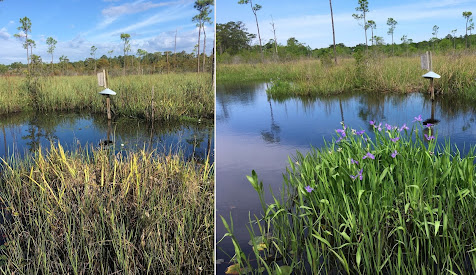
The irises in our Big Branch National Wildlife Refuge project have survived the hurricane, but are struggling with a naturally occurring fungus called "rust". The picture on the right was taken in April.


The Northlake Nature Center had significant damage to their stands of old growth hardwood trees. The high water from this year's rains has threatened the irises. Hurricane Ida's heavy rain arrived just as the water level in the swamp was finally coming down. 
The picture on the right was taken in April.


The irises in our Bayou Sauvage National Wildlife Refuge project have survived the hurricane, but are struggling after dealing with high water from the heavy rains this year. The water level was finally dropping when the rains from Hurricane Ida raised it up again. The picture on the right was taken in April.


The area shown above is part of a LICI iris restoration project in Fontainebleau State Park. It was totally submerged by 3 feet of water from the storm-surge tide of Hurricane Ida. Being under water actually protected the irises from the wind and waves. All of the irises appear to have survived. The picture on the right was taken in April.


Hurricane Ida's high tides impacted the Joyce Wildlife Refuge boardwalk, a location for one of our most successful iris restoration projects. Most of the irises that were growing in the semi-liquid swamp muck have disappeared. We are hopeful that they were just pushed further back into the swamp and will reestablish themselves there. The irises that were growing on the flotant did well. They likely floated up with the storm-surge and settled back down intact once the tide went out. The photo on the left was taken in April. The same area is shown on the right one week after the storm. A recent visitor to the boardwalk told us the irises are starting to peek up from under the debris at that spot.


There are still a few areas where we have projects that we have not been able to visit yet due to their still needing to be cleared of debris. Like everyone else in southeast Louisiana, we will pick ourselves up and carry on with our work. We are all motivated by our love for Louisiana and a desire to do our small part in preserving the plants and habitat that makes this state so special.


The Louisiana Iris Conservation Initiative website can be found here: https://www.licisaveirises.com/

Recent articles about our work can be found here: https://www.licisaveirises.com/news

Our Facebook page can be found here: https://www.facebook.com/licisaveirises/

Our email address is: licisaveirises@gmail.com


Monday, October 18, 2021

Dry Creek Garden, Union City, California

by Jeff Bennett

I have been writing a series of articles about the Dry Greek Garden. In my first article, I introduced myself and my history with irises. In the second, I introduced readers to the land that encompasses Dry Creek Garden and its acquisition by the May family and then passed down to become a part of the Meyers’ estate. The third described the transition from cattle ranch to a summer retreat. In this fourth installment, I will share some of the parties that were held at Dry Creek Garden commencing in 1952 and ending in the final summertime bash in 1972.

The gatherings at Dry Creek were held to benefit the Alameda Welfare Council, which raised money for the needy in the Alameda area and still exists to this day. The Meyers sisters were very generous to local causes and loaned their ranch for the annual events for the Council which brought in thousands of dollars to help families with physical, psychological and monetary needs. They were well known not only for their kindness in helping the disadvantaged, but also for giving generously of their resources and time.

Themed parties at the Dry Creek Garden were planned well in advance of their August date. The themes varied from things like national origin, Gold Rush Days, Colonial, Victorian and the color pink. Yes, pink! For the pink party, they planted the grounds with all kinds pink flowers available at the time. I’m guessing they may have even found a pink iris or two to plant. Everything was pink, even the clothing to wear was to be pink. This made for fun times for the ladies who gathered.

During these events, a box lunch was provided with soft drinks. Booths were set up with items for sale, and many of them were hand made. Jams, pastries, fruit, clothing, and crafts were offered for sale. A nursery area sold plants nurtured by Council members. Most items were sold out at the annual events. With 400 to 700 women attending, there’s no reason why there should not be a sell out of the items.

The pictures in this article are from published newspaper periodicals in the Oakland Tribune under the sections of Women’s World and Feminine Sphere. The Alameda Times-Star also published reviews of the events under Social Whir. According to newspaper reviews, some party goers drove over 50 miles to attend the annual event and the line of cars parked down Mission Boulevard was over a half mile long. No tickets were sold at the gate—tickets had be purchased in advance. The pictures show that all the ladies wore dresses and fancy shoes. This was the highlight social event of the area every summer.

Gardens were planted and full of summer blooming flowers: dahlias, roses, zinnias, daylilies, hydrangeas, daisies, begonias, fuchsias, hollyhocks, snapdragons, petunias, and others. Events started at 11 am and ended at 3 pm. Some years, it actually rained and thundered during the event. These days, it would be quite rare for it to rain in August. During parties at Dry Creek, visitors were free to roam the approximately 4 acre site, see the fruit trees of citrus, apples, plums, almonds, avocado, peaches and persimmons. They would also play bridge or other card games. A dip in the swimming pool was also allowed for any that wanted to.

The last of these parties was held at Dry Creek Garden in 1972. Dr. Edith Meyers became ill and passed away in 1971 at 70 years of age. With Edith gone, the remaining sisters, Mildred and Jeanette, decided to donate the 1,200-acre ranch to the East Bay Regional Park District. They kept the cottage and garden as their summer home. Mildred, the architect, passed away in 1986 at age 88. In the later years, Jeanette no longer traveled to the garden as often. Jeanette, the gardener, passed away in November of 1993. In their will, the final 60-acre parcel of Dry Creek Garden was passed to East Bay Regional Park in 1995 to be preserved for the public to enjoy.

It took until 2007 to get repairs done to the cottage and property to open to the public. Thirty-five years after the last party in 1972, Dry Creek Garden was once again open to the public for all to enjoy. Today, both parcels of land are enjoyed  by hundreds of people on a daily basis. To this day, the 1,260 acres that Mildred, Edith and Jeanette donated is the largest piece of land ever donated to the 121,000+ acre park system called the East Bay Regional Park District.

In my next and final article, I will bring you to the development of the iris gardens at Dry Creek that were established for the 2019 American Iris Society Convention, “The Sun Sets on Rainbows”, headquartered in San Ramon, California


Monday, October 11, 2021

Photo Essay: Let There Be Light!

by Mike Unser

One of the joys of iris photography for me is capturing the sunlight playing thru the blooms. It is especially dramatic just after sunrise or before sunset when the light comes in at an angle, making for intense colors and shadows. 

Here are a few of my favorite photos from the 2021 bloom season featuring sunlight.

'Treasure Island'


'Kathryn Fryer'


Read more about these irises using the following links to the Iris Encyclopedia: