Monday, February 1, 2021

Wrapping up this winter's iris planting season

By Gary Salathe

The Louisiana Iris Conservation Initiative (LICI), of which I am part of, is in the process of winding down our iris planting projects for the 2020 - 2021 fall and winter Louisiana iris planting season.  

In two previous World of Irises postings I explained how our group finds native I. giganticaerulea species of the Louisiana iris that are threatened with destruction.   We relocate the irises into public refuges and nature preserves after getting the landowner’s permission.  The purpose of this is to engage the public to try and motivate them into helping to preserve and protect native Louisiana irises by making their blooms easily visible rather than hidden from view in the deepest corners of the swamps and marshes. If we can’t bring the public to the wild native irises, then the idea is we will bring the irises to the public.


Photo on right:  Bringing blooming native Louisiana irises to the public is the goal.


In years past it has always been our goal to finish up planting irises in the swamps and marshes of Southeast Louisiana by the end of December, but this year’s disruptions with getting volunteers signed up due to COVID 19 restrictions and concerns slowed down our pace. 

The self-imposed deadline of the end of December is based on the theory that any irises planted later than that will likely not bloom in mid-March to the first part of April, which is usually our bloom period.  We have discovered through experience, however, that if the full grown irises are planted in clumps (and sometimes as singles) with the root ball still intact, and all of the soil is still attached, many of the irises will not even realize that they have been transplanted.  They can still be planted until the end of January with the expectation that they will bloom 1 ½ to 2 months later.  This is especially true if they are planted in the typical soupy and rich waterlogged muck that passes as soil in our area’s marshes and swamps.  The “end of December rule” is likely true for planting bare root Louisiana iris rhizomes in typical garden soil and the actual deadline may be much earlier.


Photo:  An example of a clump of irises with dirt still attached to the root ball that we tried to focus on planting starting in mid-December.


The only reason to care about whether or not the freshly planted irises bloom in the spring is that the volunteers really, really want to see the result of their work and the owners of the property, who are sometimes disinterested about their new irises, need that spring “bling” payoff to get them hooked on irises.  

Photo:  The volunteers involved and the landowners where we have iris planting projects usually need some iris bloom “bling” the first spring after the irises are planted. 

In projects where we are just adding to an existing stock of irises that we planted in the past, whether or not our new ones bloom is not as important.  We moved these plantings lower on the priority list so that they could be done in February.  Each one of these smaller iris plantings will require only a few volunteers to complete.

Our plan is to have our iris holding area in the Lower Ninth Ward neighborhood of New Orleans empty of irises by the end of February. (We're almost there.) Our revised goal of planting 8,000 I. giganticaerulea Louisiana irises for this past year will then be accomplished thanks to everyone that has volunteered to help us.

Here is a list of the iris plantings and rescues we were able to get completed since I last reported in my mid-November World of Irises posting:


Photo on left:  We went back into the Bayou Sauvage National Wildlife Refuge in late November and added more irises to our three previous plantings that started in September.


Photo on right:  In late November we also did another iris rescue event from the site we had worked in this summer to fill containers at our iris holding area that had been emptied of irises from our earlier iris planting events.


 Photo on left:  In mid-December we planted irises at the Sankofa Wetland Park & Nature Trail in New Orleans using volunteers from the Master Naturalist of Greater New Orleans.


Photo above:  Also in mid-December we did a small iris rescue event in St. Bernard parish in a drainage canal where the parish was considering spraying the water hyacinths with a herbicide because they were starting to block the drainage.


Photo on left:  December was a busy month.  The first of three iris plantings that took place over a five week period at the Town of Lockport, La boardwalk was done.


 Photo above:  In late December we did the first of what turned out being three iris plantings over a one month period at the Town of Jean Lafitte, La. Wetlands Trace boardwalk.


Photos above:  In the first days of January, 2021 we did an iris planting at the Bayou Teche Paddle Trail trailhead in Breaux Bridge, La. (left)  and on the same day an iris planting at the Chitimacha Tribal Nation of Louisiana in Charenton, La. (right)
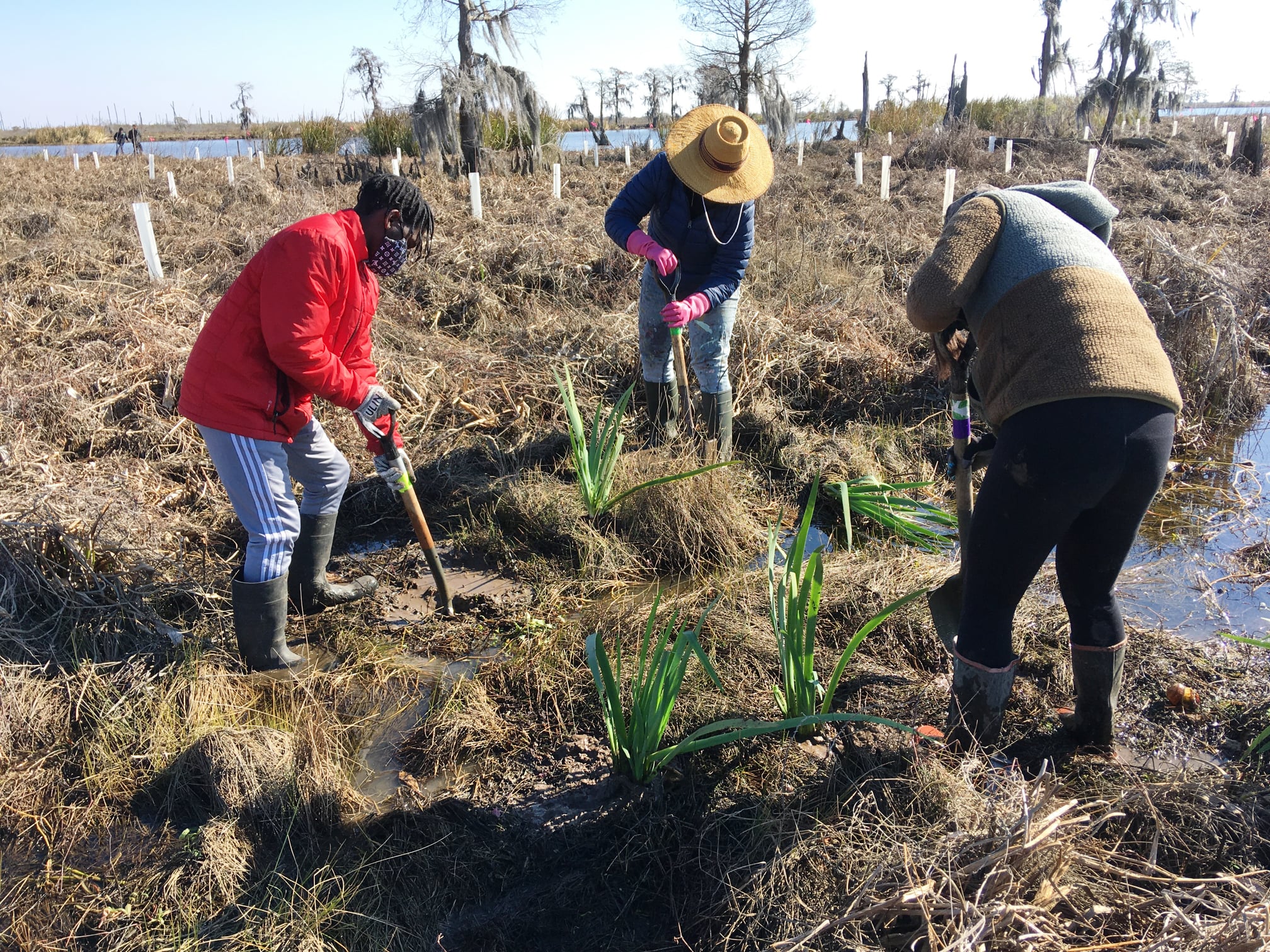
Photos above: On January 9th we did an iris planting as part of the Coalition to Restore Coastal Louisiana’s cypress tree planting event in the Manchac swamp located south of Ponchatoula, La. 


Photos above:  On January 13th a small group of our volunteers planted irises at the Mandalay National Wildlife Refuge near Houma, La.  These added to the irises that were planted there last year. 


Photo above:  On January 16th we organized an iris planting in a freshwater bog at the Nature Conservancy’s Grilletta Tract in Grand Isle, La.   Some members of the Native Plant Initiative, Grand Isle Garden Club and the Terrebonne Parish Bird Club volunteered to get the irises planted.


 Photos above:  Four days later on January 20th volunteers from Common Ground Relief worked with LICI volunteers to plant irises in the swamp next to the Cajun Coast Visitors & Convention Bureau's visitor’s center in Morgan City, Louisiana.  It was the third iris planting we did there during January.


Photos above:  On January 24th a small group of our volunteers planted irises at the Joyce Wildlife Management area, which is  located south of Ponchatoula, La.


Photo above:  On January 27th working with volunteers from the St. Tammany Master Gardeners Association, Louisiana Master Naturalists of Greater New Orleans, Native Plant Initiative of Greater New Orleans, Sierra Club of Slidell, Common Ground Relief, Limitless Vistas, as well as our volunteers, we planted irises at Fontainebleau State Park near Mandeville, La.


Photo on left:  Two days later we planted irises at the 40 Arpent Wetlands Observatory in Chalmette, La.


We have a few small “clean-up” iris planting projects that need to get done in the next few weeks involving either lesser number of irises or that have sites that are too treacherous to include large numbers of volunteers. 

 A very big “THANK YOU!!” goes out to all that have volunteered to help us this past year and to our donors that allowed us to create and maintain our iris holding area.

We will be doing Facebook postings, likely in early to mid March, as the native Louisiana irises begin to bloom to invite all of our volunteers to come out to boardwalks and trails where they planted irises to celebrate the results of everyone’s hard work!!

The Louisiana Iris Conservation Initiative website can be found here: https://www.licisaveirises.com/

Our Facebook page can be found here:  https://www.facebook.com/licisaveirises/?modal=admin_todo_tour


Monday, January 25, 2021

Dry Creek Garden, Union City, California

By Jeff Bennett

In my first article, I introduced myself and my history with irises. In this next article, I will introduce you to the land that encompasses Dry Creek Garden and its acquisition by the May family and then passed down to become a part of the Meyer’s estate.

Prior to the California Gold Rush, for approximately 2,000 years ago, Costanoan Tribes occupied the area now known as Alameda County. In 1770, there were an estimated 2,000 Natives living there. The Dry Creek Garden site was an important seasonal gathering site used by the Ohlone Village due west of Dry Creek. Here they gathered acorns from the numerous oak trees that were in the canyons.

An expedition by DeAnza, in 1776, is probably the first description of the Dry Creek area--a description of a small village without people.

Mission San Jose was established just South of Dry Creek in 1797. The Native population was in quick decline after settlement of the area. In 1840, The Dry Creek Ranch was part of a grant from Governor Alvarado of 17,754 acres to Jose de Jesus Vallejo. He was the brother of Mariano G. Vallejo of Sonoma. He grew many crops on the land surrounding the Mission including wheat, potatoes and tobacco, along with cattle, horses, oxen and pigs. Two miles south of Dry Creek, he built a brick adobe, one of six he built in the area. This one still stands today in the California Nursery Historic Park. In the 1850’s, Jose de Jesus Vallejo was forced to sell 10,000 plus acres to Jonas G. Clark for $35 per acre to meet his rising lawsuit bills. 

In approximately 1855, Dry Creek became a destination for social gatherings. A pleasure resort and picnic grounds was established.  With a growing population, Mr. Clark donated some land near Dry Creek for a school. The school was built on the road leading to Dry Creek. This is now May Road. Once a train station was established in the town of Decoto nearby, the picnic grounds were used for May Day events. With the May Day event, often lasting more than one day, planning for entertainment and food was made beforehand to handle the crowds of people that would attend.

A dance floor was constructed and the best entertainment was hired. Between the years 1870 and 1884, the Decoto Land Company sponsored these events to attract people to buy parcels of their land in the Decoto township. There were also Fourth of July events held at Dry Creek during this time.

In 1884, August May Sr., from Germany who owned a butcher shop in San Francisco, purchased approximately 1,200 acres from Mr. Clark.  His land became known as Dry Creek Ranch. He traveled each day from his home in Alvarado to tend to the ranch. At Dry Creek he planted a 10 acre fruit orchard. With this land now privately owned, the public festivities at Dry Creek came to an end, for now.


August May Sr. And his wife Sofia raised four children. George, August Jr., Henry and Bertha. In 1900, after August’s passing, Henry Meyers, Bertha’s husband, an architect, designed and built the Cottage at Dry Creek for Sofia.

This cottage became the summer retreat for the May’s family and then the Meyers’ family. Sofia deeded the entire ranch property to her daughter Bertha in 1900.

Bertha and Henry were the parent of three daughters. Mildred, Edith and Jeanette. They lived in the city of Alameda just southwest of Oakland. Dry Creek was where they spent their summers, playing on the grounds and ranch property.

Their father, Henry Meyers, worked in San Francisco during the week. During the summer residence at Dry Creek, he would travel everyday by ferry and train to be with his family.

My next article will bring forth the Meyers sisters and the establishment of the gardens at Dry Creek.....this is where some irises show up!

Information gathered here from the: Historic Landscape Report by Russell A. Beatty ASLA Landscape Architect 1996 for EBRPD.

Monday, January 18, 2021

Dishing the Iris Dirt

By Bryce Williamson

No, The World of Iris blog has not joined The National Enquire in dishing iris dirt on people, but rather this post is about real dirt and the problems iris growers face when growing irises in the same garden for many years.

I first planted irises in this yard in 1977 and the bloom the next year was amazing and just what I would have expected from soil that had never had irises grown there; however, as the years went by, the quality of growth and bloom declined and this seems to be a common story among iris growers.

Looking back, many of us have tried different things to get good growth and bloom. Some were more successful than others; other methods no longer are allowed by environmental regulations. I know of no one that really understands why modern bearded irises deplete the soil.

The most obvious thing is to fertilize more—Region 14 hybridizer Vern Wood wrote in an article for The Bulletin of Region 14 that he applied fertilizer heavily so that it looked like a light snowfall.

In the good old days, it was possible to fumigate soils and this seemed to reset the soil for a period of time.

Large growers like Schreiner’s rotate their fields, but that is not really possible in home gardens. I have tried letting areas of the yard go fallow, but that does not seem to really work.

I have even shifted the main planting of named irises to the front yard and that helps for a time.

Bringing in new soil helps too, but again it only helps for a time. 

Over the last 8 years, I have been on a different program. 

Once the area to be used is cleared, we apply 15-15-15. Some will question the numbers of the fertilizer, but that was what irises growers in this valley were using when I first joined the iris society and I have not had a reason to change. Once the fertilizer is down, I water heavily and I want moisture down 4 or more inches into the soil.

Then I buy chicken compost. It is more expensive than steer compost, but steer compost can contain unwanted seeds. The chicken compost may be a bit hot upon arrival, but that quickly is resolved over a few days or a week. That chicken compost is moved into the area to be renovated and covered to a depth of 3-4 inches. The amount of compost is determined by the area to be covered. In the good old days, if I bought enough compost, the delivery charge was waived, but that perk has done the way of the dodo... Ah, the good old days.

Then we bring in the largest rototiller we can get into the yard; when I moved here, I could have a tractor and tiller brought in and that was wonderful because it would cut deeper into the soil, but these days the infilling of what was once a semi-rural area has sadly removed that option. The area is then ready to be tilled.

I insist that the area tilled must be cut in at least two directions. All of these preparations I like to have done between the end of bloom season and the start of shipping season when my purchases start to arrive.

The plants grow well, bloom freely, and there is the added bonus of the soil being very friable. Although it is early November as I write this and I am having problems figuring out how to come up with images, I will dig a rhizome or two in the morning so that you can see the quality of plant this process produces.

A sample of an iris grown in revitalized soil.