Monday, October 7, 2019

Louisiana Iris Names - Where did the hybridizer find that name?

By Ron Killingsworth and Patrick O'Connor

Where, oh where, did that name originate?

Iris names have always intrigued me.  Some names are easy to figure out.  Others defy reason.

Another interesting subject is people's names.  Where in the world did the parents get the name they stuck on that poor child?  Have you often wondered that?  That subject could quickly get me into trouble, so I will refrain from writing about the origins of people's names.

I am limiting my discussion of iris names to only Louisiana iris names.  There is much that could be said about the names of other species of irises.

'Adell Tingle'

It is only fair that I start with some names I have “stuck” on irises.  My first attempt to name an iris was a beautiful light lavender iris, that although registered by my sister, was named by me.  ‘Adell Tingle” (Hutchins, R 2006) was named for my Aunt Adell.  She loved all native plants and when we started growing Louisiana irises, she spent many days with us admiring the irises.  Her legacy as a native plant lover lives on each time I see 'Adell Tingle' growing in someone’s garden.


'Roberta Rowell'

My second iris was a lovely yellow iris and I named ‘Roberta Rowell’ (Killingsworth, R 2007) for my mother, Roberta Rowell Killingsworth, the sister of Adell Rowell Tingle.  While mother was never much of a gardener, she did love the huge beds of Louisiana irises we have and often rode the golf cart through the irises, many times knocking the irises over in the process.  Both sisters have gone to be with the Lord.


'Poogie Peets'

I think naming an iris for a person is a great way to remember them.  However, the iris I named that draws the most questions is ‘Poogie Peets’ (Killingsworth, R 2007), a light-yellow iris with green style arms that always looks like a yellow plate.  Our first grandchild was raised in our home until she was several years old.  We called her our “poogie”.  When she was small and walking, she did not like to be left alone, so when you went into a room and closed the door, she would stick her feet under the door and say, “Grampaw, can you see my peets?,” (her word for feet).  Thus, the name.  It is not an exceptional iris by “judging standards” and I have never introduced it; however, I will always cherish it because of the love I have for Lauren Payne, my first grandchild.

'Peaches in Wine' with Mary Swords DeBaillon Medal
Heather Pryor of Australia named an iris ‘Peaches in Wine’ (Pryor, H 1997) and said she used that name because it looked like peaches and wine.  A beautiful peach and red iris that won the  Mary Swords DeBaillon Medal (MSDM) in 2006, the highest award within Louisiana irises.

'Hush Money'
 ‘Hush Money’ (Dunn, Mary 1998) is one of my all-time favorite irises.  It grows shorter but still produces plenty of bud positions.  The coloring is fantastic.  Why Mary named it 'Hush Money' is not known to me, but I love the name!

'Plum Pleasing'
‘Plum Pleasing’ (Strawn, K 1993) is a very “plum looking” iris, a self, with tiny yellow signals, making it plum pleasing to anyone looking at it.

Dorman Haymon and his iris 'Longue Vue'
‘Longue Vue’ (Haymon, D 1999), a beautiful and well know white iris with a pale silver overlay, was named for Longue Vue House and Gardens.  Longue Vue is a must see if you are in New Orleans, especially in early April during the iris bloom season.  Caroline Dormon designed the Louisiana iris beds at Longue Vue and the Greater New Orleans Iris Society has increased the number of irises there and helps maintain the beds.

'Marie Dolores'
‘Marie Dolores’ (Haymon, D 1986) is a beautiful white (some think it is the “best” white Louisiana iris) named for a Mother Superior at Carmelite Covent in Lafayette, LA.

'Miss Gertie's Bonnet'
‘Miss Gertie’s Bonnet’ (Haymon, D 1999) is one of my favorite irises.  The picture does not do it justice.  It was named for Dorman Haymon’s mother -- really for the hat she wore when working in the garden.  What a great way to remember her!

'Empress Josephine'
‘Empress Josephine’ (Haymon, D 1989), a beautiful darker red violet with flashy signals, was named for Josephine Shanks.  Josephine has been actively working with and growing Louisiana irises for many years.  Dorman wanted to name an iris for her, but someone beat him to the name.  So, he asked Josephine what he could name it and she told him her mother was often called “Empress” or “Empic”, so the iris wound up being named for her and her mother.

'Cala'
‘Cala’ (Betzer, Ron 2008) is a beauty, cream and yellow, that Ron had to move with him, as a seedling, when he moved from CA to LA.  So, can you figure out the name?


‘Red Velvet Elvis’ (Vaughn, K 1996) was named by Kevin, who lived in Mississippi at the time, because of the many places he saw pictures of Elvis Presley painted on red velvet.  He was advised NOT to name an iris with such a name, but hey, it won the MSDM in 2005!


'Geaux Tigers'

‘Geaux Tigers’ (Vaughn, K 2009) (pronounced Go Tigers) could only be named for the LSU tigers (football).  It certainly has the LSU colors, purple and gold.


'Bayou Tiger'

‘Bayou Tiger’ (Strawn, K 1993) is another iris that must be named for the LSU tigers.  A beautiful purple and gold iris that is wanted by every LSU fan who visits the gardens here.


'Roar of the Tiger'

‘Roar of the Tiger’ (Wolford, Harry 2009) is another beautiful iris named for the LSU tigers.


'Great White Hope'

‘Great White Hope’ (Haymon, Dorman 1999) is NOT white.  This iris has raised many questions – why that name?  It has nothing to do with the color of the iris but does had to do with color.  It was named for a boxer. To learn more, go here.


'Donna Wolford'
‘Donna Wolford’ (Pryor, Heather 2004) was named for Donna Wolford, a retired school teacher and wife of Harry Wolford, both very active members of the Society for Louisiana Irises.  A beautiful iris with such eye-catching halos and scalloped edges.  Here is a picture of Donna and Heather.


Heather Pryor (left) the hybridizer with Donna Wolford, the namesake.

'C'est Si Bon'

‘C’est Si Bon’ (Taylor, John 1983) is, of course, very French (meaning ‘it is so good!”) and appropriate for a Louisiana iris because of the French influence in the southern part of that state.  It was, however, named by John Taylor of Australia!


"Circe Queen'

‘Circe Queen’ (Faith, M.D. 2006), along with several others, were named in part for the town M.D. Faith lived in, Searcy, AR.  Searcy is pronounced “Circe”.


'Atchafalaya'

‘Atchafalaya’ (Campbell, F 1998) (pronounced Augh chaf a lie ya – kinda like a big sneeze) is of course named for the huge Atchafalaya Basin in south Louisiana. It is a beautiful dark red violet in the cartwheel form.  It won an honorable mention and an Award of Merit.


'Big Charity'
‘Big Charity’ (O’Connor, Patrick 2005) is the popular name of a public hospital first opened in 1736 in New Orleans and destroyed in 2005 by Hurricane Katrina.  It provided care for anyone regardless of ability to pay.  It is not certain if this hospital will be re-built. To learn more, go here.

Pat O’Connor loves to name his irises after streets, bridges, waterways and things “New Orleans”.  After all, he lives in Metairie, next to New Orleans. He wrote an article for the “Fleur de Lis”, the publication of the Society for Louisiana Irises, back in 2005 about iris names.  I re-read it a few days ago and it led me to write this “blog”.  Pat agreed to share authorship since a lot of it is in his original article.

Some of Pat’s irises are ‘Prytania’, ‘Tchoupitoulas’ and ‘Frenchmen Street’, which are all names of streets in New Orleans.  You are on your own in pronouncing Tchoupitoulas and I am glad I don’t live on that street!  To learn more about some of these streets, go here.   He also named irises for ‘Gentilly’ and ‘Faubourg-St. John’ which are old neighborhoods in New Orleans.  Both flooded during hurricane Katrina with up to ten feet of water on some streets.  So, let’s look at some specific irises that Pat has named for things found in or near New Orleans.
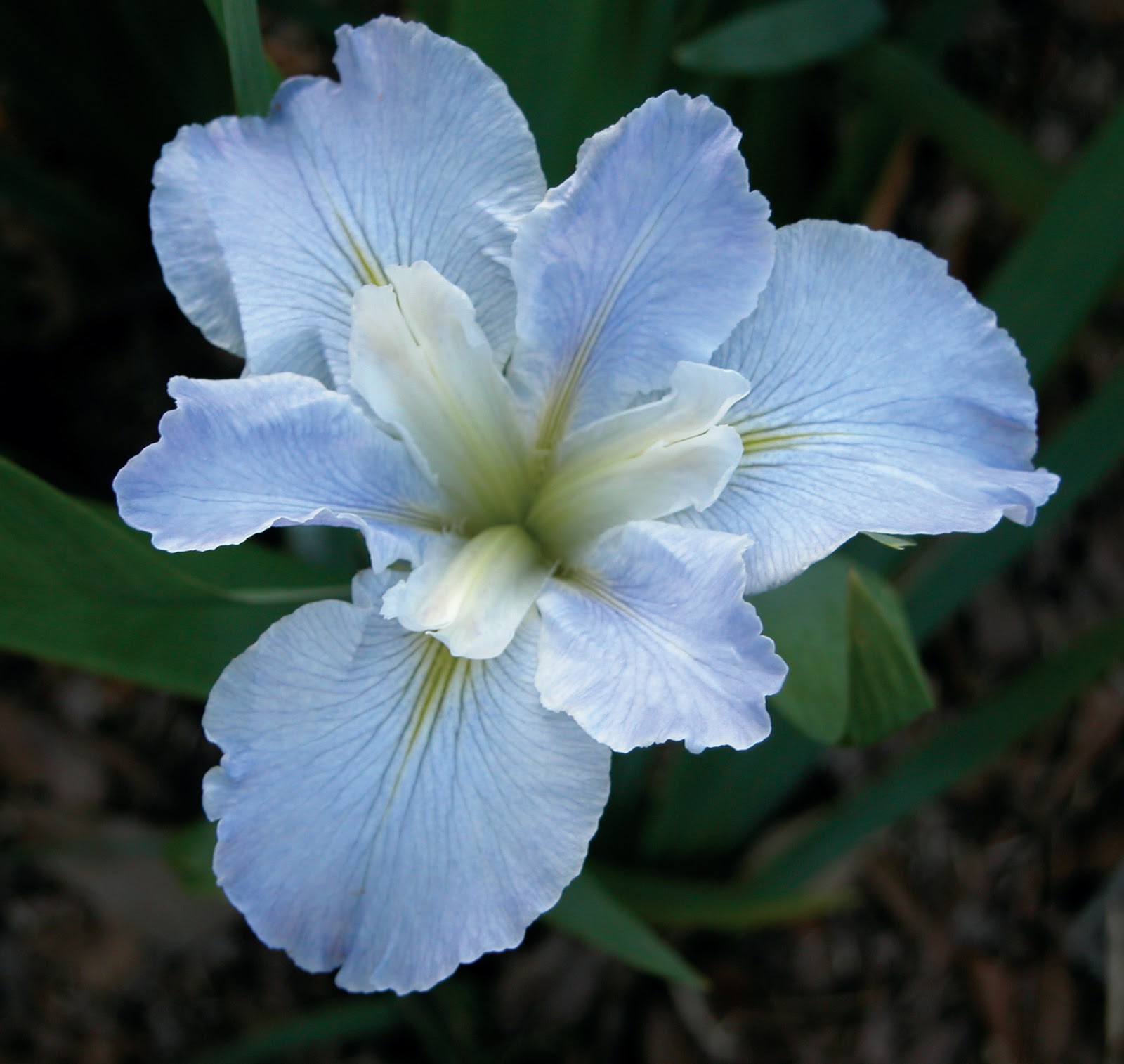
'Bywater'
‘Bywater’ (O’Connor, P 2005), a pale blue iris was named for an old neighborhood in New Orleans that is down river from the French Quarter just as you enter the Ninth Ward (which was almost destroyed by Katrina).

"Nottoway'
‘Nottoway’ (O’Connor, P 2005) is the white namesake of a big white plantation house upriver from New Orleans.

'Early On'
‘Early On’ (O’Connor, P 2005) is a “big early blooming thing” according to Pat.

'Highland Road'
‘Highland Road’ (O’Connor, P 2005) is “a red iris named for a picturesque road in Baton Rouge that hugs the high ground along what was the natural limit of the Mississippi flood plain before the levees were built.”

'Monkey Hill'
‘Monkey Hill’ (O’Connor, P 2005) is “a medium height red named for a huge mound of soil at Audubon Park built up so that the children of New Orleans would have some notion of what the word “mountain” might mean,” living in a city that is below sea level!

'Storyville'
Lastly, ‘Storyville’ (O’Connor, P 2005) is “named for a famous red-light district in New Orleans dating from 1896 to 1917.  Storyville was of historical and architectural importance, with extensive documentation of life there and great local interest.  The iris is red, of course!”

Some possible iris names Pat rejected from Katrina were ‘FEMA’, ‘Katrina’ and ‘Corps of Engineers.”

To learn more about Louisiana irises, go here..

To learn more about other irises, go here..

To learn more about New Orleans, go here.

To learn more about the damage from Katrina and the re-building, go here.  https://www.theatlantic.com/photo/2015/08/new-orleans-10-years-after-katrina/402277/

Monday, September 30, 2019

THE ITALIAN LADIES


By Sylvain Ruaud


In Italy iris hybridizing is not a new activity. But as you are about to find out, over the years it has taken its own — very original — dimension. Everywhere else in Europe it is men who have dedicated their lives to irises, certainly with enthusiasm and passion, but also as a legitimate business concern. In Italy, women were the ones to start the work. Primarily as a hobby, but secondarily to ensuring sustainability. Many of us have long ignored what was happening beyond the Alps during the first half of the twentieth century. And that may have been kept a mystery if it wasn’t for a recent Bulletin by the Società Italiana dell'Iris. I read an article written by Patrizia Verza Ballesio that brings attention to the mystery about these ladies. I do not read italian enough to be able to make a true translation of this article, but at least I understand enough to satisfy my curiosity, especially since reading the little book "Iris tra Botanica e Storia" I had already learned a little more. Here are the portraits of these women hybridizers so little known.
Mary Senni


In the collection of Parc Floral de Vincennes in Paris I discovered a variety of tall bearded iris called 'Verlaine' by Mary Senni. This beautiful flower in bronze tones pleased me, but I was even more taken by the name of the hybridizer. Who was this Mary Senni? I figured that this person was someone known by hybridizer Armand Millet, in 1931, since he chose this name for one of his novelty irises: 'Mary Senni' is a charming pale purple iris, very feminine in appearance.


Thanks to Signora Ballesio for giving us a brief portrait of this great lady. "Mary Gayley (1884-1972), of American descent, married Count Giulio Senni in 1907. In her garden called Grottaferrata she cultivated mostly roses and irises. During the 30s to 50s, she played a prominent role in publicizing information on the progress of iris hybridization in Europe and the United States through articles she published in the magazine "Il Giardino Fiorito". She was in close contact with the most important hybridizers of the time, so much so that Millet in 1931 dedicated one of his irises to her. At the same time, she practiced hybridization herself in her Roman garden. In 1937 she managed to create an international iris competition in Rome, which was quickly interrupted by the war.” Known and appreciated in Britain where her articles were often published, the British Iris Society awarded her in 1959 the Foster Memorial Plaque for her contribution to the advancement of knowledge of the genus Iris.
Gina Sgaravitti


I was eager to know who Gina was. For twenty years I cultivated the variety 'Beghina' knowing nothing else than the name of its creator. This is what Patrizia Verza Ballesio says about her: "Angela Perocco, known as Gina (1907-1995) is of Venetian origin. Her marriage to Teresio Sgaravitti brought her to Rome where she had to look after a large garden that over the years was to become full of irises and roses.” She became a producer of perennials and even created a catalog exclusively devoted to irises called "Iris di Via Appia," it presented a wide choice of the best American and French irises of the 40s and 50s as well as a dozen of the owner's personal seedlings. She was a very organized hybridizer who meticulously noted the coordinates of her irises and their location in a garden — despite the years, they remained identifiable.

Flaminia Specht
The name Flaminia Specht first came to my attention when I read the winners of the 1973 Florence Competition and her 'Rosso Florentino' was awarded the Golden Florin. Her maiden name was Flaminia Goretti (1905-2004) and her husband's name was George Specht. (1) "She devoted her life to the iris and the results of her efforts are still appreciated today; it was thanks to her determination and tenacity, combined with that of another Italian-American, Nita Stross, that the Iris Garden of Florence, the International Competition and the Italian Iris Society were created. Many of her irises, such as 'Ala d'Oro', 'Napoleone', 'Chianti', 'Zabaione' have been present for years in the catalog Guido Degl'Innocentis.


Nita Stross


The name of Nita Stross, born Radicati, (1910-1995) is firmly attached to many activities related to irises. Including the creation, in the property of her husband, of the Garden of Mugnano. She added the importation of American varieties and the distribution of a mail-order catalog "The Iris of Mugnano" distributed in the 60s. She took part in the creation of the Iris Garden of Florence and the direction of the magazine "Il Giardino Fiorito." She joined her friend G.G. Bellia in the creation of the San Bernardino di Trana Experimental Garden, near Turin, which has since become the Giardino Botanico Rea, which houses a superb collection of historical irises.

Her dedication to the iris world are remarkable, including the creation of her own varieties. They were rather numerous and one of them, 'Il Cigno', a beautiful white iris, won in 1963 the second prize of the International Competition of Florence. Many of her irises were used by another 60s Italian breeder, Giuseppe Giovanni Bellia.
Eva Calvino


Those who are interested in literature know well the Italian writer Italo Calvino, whose story "The Baron in the Trees" is known worldwide. But, they do not know that his mother, Eva Mameli Calvino, made her name in the field of botany and, in particular, in the field of irises. She was successively professor of botany at the University of Cagliari, Sardinia, then Director of the Experimental Floriculture Station of San Remo. Her interest in irises can be seen in the large number of articles written for the magazine "Il Giardino Fiorito" during the 30s — 50s. She was also a founding member of the Italian Iris Society. Finally, she also tried to hybridize and to send several of her new varieties to the Florence International Competition that she helped launch.


So here are five ladies, almost unknown in irisdom today, but who brought so much to the iris world in general and, in particular, to its Italian sphere, a heritage that deserves to be preserved. In fact, if they have remained so little known outside the small circle of Italian irido-philes, it is largely because, until recently (2), hybridization was, in Italy, considered a pastime, practiced by intellectuals and aristocrats who granted their acquaintances a modest attention, not considered it necessary to record them, and for whom the marketing of iris has been nothing but a little anecdote.


(1) In fact it would be George Specht who would be the breeder of 'Rosso Fiorentino'

(2) The first registration of an Italian variety took place only in 1997.

Monday, September 23, 2019

Importing Iris into Australia


By Mel Schiller

Bailey and I at Smokin Heights are in the process of going through what is considered the best protocol and procedures of importing bearded iris to Australia from the United States.


As we type this, we have approximately 90 rhizomes coming into an Australian Quarantine Facility in Melbourne from the United States Of America.

It is an extremely lengthy and costly exercise. Here is a basic overview:

Before we even decide on what rhizomes we would like to import into Australia we need to apply for a permit to import conditionally non-prohibited good: plant and plant products, essentially Iris Spp.

To obtain the permit is probably the easiest step in the process!

Once we know that we have obtained the permit, we then look at which rhizomes we would like to import. Bailey and I agree to disagree on this process, bearing in mind the purchase price, the shipping, the phytosanitary certificate and the forever changing currency!
Our permit has a 12 month use on it. We use the permit once in a year. It is best to have the irises come into Australia at the beginning of spring after the USA bloom time to slowly acclimatize to our heat and weather conditions.

Before being mailed to Australia, the rhizomes are dug, labelled, washed and trimmed then sprayed to remove pests and eggs. A health inspector's visit is organized to issue a phytosanitary certificate to approve of the mailing of the iris rhizomes into Australia. This certificate approves the treatment of the rhizomes being shipped to a foreign country and says that all permit conditions have been met.

The rhizomes are inspected upon arrival into Australia by Biosecurity and held in customs. This process takes a long time. All imported goods must be free from contamination including no dirt, no insects, no living creatures in or on the rhizomes and packaging. The packaging must meet Australian regulations. The package and rhizomes must be appropriately labelled and packaged in accordance with the import permit conditions.  If these conditions are not met, the rhizomes may face destruction, export, or even forfeited to the Commonwealth at the importer’s expense.

Once the rhizome pass this stage, they are then fumigated by a company. The fumigation is the worst stage for the iris. Some rhizomes can handle the process; some do not. The rhizomes are fumigated with Methyl Bromide 32g/m3 for 3 hours at 21 degrees Celsius, at the cost to the importer.

Once this process is completed the rhizomes are taken privately to a Quarantine post entry facility where they can remain for a minimum of 3 months, or until sufficient new growth has occurred to enable them to be screened for any disease symptoms.  The facility schedule of fees are per pot. The rhizomes are screened for any symptoms twice or three times over the 3 month period at the cost to the importer. The rhizomes are not classed as single items. They are classed as the whole shipment. The shipment of rhizome have to be free from disease and be cleared by a biosecurity officer before they can be released. Fees need to be paid to the Quarantine facility and Biosecurity before the are released.

Rhizome collected from Quarantine
Once we have been notified that the rhizomes have passed the inspections and have been released, we arrange for transportation from Melbourne to our home in South Australia.

Australia has extremely strict laws on importing goods and plants. We have a very unique environment and agriculture industries and want to minimize the risk of pests and diseases entering into the country.

On top of that, there are also strict laws moving plants foods and animals from state to state. We cherish our uniqueness and don’t want to damage it for future generations. Plant pests and diseases can significantly damage Australia’s productive plant industries. They reduce yields, lower the quality of food, increase production costs, and make it difficult to sell our produce in international markets.
Plant pests and diseases may also be a huge threat to our natural environment: native forests, grasslands, and shrub lands.
Australia does not need the iris borer caterpillar (Macronoctua onusta), which are the most destructive insect pests of iris.
  • The caterpillars chew holes into the leaves and tunnel all the way into the rhizome.
  • The tips of iris leaves turn brown and seem to be dying, but the entire plant dies very rarely.
  • Iris borers cause severe damage to irises by feeding on the rhizome.
  • Management of iris borers is difficult, but damage caused by them can be reduced.
  • Pesticides or natural enemies of iris borers may be used to control these insects.
Again, Australia is lucky to be free of many damaging pests prevalent elsewhere in the world. 
Fewer pest and disease problems mean lower production costs. Areas where rigorous biosecurity can deliver “pest freedom” give Australian producers an enormous advantage in international markets and allow us to have safer and cheaper locally produced food.
Please do not ship plants to Australia without following our strict guidelines. For those Australians who bring plants in without the proper paperwork and procedures, well I know what I would like to say: you're a bloody idiot!