Monday, July 2, 2018

Developing More Color Patterns Into Rebloomers


by Ginny Spoon


'Little John' -- photo by Ginny Spoon

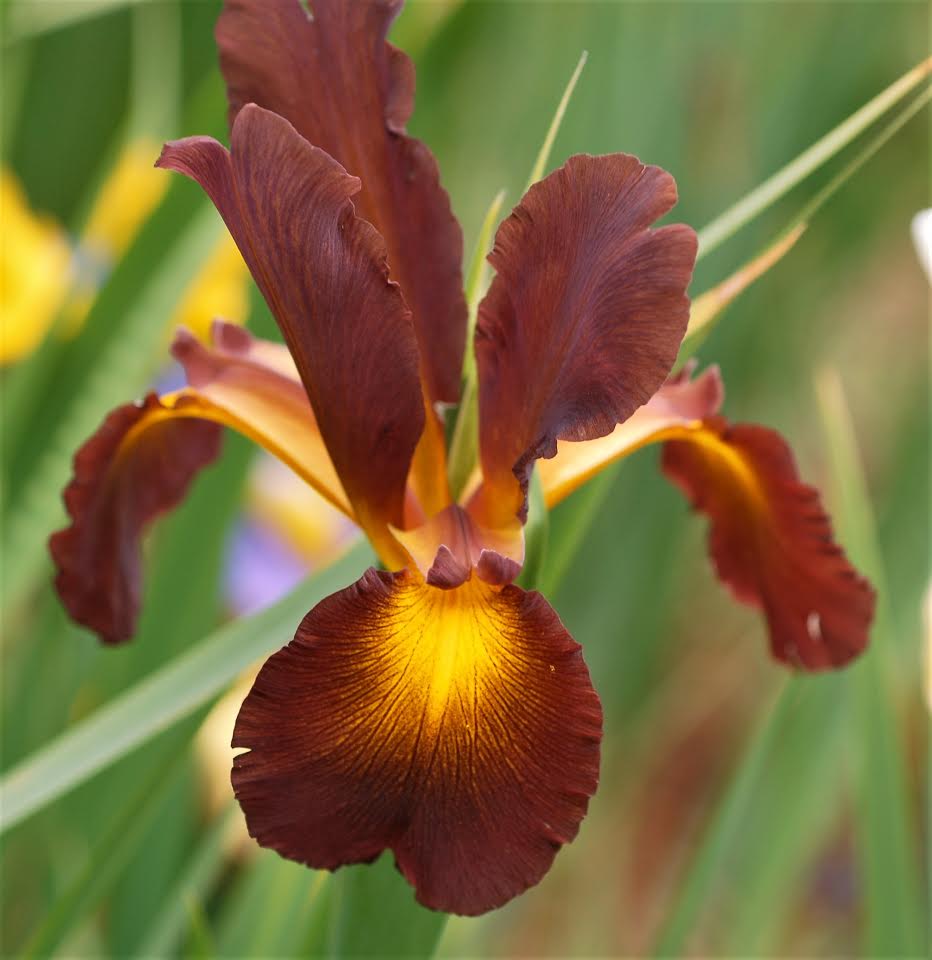
One of the goals of an iris hybridizer is developing new hybrids with richer colors and new color patterns. When we crossed 'Damsel' with 'Queen Dorothy' one of the results was our 'Little John'. It was a cross of a non reblooming iris with one that was a reliable rebloomer  (Queen Dorothy) in our colder zone 6. 'Damsel' is a lavender pink with a tangerine beard and has not been reported to rebloom in any zone, so that is what we call a rebloom carrier. You can see by the photo that is where 'Little John' gets its lovely color combination.  'Queen Dorothy' is a plicata and have gotten  plicatas and variegated flowers out of crosses with 'Little John'.


'Liquid Amber' -- photo by Ginny Spoon

Taking our 'Little John' and crossing it with another warm climate rebloomer, 'Lady Juliet' (zone 7), we got our reliable zone 6 rebloomer 'Liquid Amber'.  Don has long admired the West Coast hybridizer, the late  Monty Byers, who used cold climate rebloomers for crosses with the warmer zone rebloomers to develop better form and color patterns. Raymond Smith from the Midwest and Lloyd Zurbrigg from Canada and then the east coast also used this method to produce more modern cold climate rebloomers.


'Daughter of Stars' -- photo by Ginny Spoon

Our Wister Medal 'Daughter of Stars' is a good example of a cross with a cold climate rebloomer ('Clarence') by a carrier ('Mind Reader') producing not only a zone 6 rebloomer but a lovely luminata pattern as well. The lovely pink 'Vanity' by Ben Hager is another carrier that has been reported to rebloom in the warmer zones is in the parentage of many cold climate rebloomers. 'Starring' a beautiful non rebloomer by 'Daughter of Stars' produced a lovely cold climate rebloomer, 'Starring Encore'.


'Starring Encore' -- photo by Ginny Spoon


Immortality' --  photo by Ginny Spoon

Taking Midsummer's Eve X Fancy Woman (another carrier) we got BB 'Twiggy' a much better formed pink.  Both 'Twiggy' and our 'Love Goes On', both prolific rebloomers here, have produced early rebloomers with more saturated colors and more modern form. 'Love Returns' (Twiggy X Love Goes On ) is a good example. 'Midsummer's Eve' has 'Immortality' in its parentage.


 'Vanity' -- photo by Ginny Spoon

Don tried over 25 crosses of pinks with the cold climate rebloomer 'Immortality' before he finally got our BB RE 'Midsummer's Eve' While not the best form, 'Midsummer's Eve' has been the parent of many reliable and beautiful cold climate rebloomers.


 'Twiggy' -- photo by Ginny Spoon


'Love Returns' -- photo by Ginny Spoon

I have to relate a story about when 'Little John' was just a seedling. When Don was first hybridizing, and before we were married, he planted his seedlings surrounding his office of the Georgetown Observatory on the campus at Georgetown University in Washington, D.C. where he taught Biology and Ecology. He also planted his excess seedlings in the Historic Colonial Farm in Accokeek, MD just across the river from Mt. Vernon. 

When the seedlings were blooming we would go and evaluate those we thought worthy of introduction. When I first saw 'Little John' it was love at first sight. We didn't have any tools with us and I wanted to take a piece home with me, but the ground was so dry that it was as hard as concrete. I would not be deterred so I took a rock and chipped out a few rhizomes and planted them in our garden in Cross Junction, Virginia. The next spring, we had a show stalk with 9 buds and perfect branching. Don said, "Get the shovel, we are going to get the rest!"

   
            Future introduction, reblooms in zone 6 -- photo by Ginny Spoon

This is a cross of a reblooming seedling from Daughter of Stars X Autumn Explosion. So, from a cross of a non rebloomer back in the parentage that produced a strong cold climate rebloomer, then crossed on another cold climate rebloomer, we have quit a lovely pattern and color combination on a reblooming iris.


Monday, June 25, 2018

Finding the Goldilocks Zone for Pacifica Iris


June 19, 2018
Kathleen Sayce

Pacifica Iris are like Goldilocks when it comes to growing conditions:   Not too wet, not too dry, not too cold, and not too hot. Soils should be mildly acidic and well drained, with ample carbon and mulch. Avoid at all cost the combination of humid hot weather and warm alkaline water—plants will be toes up in days if they experience these conditions. Despite this, we have brave gardeners in summer-hot climates who continue to experiment with this fussy iris. 

Iris tenax in the garden; grown from seed in a protected styrofoam container

Water preferences:  Cool temperatures in summer, and slightly acidic at all times.  Not warm, never alkaline.  Established plants tolerate drought, but this statement hides the reality that in their native climates, Pacifica Iris have deep roots and cool root runs despite long dry summers. When in doubt, water more than less. 

Bare styrofoam--it does work, but it's fragile; this planter houses PCI seedlings for Garry Knipe's cross climate/cross continent experiment. 

Light:  Varies with temperature—the hotter the climate, the deeper the shade for this fussy group.  SPCNI members in Idaho, Arizona and Texas have grown Pacifica Iris for at least a few years by mulching, planting under roof overhangs, watering in summer, and arranging deeper and deeper shade as summer heat builds up. They also expect to grow new plants from seed whenever an extremely hot summer wipes out all their Pacifica Iris. 

Soils:  Moderately acidic, well drained, never soggy or saturated. Good carbon levels help promote soil fungi, which are probably key partners in keeping these irises happy. Carbon can be biochar, compost, or decomposing wood chips. 
Painted styrofoam:  The color is less obnoxious than white, but it is slowly wearing away, and the planter is only slightly less fragile.

Mulch:  Shredded bark or wood chips, or gravel. I use granite gravel, AKA chicken grit, to top all pots and planters, which helps keep seeds off the surface, soil from flying around in heavy rain, and slows down birds and rodents determined to eat iris seeds. 

Pots:  Like many gardeners, I began with dark colored plastic pots for growing plants from seeds. Lightweight, stackable, easy to store and reuse, it took me too many years to discover their drawbacks. Lightweight—they heat up quickly, soils dry out quickly, and roots heat too. 

Styrofoam containers followed, and the results were wonderful. Roots are cooler, plants are happier. But these materials are fragile, easily damaged by pecking, chewing, or as I learned when we had danger trees removed, by having large tree-like objects dropped on them. 

Styrofoam with epoxy cement coating, patched in two corners (upper right, lower left):  this planter survived a tree falling on it, and after patching, went to housing Iris hartwegii australis, which is happier under house eaves than in the garden. 


Treatments were tried to protect the soft surface, including:   
1. Paint, using various colors to make rock-like objects, as Ian Young and others in the Scottish Rock Garden Club have done). 

2. Epoxy concrete patch, mixed in small batches and troweled on thickly, mimicking rocks. This works well enough that the planter that did have a falling tree dropped on it was resurrected with additional patching material, and now houses a happy Iris hartwegii australis. 

3. Not yet tried—painting on cement, or troweling on hypertufa mix.

Hypertufa planter with PCI seedlings--the best solution so far.

4. Then came hypertufa planters, which are made with various combinations of perlite, cement, water, and peat / coir/ compost, or minus any organic material, and using a variety of containers as forms. Joseph Tychonievich, editor, The Rock Garden Quarterly, wrote an article about the wide variation in recipes for hypertufa in the Winter 2017/2018 issue. 

It’s my new favorite material for planters. Irises/lilies/crocus/tigridias/brodiaeas love it. Cool roots; never soggy, not even in 11 inches of rain in 8 hours; not too cold in winter, nor warm in summer. Tougher than styrofoam, and porous, so roots are well aerated. It’s also easy to make those important wire mesh covers to keep voles and jays off the seeds and tiny seedlings. 

Now, all I need is the time to make 50+ new planters!

Monday, June 18, 2018

Spurias in Oregon - Part II

By Kevin Vaughn


I was most happy that the seedlings had taken after ‘Banned in Boston’ for having large and wide flowers as seedlings from the oranges can often be small, harking back to small-flowered  ‘Elixir’, which is behind most of the oranges. The best of these flowers were sib-crossed to see what will come next from this most interesting group.
As hybridizers we try for things we don’t have already.  Dave Niswonger has pursued pink for a while and others have gone after red.  When Lee Walker’s ’Red War Clouds’ first bloomed for me I was impressed at how much further towards red this spuria was than its predecessors.   A look at the pedigree showed that it had the red and pink approaches developed by others (‘Zulu Chief,’ ‘Countess Zeppelin’ and ‘Pink Candles) so the genes were there for further improvement.  Although the flower was not large, it was rather nicely formed and the plant grew well. Just down the bed from ‘Red War Clouds’ was Barry Blyth’s ‘Mahogany Lord’.

Spuria seedling (and photo) by Kevin Vaughn
‘Mahogany Lord’ is an odd shade, purple sort of flushed red, giving a maroon effect. On paper this looked like a match made in Heaven, as both were approaches to red and hopefully the effect of both would be redder yet.’Mahogany Lord’ was also a bigger, wider flower so improvements in size and form could also result.   Almost 200 seedlings resulted from the crosses, done in both directions. Let’s just say it was easy to dig out the good ones. It was a very sad lot for both form and color. Most were small flowers with rather muddy brown colors predominating. Only one was saved as a slight improvement in color and had at least acceptable form. It will never be introduced but it might be useful as a parent down the road. I should say that ‘Red War Clouds’ is not a horrible parent as I had just 4 seedlings from ‘Lucky Devil’ X ‘Red War Clouds’ and all were nice, not red, but nice dark purples with good form.  Two of these were sib-crossed in an effort to recover the red. I also used Terry Aitken’s lovely ‘Hot Chili’ with these seedlings, so there may be red in my future yet. Several years ago Dave Niswonger commented that he often made crosses that on paper would think you were progressing towards pink and getting nothing close but in a cross not intended for pink they appeared. I suddenly knew exactly how he felt!
A group of spuria seedlings (and photo) by Kevin Vaughn

This year all the selected seedlings from previous years bloomed well and I hope to make final selections of a number of seedlings from the last 4 bloom seasons. These mostly involve crosses of ‘Banned in Boston’ and ‘Angel’s Smile’ crossed to other colors, to take advantage of the form and branching habits of these hybrids.   Most of these crosses gave siblings of similar quality so final decisions will be made based upon bud counts and vigor as well as beauty of the flowers. Seedlings from intercrossing these selections should bloom this spring to see if any of these plants are also going to be yielding parents.

From the Editor: This article first appeared in Spuria News, the bi-annual newsletter by the Spuria Irises Society. Part I, can be found here. Reprinted by permission of the author. The Spuria Iris Society is a section of The American Iris Society, and is dedicated to expanding the public's knowledge of spuria iris. For more information about growing spuria irises and/or becoming a member of the society please visit their website.

Monday, June 11, 2018

The Black Swamp Boardwalk Tour in Baton Rouge, LA

by Ron Killingsworth

The joint American Iris Society (AIS) and Society for Louisiana Irises (SLI) convention in New Orleans was a smashing success.  On Friday we toured the Baton Rouge Burden Museum and Gardens in Baton Rouge, Louisiana, about an hour drive north of New Orleans, LA.

Our tour buses arrived at the Baton Rouge Burden Museum and Gardens early Friday morning.  Four buses full of iris lovers crowded into the registration/gift show area and were treated to a short video on the history of the museum and gardens.  Next to the gift shop was a pen with two “Texas Longhorn” cows.  I’ve seen a lot of Texas longhorns before but these two had extra long horns!

Texas "Longhorn" steer

Texas "Longhorn"
 
While most people chose to walk around in the gardens and to tour the historical buildings scattered around, a group of us “able to walk quite a distance” were led by Patrick O’Connor on a mile or so walk to the Black Swamp boardwalk entrance.  There is a small pond, located at the entrance of the boardwalk through the swamp.  We did lots of “picture taking” there as there were a few Louisiana irises growing in the edge of the pond.

Iris lovers walking toward the Black Swamp tour entrance


Small pond at entrance to Black Swamp

Louisiana irises grown in small pond

Louisiana irises growing at back of pond with beehives in left background

Patrick O'Connor prepares to lead us into the swamp!
We walked on to the entrance of the boardwalk and walked along the extensive walkway through the “swamp”.  The swamp is a rain-fed swamp and is believed to have originally been a Mississippi flood fed swamp.  The swamp is no longer fed by flood waters since the building of the many levees in the area. Although the swamp is called the “Black Swamp”, the water was not that dark, instead, sort of brown from the tannins from the Black Tupelo tree.

On the boarwalk in the pond with Black Tupelo trees in forground
 I understand that until recently there were no Louisiana irises to be found in this swamp, but thanks to the efforts of the Greater New Orleans Iris Society (GNOIS) and especially Benny Trahan, many rhizomes of three species of Louisiana irises were planted in the swamp in 2015.  There were not a lot of blooming irises to be seen but when a clump was found, everyone crowded around for pictures. 

iris.giganticaerulea growing near boardwalk
 One clump of blue i.giganticaerulea received a lot of admiration and a clump of i.nelsonii about 30 feet out into the swamp was really beautiful, especially if you had a telephoto lens on your camera.  Another clump of white i.giganticaerulea was very close to the boardwalk.

iris.nelsonii growing in Black Swamp

iris.giganticaerulea (white) growing in swampy waters

Louisiana irises growing near boardwalk
 No “critters” were noted during the walk and only one snake was found, up in a tree, but either the snake was dead or fast asleep.  It was a very pleasant walk along the boardwalk and the two varieties of tupelo trees were evident everywhere you looked.  We have tupelo trees on Caddo Lake in NW Louisiana and I know they produce a fruit much loved by squirrels. We also saw one Magnolia tree just starting to bloom.

Walking along the boardwalk deep in the "Black Swamp"!
While we did not see a vast amount of irises, the ones we saw were beautiful in their native habitat.  Hopefully more irises can be planted here in years to come.  If you visit the museum, you can park closer to the swamp entrance and save the walk.

To learn more about Louisiana irises visit the Society for Louisiana Irises.  To learn more about the American Iris Society visit their website.

For many more pictures of Louisiana irises growing in south Louisiana, visit the Greater New Orleans Iris Society.