Monday, April 9, 2018

Cords and Ropes from Pacifica Iris Leaves


Kathleen Sayce
January 27, 2018


For a change of pace, I’ve been making iris leaf cordage, using a simple three strand twist of dead Iris douglasiana leaves. Using fine thin leaves, this works up quickly into cord. The leaves are individually twisted counterclockwise and then wrapped clockwise around the other two twists. These cords are twisted together or braided to make stronger ropes. This method is widespread in Europe and North America as a way to make cords from many plant species, including nettles, milkweed, flax and other plants.
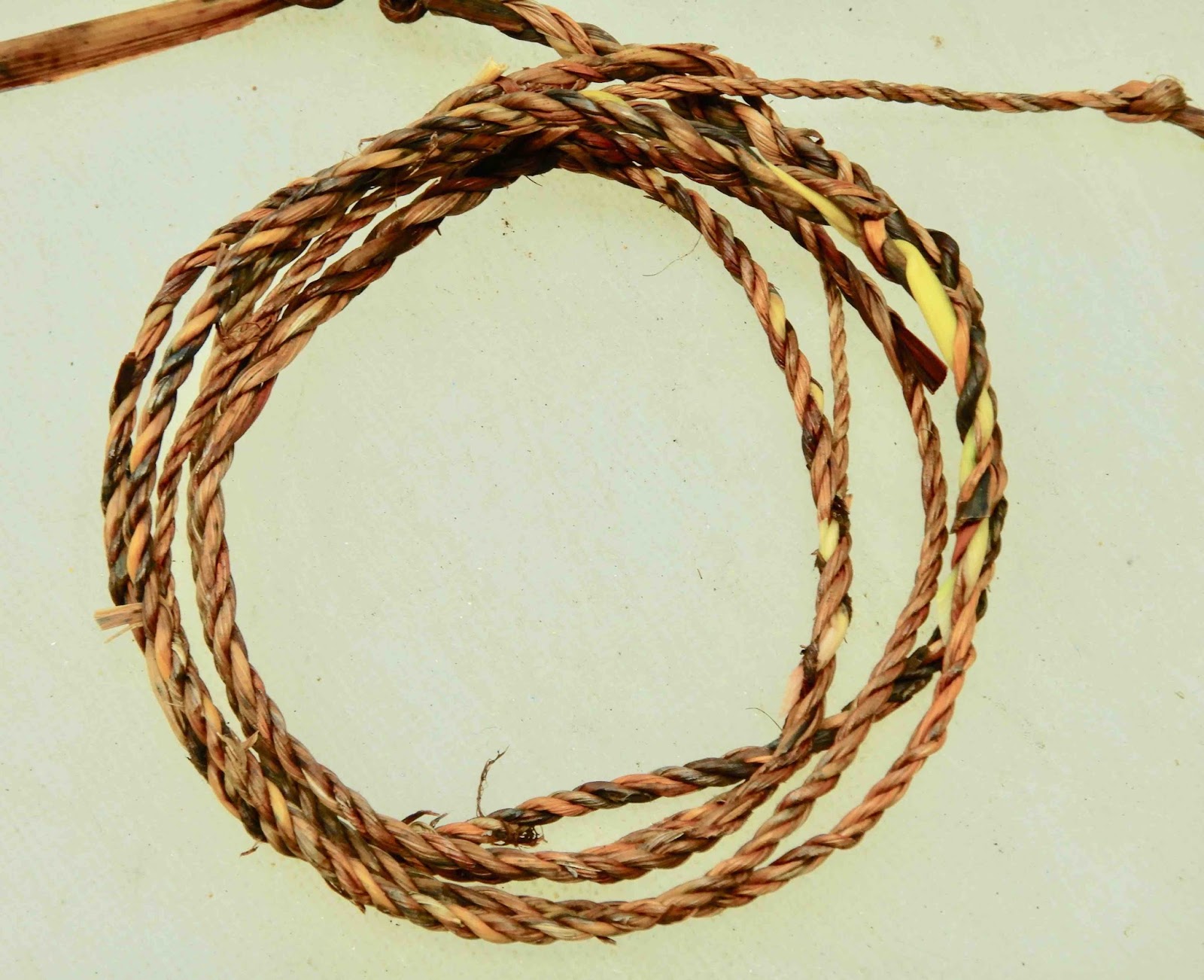
A few feet of Pacifica Iris leaf cordage, made in an hour from brown leaves
from Iris douglasiana. Note the lumpy area on the right where I twisted in a
larger leaf. Next time, I'll split the leaves into uniform widths first. 

Harvesting Pacifica Iris leaves when they have just turned brown probably gives a stronger cord. I went out this winter between rain squalls to get dead leaves, and quickly focused on thin, still-strong leaves of Iris douglasiana selections like Iris ‘Mission Santa Cruz’. I have several larger leaved selections, so could make larger cords from those leaves. 

Something to remember for next fall —harvest iris leaves at the right time, between loss of green in fall and subsequent decay in late winter. Clean and dry, the leaves can be stored for months, then soaked in water to prepare to twist. 

Iris douglasiana leaves before twisting into cordage. They were already damp,
so did not need a presoaking in water to soften before using.

West Coast tribes in northern California made rope from Pacifica Iris leaf fibers. Leaves were harvested from late summer into fall, wilted, then split and scraped to remove a strong fiber, one from each side of the leaf. Fibers were rolled and twisted into fine cord, then multiple cords  were twisted together to make strong light ropes. Strong lines to trap deer and elk were made from those ropes. The processing that went into removing and cleaning the fibers, then twisting into cordage, then wrapping cords to make rope, and making nets from the rope, was considerable. Read more about this method here:  http://www.paleotechnics.com/Articles/Irisarticle.html .

Irises, including all Pacifica Iris, have the same strong fibers in their leaves. Years ago the general iris leaf structure of two outer layers of leaf linked by fibrous cross walls was compared to a I-beam--creating a strong, flexible leaf. The authors looked at dozens of species in many iris sections, and while the cross-beams changed a bit in shape, the basic plan did not, across all species they examined. If you have access to a college library, look for "Structure and mechanics of the iris leaf", Journal of Materials Science, vol 23, pages 3041-3048, by L. J. Gibson, M.F. Ashby and K.E. Easterling, published in 1988.

Iris douglaisana, I. macrosiphon, I. purdyi and natural hybrids of these species seem to contain the right vein structure in their leaves, with two larger veins running up the outside edges. I suspect this is because they tend to have larger leaves. 
The thin end, made from fine leaves.

During dry moments this winter, I also collected long green leaves from several Pacifica Iris plants to see if there are usable fibers in them. It’s a little late in the year, but on the West Coast, this winter has been mild and wet, and iris leaves are still green. As with other fiber-containing species, longer iris leaves produce longer fibers, which spin more easily into cordage. Now I wonder what the leaf fibers are like in Iris unguicularis, I. lazica, ornamental Carex, milkweed, and Diplorrhena. 

A closeup of the three-leaf cord, showing natural color variation
in brown Pacifica Iris leaves.


It’s a slippery slope from playing with natural cordage to spinning your own yarn, I understand, and I’m hoping to not be enticed into another hobby just yet. My goal is to garden as long as I can, and only then retire to less taxing hobbies. 

Monday, April 2, 2018

Rebloom With the Dwarf Irises

by Ginny Spoon

One night, I had a dream that our entire front yard was in bloom with dwarf irises. Not only were they a carpet of color, but they were blooming in the autumn. It doesn't have to be a dream though, there are many miniature dwarf (to 8") and standard dwarf (8-14") irises that will rebloom  in our cold climate zones. Our garden is located in zone 6b, and many dwarf irises have been reported to rebloom as far north as Canada.


         'Blue Hues'  (standard dwarf bearded) -- photo by Ginny Spoon

Our 'Blue Hues' is a prolific rebloomer for us and even when the temperatures go below freezing it will keep blooming sometime into late December.


'Blue Hues' after a cold snap in mid November--photo by Ginny Spoon


       'Rosalie Loving' in early December -- photo by Ginny Spoon

The dwarfs don't wait until it snows or freezes, they start their rebloom earlier in the fall since their spring bloom is earlier than the tall beardeds. They continue to rebloom until the freezing temperatures last longer than a week. Then they take a winter nap until they awaken in the spring.


'Forever Blue' is another dwarf that reblooms well into the cold season and has been reported to have multiple rebloom in some areas. Chuck Chapman is the hybridizer of this lovely iris and he lives and hybridizes irises in Canada.


                                              'Forever Blue' -- Photo from Iris Wiki

Working with the blues and teasing out some turquoise, we got this pretty dwarf rebloomer, 'Teagan'.


  'Teagan'  -- photo by Ginny Spoon

'Carmel Celeste' is one of my favorite yellow dwarf rebloomers.  It was hybridized by Rick Tasco, who hybridizes in California. 'Ray Jones' by Don Spoon is another bright yellow rebloomer that sometimes puts up multiple stalks on the same rhizome and is a prolific bloomer.


       'Carmel Celeste' -- photo by Ginny Spoon


'Ray Jones' -- photo by Ginny Spoon

There are many colors available in the reblooming dwarf irises. Here is one that is green, a newer introduction by Don Spoon, 'Lime Pie' (2017).


'Lime Pie' -- photo by Ginny Spoon

The miniature dwarfs also love to rebloom in cold climates. 'Sapphire Jubilee' (Ginny Spoon), 'Ditto' (Hager), 'Storm Compass'  (Chancellor/Rust) and 'Trimmed Velvet' (Don Spoon) are just a few that we grow.


 MDB 'Sapphire Jubilee' -- photo by Ginny Spoon


 MDB 'Trimmed Velvet' -- photo by Ginny Spoon

   
  MDB "Storm Compass'-- photo by Ginny Spoon

For more information on reblooming irises go to the American Iris Society website: www.irises.org and go to link for the reblooming iris society. They also have a checklist that lists the irises that rebloom and the zones reported for rebloom.


Wednesday, March 28, 2018

IRISES: The Bulletin of the AIS - Spring 2018 Edition

By Susanne Holland Spicker

The American Iris Society Blog, "World of Irises," extends a hearty welcome to all iris lovers and is happy to give an introduction to the Spring Edition of IRISES: The Bulletin of the American Iris Society. Whether this is your first time viewing, or you're a member of The American Iris Society, we hope you enjoy the new Spring 2018 issue.

Note: to access this area of the website you must have a current AIS Emembership. AIS Emembership is separate from the normal AIS membership. Please see the Electronic Membership Information area of the AIS website for more details.

The Spring issue of the AIS Bulletin is already available for online viewing and accessible via the Emembers section of the AIS website. The print copy is in the hands of U.S. Post Office. 

Featured on the cover is 'SUMMER HONEY' (Betty Wilkerson 2013 TB-Re), photo by Carole Buchheim.


This edition offers a wealth of information, good articles, and lots of beautiful pictures.

Page 11 gives us important information concerning Novelty, Spuria and HIPS (Historic Iris Preservation Society).

On page 12, Mike Lockatell gives us a nice article on the late Betty Wilkerson (1941-2017). "A Bridge In Time" highlights the cool season rebloom hybridizer with lots of beautiful pictures of her reblooming cool season irises. It's a wonderful insight to this great lady and her lovely irises.

On page 16 we have the news of our Youth achievers. The winner of the Clarke Cosgrove Memorial Award for Youth Achievement, Hope Winzer - Region 18, is announced. Congratulations!

On page 24, Jim Morris takes a look ahead to 2020, the 100th anniversary of the American Iris Society in New York City.  Jim also looks back with a comprehensive capsule of the Tall Bearded Iris history.  You won't want to miss this fascinating article!

On page 30, Terry Aitkin gives us an excellent article in "The Continued Search for the Red Iris." Compelling information from Terry--thank you!

And on page 44, "Ask the Vets" gives us some very informative and interesting answers to questions pertaining to all irises.  Excellent!

Not a member of the AIS (American Iris Society)?  Please see our website for information about becoming one:  http://irises.org/

There is much more to view and read in the Spring 2018 Edition of 'Irises,' either in digital or print formats. If you're an AIS member, you will be receiving your print edition soon. If you're an e-member, that version is already available online.


We wish you a great spring bloom season, 
and happy gardening!

Monday, March 26, 2018

Carl Salbach - Important Early California Iris Hybridizer and Purveyor

By Jean Richter

Carl Salbach is the third, and perhaps least known, of the early San Francisco Bay Area iris hybridizers, along with Sydney B. Mitchell and William Mohr, whom I have covered in some of my previous blogs. In addition to being an award-winning iris hybridizer himself, Salbach introduced iris for many other hybridizers, including many of the most important varieties of the early and mid-20th century. Although iris were his primary horticultural interest, early in his career he also hybridized dahlias and gladiolus.

Carl Salbach was born on a ranch near Stockton, California in 1870, one of seven children of Edward and Katherine Salbach, who left their native Germany to settle in California's central valley. After graduating high school he served as the Deputy County Clerk for seven years, before moving on to the field that occupied his interest for much of his early years, the selling of typewriters. He worked for, managed, and owned typewriter companies in San Francisco and Los Angeles. While living in Oakland (across the bay from San Francisco), his growing interest in horticulture led to him publishing his first plant catalog (devoted to dahlias and gladiolus) in 1922. Around this same time period he first was introduced to modern tall bearded iris, and he so enthusiastically embraced iris that he offered his first iris catalog just two years later in 1924. This first catalog had nine of William Mohr's varieties.

At this same time Sydney B. Mitchell established his Campos Altos Iris Gardens in the nearby Berkeley hills, but soon found that running an iris business left him little time to pursue his hybridizing activities. In 1925 he sold 4.5 acres of his land and all of his commercial iris stock to Salbach, who moved his office to the Woodmont Avenue location. His 1925 catalog included 23 Mohr introductions, including the important early arilbred iris 'William Mohr', which sold for the princely (for the time) sum of $50.00!

Salbach began introducing his own hybrids in 1933. From the start they began winning awards, and in 1944 Salbach was awarded the American Iris Society's Gold Medal for Achievement in Hybridizing, on the strength such introductions as 'Golden Majesty', 'Deep Velvet', 'Radiant', and 'Lighthouse'.

'Lighthouse' (Salbach 1936)
photo courtesy of Superstition Iris Gardens

In 1939 he introduced Clara B. Rees' 'Snow Flurry', one of the most important advances in tall bearded iris in the early 20th century, with unprecedented ruffling and form. 'Snow Flurry's importance as a parent in hybridizing led to it being referred to as the "Queen Mother of the Iris World." Local legend has it that Ms. Rees' sister Ruth cut several of its flowers, securing them with tissue paper in a shoebox, and made an all-day journey by train, ferry, and trolley all the way from San Jose to Salbach's home in the Berkeley hills. Upon seeing the magnificent flower Salbach was so amazed that, after seeing the plant in Rees' San Jose garden, he bought her entire stock on the spot.

'Snow Flurry' (Rees 1939)

Among the hybridizers that Salbach introduced for was Frank Reinelt. In 1940, he introduced Reinelt's important arilbred iris 'Capitola'. Apparently Reinelt was so disappointed by the cross (the parents were 'William Mohr' and 'IB-Mac', one of the first arilbred iris), that he considered throwing it away! Luckily for the iris world he did not, as 'Capitola' is a major parent in arilbred breeding.

'Capitola' (Reinelt 1940)
photo courtesy of Superstition Iris Gardens

In 1943 Salbach introduced one of his finest creations, the arilbred 'Lady Mohr'. This variety went on to win the Honorable Mention and Award of Merit, and many thought it deserving of the Dykes Medal as well, though it was not given that honor. This iris is a good example of Salbach's well-thought-out and planned approach to hybridizing (unlike the hit-or-miss methods of many of his contemporaries). 'Lady Mohr' was the result of a direct effort to produce a light-colored "Mohr" type iris from Capitola. The pod parent was chosen for its form, color, and ability to yield seedlings from hard-to-take crosses (a common problem when working with arilbred iris).

Lady Mohr (Salbach 1943)

The last year Salbach introduced his own creations was 1952, and he saved one of the best for last in 'Oriental Glory'. This striking iris has great garden impact. It's a difficult iris to photograph well, as the blue blaze beneath its beard can be tough to capture correctly.

Oriental Glory (Salbach 1952)

While iris were his main focus, Salbach also introduced a number of other plants. Along with the aforementioned dahlias and gladiolus, he introduced Reinelt's strain of delphiniums (which were to become world famous as the Pacific Hybrids). He also sold seed of Sydney B. Mitchell's hybrid broom (Cytisus), as well as Iceland poppies and helianthemums.

Salbach received a number of awards for iris as well as other plants. As well as the AIS Gold Medal, he received the Foster Memorial Plaque from the British Iris Society in 1948. In 1945 he received the Gold Medal of the New England Gladiolus Society for his work in hybridizing gladiolus, and in 1948 received the Achievement Award of the North American Gladiolus Council for "meritorious work in promoting and bettering gladiolus."

In 1933 Salbach took out the first plant patent to be given to a gladiolus for his introduction 'Golden Goddess'. He patented six gladiolus in all, and was so successful that he announced he was going to patent Clara B. Rees' iris 'Snow Flurry' and his own 'Deep Velvet'. For some reason (perhaps the difficulty of controlling the patents) he never actually did file the patents, which would have been the first filed for iris.

Salbach worked with other types of iris besides tall bearded and arilbreds, growing and selling numerous other kinds of iris and introducing a dwarf iris. He also hybridized Dutch iris. At one time a representative from the Dutch bulb growers visited his garden, and upon seeing several of his Dutch iris seedlings, asked if he would sell them. Salbach replied (probably in an effort to end the conversation) that they were for sale that day only and for $1000. Much to his surprise, the representative immediately handed him a check for that amount!

Salbach married Ella Stockwell in 1900, and their only child Edward was born in 1907. Edward was as keenly interested in iris as his father, and had begun taking on an important share of the management of Salbach Gardens when his life was tragically cut short in an automobile accident in 1939. Without a second generation to continue the management of the business, Carl Salbach retired and closed down the garden in 1959 and the acreage was subdivided for housing (which had already begun to encroach on the area). As Roy Oliphant noted in his appreciation of Salbach in the 1960 AIS Bulletin, "It seems a great loss to those of us who remember the many fine things that came from his gardens, and who remember the beauty of the gardens themselves with their fields of iris, the banks of wildlings, the great bushes of fragrant rhododendrons, the superb spectacle of the flowering cherries in full bloom and who, above all, remember Carl in his garden."

Carl Salbach passed away November 2, 1962, after a massive heart attack just before his 92nd birthday. His legacy among iris enthusiasts is vast, both from iris he developed himself and those he introduced through his business. Without Carl Salbach, the great accomplishments of the early 20th century northern California hybridizers might never have been known.