Monday, February 6, 2017

The Winter Flowering Iris, Part 2

By Bryce Willliamson

In putting together the blog The Winter Flowering I. unguicularis, Mr. Richard Tasco answered my questions and provided images. The following interview has been constructed from our correspondence. I. unguicularis do provide good winter flowering plants in Zone 7 and up, but cannot be grown outside in other zones.

BW: How did you get started hybridizing I. unguicularis?

RT: During the 1998 season I made my first cross with the Iris Unguicularis.  This was I. Ssp Cretensis X Marondera.  Marondera is an unregistered large flowered Unguicularis of unknown origin.  I found reference to this clone in South Africa.  This cross produced 3 seeds, two of which germinated and one went on to die.  The other turned out to be my first Unguicularis introduction “Dazzling Eyes” (Tasco 2004).

Dazzling Eyes (Tasco)--image by Rick Tasco

In succeeding years I started to use more clones which I acquired:  Mary Barnard, Walter Butt, Alba, Lazica and of course Marondera.  Marondera more than any of the others proved to be a wonderful parent.  It was largely responsible for my goal of getting large flowers with large rounded petals in this class.  Lazica and Walter Butt did not produce anything worthwhile.  I was more successful with Alba and Mary Barnard.   Wishmaster (Tasco 2007) was Marondera X Mary Barnard.  This is a large medium purple flower.

BW: What were and are your goals in hybridizing?

RT: Another goal was to use Alba to create a very pale lavender along the lines of Walter Butt, but much larger.  This was achieved with my Lavender Moonbeams (Tasco 2014) by using Alba X Marondera.  I called it Lavender Moonbeams.  I’m still using Alba trying to get a white flower with blue shadings.  White flowers do appear in my seedlings but only in the second generation.  Such as Alba X Marondera and then Alba by the progeny of the first cross.  The percent of white flowers in any cross is about 10 percent, but most white flowers, like Alba, aren’t strong growers.  I’m working to improve that.

Lavender Moonbeams (Tasco 2014)--image by Rick Tasco

Still another goal was for dark flowers.  Result was Winter Echoes (Tasco 2011), this was a cross of Marondera X Mary Barnard.   I’m still working for something darker.

Winter Echoes (Tasco 2011)--image by Rick Tasco

The progeny of these crosses do not produce that much diversity and it is difficult to select something different and better.  One year I grew 800 seedlings and only selected two to introduce.  Currently I have about 700 unguicularis seedlings. 

Tasco 04-UNG-03-10--image by Rick Tasco

BW: Do you have any tips for gardeners?

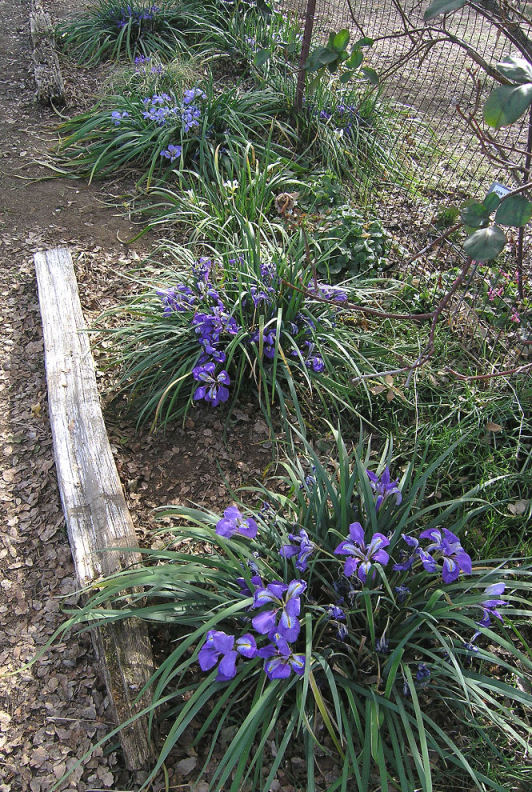
RT: Unguicularis are easy growing plants that can grow and bloom in either full sun or partial shade.  In full sun the foliage may yellow somewhat and become upright making it difficult to observe the flowers in bloom.  In partial shade the foliage remains greener and tends to reflex so the flowers can be easily be observed.

Image by Rick Tasco

BW: What are some of the unusual characteristics of I. unguicularis?

Unguicularis do not have stalks.  They flower on elongated perianth tubes.  Some varieties have longer tubes than others, but most are between 8 and 15 inches.

BW: Do you have any special cultural recommendations?

RT: In our Central California climate it is best to plant or transplant Unguicularis at the end of October or the beginning of November.  Although most literature say they can grow in poor soil, I amend my soil with a good soil amendment, half and half, such as Miracle-Gro or Sta-Green (very comparable and less expensive than Miracle-Gro but only available at Lowe’s).  This makes a big difference in good growth and more flowers.

Rick Tasco's I. unguircularis seedling bed, February 3, 2017--image by Rick Tasco

From late spring thru October the plant is dormant and the roots will die.  When digging for transplant there will be many wiry roots that are dead.  With the onset of cooler and wetter weather the plants will begin to grow new fat white roots similar to Pacific Coast Natives.  I cut off all the dead and wiry roots before I transplant being careful not to cut the new fat white ones.  They transplant easily even into pots.


Tasco 04-ung-02-11_2_2013 (1)--image by Rick Tasco

Editor’s Note: For plants, two sources are available. Superstition Iris Gardens offer three of the four Tasco varieties this year in 4 inch pots for sale and can be contacted at randrcv@sti.net or search for the Superstition Iris Gardens page on Facebook; Plant Delight Gardens in NC sells them too and they have an on-line catalogue at https://www.plantdelights.com.

My sincere thanks to Mr. Richard Tasco for providing information and images.

Saturday, February 4, 2017

The Winter Flowering Iris Unguicularis

By Bryce Williamson

Gardeners are always looking for ways to extend bloom season and iris gardeners are no exception. In his recent blog, Hooker Nichols talk about using Louisiana irises to extend the iris season after the tall bearded irises bloom; for those of us that live in a mild climate, there is a little grown iris that can start to flower as early as October and bloom during the winter months—I. unguicularis, sometimes called the Algerian iris. The term Algerian iris is a bit confusing since clones of I. unguicularis are found in the Greek islands, Greece, Syria, Tunisia, and even Turkey.


Lavender Moonbeams (Tasco)--image by Rick Tasco

With plants that grow 12 to 15 inches in height, the flowers can bloom in the foliage. Producing fragrant flowers off and on through winter, the buds are frost resistant though the flowers are not. Unlike most types of irises, I. unguicularis produce flowers over weeks and even months during the winter; however, the plants are loved by snails and slugs, making it necessary to keep the plants free of debris and snails and slugs under good control or they will eat the flowers before you have the chance to enjoy them.

As a plant from dry Mediterranean areas, this iris survive in the summer with only occasional moisture and grows and blooms in poor soil. I. unguicularis is recommended from USDA Zone 7 and higher only. While not widely grown in the United States, the Royal Horticultural Society has named I. unguicularis as one of the top 200 plants in the last 200 years.


Curtis's Botanical Magazine, 1869

Writing in Curtis’s Botanical Magazine in 1869, J. D. H. May noted that information about this iris was “was first published, without a specific name, in 1789, by Poiret, in his Voyage en Barbarie, v. ii. p. 96, and afterwards, first as I. stylosa, by Desfontaines in 1798, and then as I. unguicularis by Poiret, in 1799.” Today I. stylosa is no longer used to describe this fragrant little gem in the winter garden.

There has been some interest in I. unguicularis in what is now known as Silicon Valley for many years; the late Edith Cleaves, of Los Gatos, California, created the varieties 'Edith Cleaves', 'Winter Gay', 'Winter Goldback', 'Winter Memories', 'Winter Mystery', 'Winter Snowflake', and 'Winter Treasure', but they no longer seem to be in commerce. More recently, the noted Central Valley hybridizer, Richard Tasco, best known for creating award winning tall bearded, median, and arilbred irises, has been working with I. unguicularis too. This last year, he raised 600 seedlings.


Image by Rick Tasco

To obtain plants, two sources are available: Superstition Iris Gardens are selling three of the four Tasco varieties this year in 4 inch pots and can be contacted at randrcv@sti.net or search for the Superstition Iris Gardens page on Facebook; Plant Delight Gardens in North Carolina sells them too and they have an on-line catalogue at https://www.plantdelights.com.

Wednesday, February 1, 2017

"Talking Irises" TALL BEARDED IRISES: COMPANION PLANTS for PINK, RED, and PURPLE IRISES


By Susanne Holland Spicker


'RED SKIES' (Ghio '07)

"The garden:  Where inspiration and creativity begins and it never ends"


This time of year I like to pause and evaluate the previous gardening year. By now in zone 6 the irises have been divided or transplanted into new areas. Perennials were planted in the fall. Poor performers have been moved or composted. Seeds and new plants have been ordered and will be planted in the beds in spring after the chance of all frost has passed.  New iris cultivars have been narrowed down to a few favorites and ready to order for summer planting. This continual evolution of the garden keeps it manageable and fresh.


'OXFORD COUNTESS' (Blyth '07)

In a favorite iris bed I like to experiment with shades of pink, red and purple irises. I've then planted several varieties of companion plants among them that have the same bloom period, and similar sun and water requirements.

Tall Bearded irises from top center: 'DANDY CANDY' (Ernst '01), 'OXFORD COUNTESS' (Blyth '07), 'DARING DECEPTION' (Johnson '12), 'TICKLE ME PINK' (Van Liere '11), 'LIMERENCE' (Blyth '09)


'ROMANTIC GENTLEMAN' (Blyth '02)

I've enlarged the bed several times now because of the sheer number of exceptional iris cultivars in these colors to choose from! I keep a visual record of the irises I have, so when planning for companion plants, I can easily choose appropriate ones. 

Tall bearded irises, top row, l to r:  'EYE FOR STYLE' (Blyth '06), 'RASPBERRY WINE' (Schreiner '01), 'PERSIAN BERRY' (Gaulter '77), 'OXFORD COUNTESS' (Blyth ;07), 'TICKLE ME PINK' (Van Liere '11), 'APRIL FANFARE' SDB, (Black '14), Row 2, l to r: 'SWEETER THAN WINE' (Schreiner '98), 'PLUM PRETTY WHISKERS' (Spoon '03), 'ROMANTIC GENTLEMAN' (Blyth '02), 'LIMERENCE' (Blyth '09), 'MONTMARTRE' (Keppel '08), 'ELIZABETHAN AGE' (Baumunk '05), Row 3, l to r: 'CHANGE OF PACE' (Schreiner '99), 'WEARING RUBIES' (Blyth'00),'FLORENTINE SILK' (Keppel '05), 'EPICENTER' (Ghio '94),'JENNIFER REBECCA' (Zurbrigg '85), 'GAY PARASOL' (Schreiner '74), Row 4, l to r: 'LENTEN PRAYER' (Schreiner '98), 'CHINESE TREASURE' (Blyth '83), 'MACHISMO'(Blyth '04), 'RINGO' (Shoop ;79), 'CAT'S EYE' SDB (Black '02), 'ARTISTIC WEB' (Tasco '10)

A portion of the bed:
Forefront:  'PERSIAN BERRY' (Gaulter '77)

To extend bloom time in the spring garden, I've added several Standard Dwarf Bearded irises (SDB's). They bloom earlier than the tall bearded irises, and are the perfect plant to put in the front of a bed.

'CAT'S EYE' (Black '02) SDB

Pictured below are some of the combinations of color in the bed. Companion plants include foxglove, lupine, poppies, peonies, delphinium, clematis, widow's tears, meadow rue, Asiatic lilies, and Siberian irises. The first flush of hybrid tea roses begin when late blooming irises are still flowering as well.

Tall bearded iris top row, l to r:  'DEEP CURRENTS' (Johnson '09), 'MING LORD' (Blyth '06), 'OXFORD COUNTESS' (Blyth '07), 'LENTEN PRAYER' (Schreiner '98), Bottom row, l to r: 'PLUM PRETTY WHISKERS' (Spoon '03), 'ARTIST'S TIME' (Schreiner '74), 'EMBRACE ME' (Van Liere '08)


From top l to r: 'ROLE REVERSAL' (Ghio '10), 'EXTRAVAGANT' (Hamblen '84),'MIDNIGHT REVELRY' (Schriner '05), Bottom, l to r: 'IN THE MORNING' (Innerst '04),'GITANO' (Keppel '07), 'PARISIAN DAWN' (Keppel '06), Garden bed: f to b: 'LOUISA'S SONG' (Blyth '00), 'POEM OF ECSTASY' (Hagar '97)


Tall bearded irises, Top, l to r: 'APRIL FANFARE' SDB (Black 2014), 'GENIALITY' (Brown '81), 'QUEEN IN CALICO' (Gibson '80), 'CAT'S EYE' SDB (Black '02), 'ROMANTIC GENTLEMAN' (Blyth '02)


Tall bearded irises, top row, l to r: 'PLUM PRETTY WHISKERS' (Spoon '03), 'CLOSE UP' (Tompkins '72), 'BUBBLE BUBBLE' (Ghio '05), Bottom row, l to r: 'DEEP CURRENTS'(Johnson '09),  'SWEETER THAN WINE' (Schreiner '98), garden shot, forefront to back:'DATE BAIT' (Meek '85), 'EVER AFTER' (Keppel '86), 'RINGO' (Shoop '79), 'RASPBERRY WINE' (Schreiner '01), 'ROSE' (Gaulter '78)

As I anxiously count down the days until spring, I'm always glad I've prepared the beds in fall by pruning, cutting down, labeling all plants, and cleaning up and discarding all debris; it makes spring clean up much easier and faster. Doing this decreases the chance of disease or other problems. Having garden maps and pictures to study helps me keep track of each plant--this is what's worked best for me, and if you don't have a system, it may for you, too.  


Tall bearded irises front to back: 'BOLD EXPRESSION' (Ernst '03), 'PURPLE SERENADE' (Schreiner '05), 'MAGHAREE' (Blyth '86)

I've enjoyed sharing some of my favorite irises and their companion plants, but I'd love to hear from you and what you're doing in your flower garden this year. I am always inspired by others and their gardens.  

Tall bearded irises from front left: 'CHAMPAGNE ELEGANCE' (Niswonger '87), 'MIDNIGHT REVELRY' (Schreiner '05), 'LATIN LOVER' Shoop '69), 'GAY PARASOL' (Schreiner '74), 'HEATHER CLOUD' (Hamner '81), 'GITANO' (Keppel '07), 'POEM OF ECSTASY' (Hager '97), 'IN THE MORNING' (Innerst '04), 'LOUISA'S SONG' (Blyth '07) 


Note: For more pictures and ideas on companion planting, go to
 "World of Irises", October 7, 2013 and December 2, 2013


IRISES, the Bulletin of the AIS - Winter 2017 Edition

By Andi Rivarola

A warm welcome to those who are seeing IRISES, the Bulletin of The American Iris Society for the first time. If you are a member of The American Iris Society I hope you enjoy this new edition, cover below, which you will receive via U.S. Mail very soon. 

The Winter 2017 issue of the AIS Bulletin will be available soon for online viewing also and is accessible via the Emembers section of the AIS website. Note: to access this area of the website you must have a current AIS Emembership. AIS Emembership is separate from the normal AIS membership. Please see the Electronic Membership Information area of the AIS website for more details.


On this issue:

On Page 6 & 7 the invitation and registration form to the L.A. Spuria Iris Fest 2017 to be held in the Los Angeles area on May 5 and 6. 

AIS President Gary White's message is on page 8.

An introduction to the 2016 Honorary Award Recipient Don Delmez from St. Louis, Missouri, on page 9, by Jim Morris.

President Gary White notes:


The AIS Board of Directors named Don Delmez of Region 18, as recipient of the AIS Hybridizer's Medal. Don hybridizes and introduces Japanese irises in the St. Louis, Missouri area. 

Fantastic iris photos in oh so many locations are available on pages 10 through 5. Displayed LARGE, they are the winners of the 2016 AIS Photo Contest

International Iris News are on pages 16 through 18, featuring stories from Australia, New Zealand, Germany and France, by Bruce Filardi. 

Bruce details the prizes to be awarded in Franciris 2017, the France Iris Competition:
  • Best irises in the competition
  • Best French iris
  • The most floriferous iris
  • The best perfume/fragrance
  • The audience award (popular favorite)

An introduction to new AIS Board members, and their visit to Sedona, Arizona during the fall meeting, on pages 20 and 21. 

Please note that the 2016 Exhibition Report was printed separate from the Bulletin but inserted and mailed together. 

Two excellent scientific reports: one called, Genetics is Easy. Really? Not! by Jim Morris; followed by Jumping Genes, An Alternate View, by Dan Meckenstock. 


Jumping genes involve two DNA elements — the suppressor and the activator. The activator encodes a transposase enzyme that attaches itself to the suppressor-mutator element and inserts it into a chromosome

Don't miss a note by Stephanie Markham, presenting hybridizer Lynda Miller, the 2016 Bennett C. Jones Award for Outstanding Median Hybridizing, on page 36. 

Lastly, Youth Views are on pages 38 and 39, by Cheryl Deaton. 

If you need information about the Des Moines, Iowa National Convention, please find it on page 50 followed by the registration form on page 51.


There's a lot more to see and read in this edition of IRISES, either in digital or print formats. If you are an AIS member know that you will receive the print edition soon (it's in the hands of the U.S. Post Office), or if you are an e-member, then that version will be a available online soon. 

Happy gardening!