Showing posts sorted by relevance for query rebloom. Sort by date Show all posts

Tuesday, November 29, 2022

Growing Irises Out East: Sharing Stories of Rebloom

by Heather Haley

In addition to being a member of the American Iris Society (AIS), I am an active participant and volunteer in North Carolina Cooperative Extension programs. I completed the NC Farm School program 2019. Earlier this month, my husband Chris and I hosted a farm visit for another Farm School graduate, her instructor, and a new horticulture extension agent in our county. 

Heather's family with reblooming iris 'Mesmerizer' on their farm in Ramseur, North Carolina
photo by Grace Kanoy, GeoCore Creative Inc.

Winter is approaching quickly, and Chris and I spent that morning straightening up the kitchen -- just in case we needed to move farm conversations inside. When the visitors arrived, they were met with spring-like conditions and all enthusiastically wanted to visit the production field for bearded irises. The intent of this visit was to support a beginning nursery owner, discuss interests, and share experiences in the business of horticulture. However, once visitors realized the farm had several irises blooming in mid-November, they lost all thought of business pursuits and became highly inquisitive about these plants. 

One inquired, "Are the irises CONFUSED?" I laughed gently and replied, "No. Those are rebloomers. They are just doing what they do best."

Chris and I explained that each of the various irises on our property has genetic information coded in their DNA. Differences in DNA make each iris interesting and different from other varieties. Some iris genes control traits like flower color, whereas others can modify growth and reproductive cycles. With the right DNA sequence, an iris can shorten or skip summer dormancy and proceed directly into its next growth cycle. If climate and cultural conditions are just right, it is possible for daughter rhizomes to bloom in the same year as their mother. These irises aren't confused; they are just unusually prolific. Science buffs use the term "remontant" to describe plants that flower more than once in a growing season. "Rebloom" is the colloquial term for this phenomenon, and an entire chapter on it appears in the third AIS study of the genus Iris: a 1978 book titled The World Of Irises*. 

*The World of Irises book is now out of print, but used copies can be found online. Wayne Messer and Bob Pries have also transcribed select book chapters (including Raymond Smith's chapter on Rebloom) for Iris Encyclopedia. AIS is always looking for volunteers who can type existing content into this online library. If you are interested and available for transcription projects like this, please reach out to Bob at bobpries3@gmail.com. 

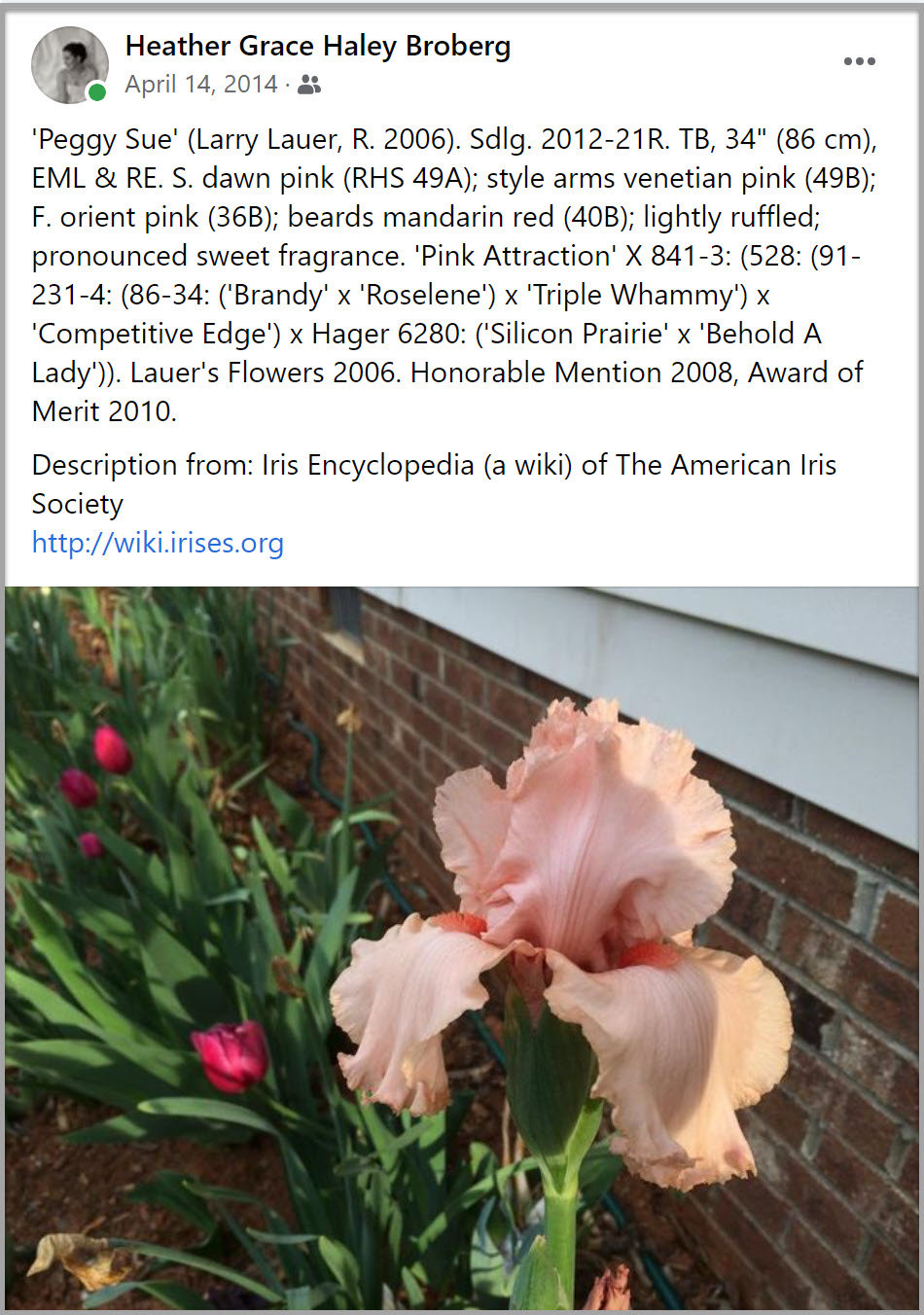
Chris reminisced about our household's earliest experience with a reblooming iris. After spending years in apartments during our college years, Chris and I became first-time homeowners and took to gardening in earnest. A modest collection of 19 irises arrived in September 2012 and were gifts from my mother Alleah. We planted them on the north side of the house where they would have good drainage and receive plenty of sun. Among these irises was 'Peggy Sue.' Alleah's description of this iris was deceptively plain: Peggy Sue - L. Lauer '06 - pink, red beard, lightly ruffled.  Although we didn't know it then, 'Peggy Sue' was destined to confuse and delight us. 

Several of our new irises bloomed the following spring, but 'Peggy Sue' wasn't among them. Her first bloomstalk appeared much later . . . in NOVEMBER! We were ecstatic to enjoy a flower in bloom, but also wrongly assumed this iris was confused. I posted a garden photo on Facebook, and included it in an e-mail to other members of the family.

Fall 2013

I suspected this bloom might be evidence of global warming, but my mother set me straight. Alleah was, and still is, vastly more knowledgeable about irises she chooses to maintain in a garden setting. Her response was, "I hate to burst your bubble, but 'Peggy Sue' absolutely knows it's November and is doing the right thing. She blooms EML and RE (AIS abbreviation for early, midseason, late season, and rebloom). . . . So whether or not I labeled the iris RE, she is. I'm attaching the October Santa Rosa Iris Society Newsletter in which I printed a long article on successful rebloomers in California and referred to a commercial garden in Virginia that specializes in rebloomers." 

Alleah's email continued with gems of motherly, irisey, and scholarly advice. "You may wish to go online and see a list of rebloomers in that geographic area and ask for some . . . .  Reblooming is a recessive trait. An iris breeder improves his chances of getting a rebloomer by crossing two rebloomers together, or involving several rebloomers in his line. 'Peggy Sue' has 'Pink Attraction' (RE) in its background, although none of the other irises in its background were registered as rebloomers. You will have to find other evidence of global warming."

Spring 2014

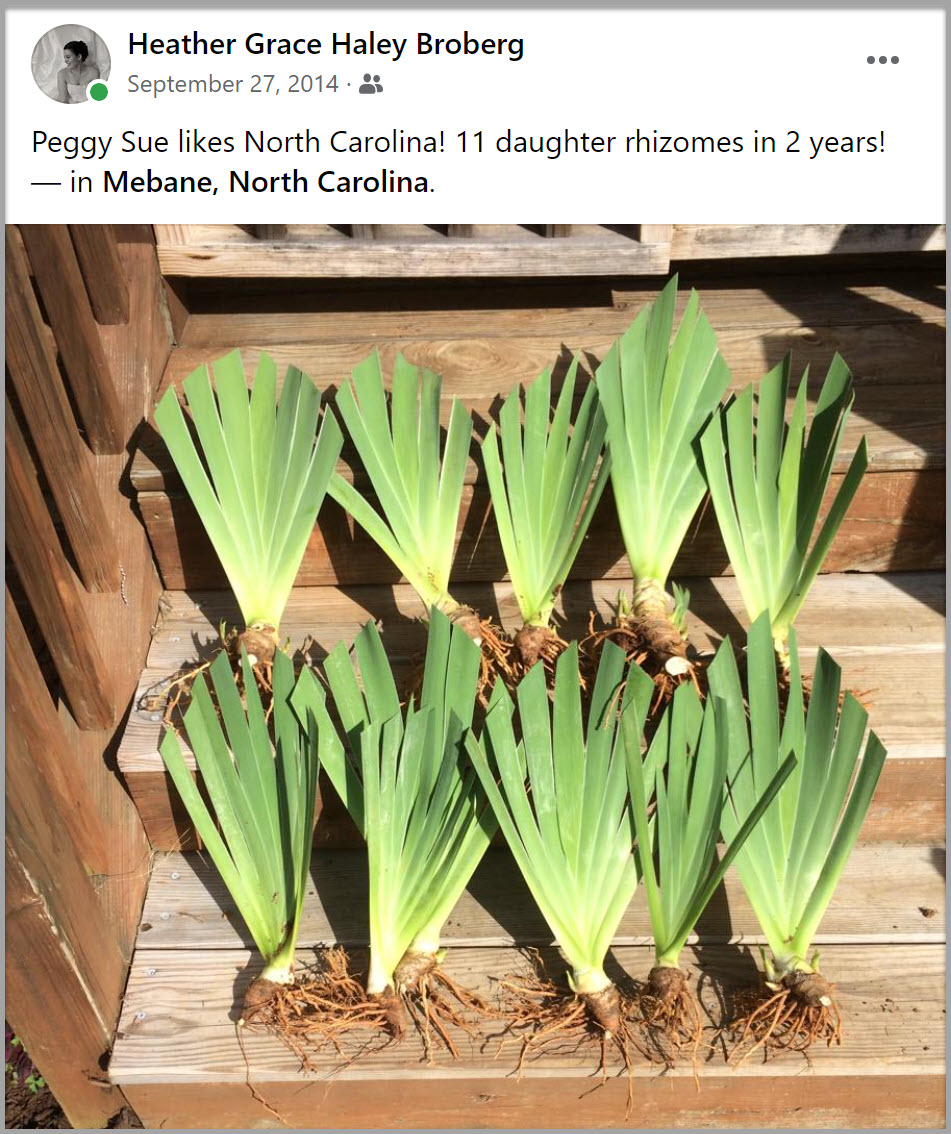
After planting some extra rhizomes of 'Peggy Sue' in the backyard, it became obvious that 'Peggy Sue' in the front yard had better growing conditions. These conditions led to more consistent bloom and rebloom in the front yard compared to the back. Rebloomers appreciate being watered throughout the summer. Frequent rain combined with a leaky hose spigot provided front yard 'Peggy Sue' regular access to water when she wanted it. She responded by blooming regularly and making lots of increases.

Fall 2014

Early Spring 2015

Very Early Spring 2016

Being located close to the foundation of our house also allowed for slightly elevated temperature. Bricks can absorb and store thermal energy from sunshine during the day. When the sun went down, the bricks slowly dissipate stored energy to their surroundings, including front yard 'Peggy Sue.' As years passed, we got several earlier- or later-than-usual bloomstalks, resulting in bloom for Thanksgiving and Christmas! Each time she bloomed, my inner Buddy Holly started singing, "I love you Peggy Sue, with a love so rare and true. Oh, Peggy, My Peggy Sue!"

Late Fall 2015

Winter 2015

Late Winter 2017

'Peggy Sue' was not the only iris we that rebloomed for Chris and me in Mebane, but it was one of the more memorable cultivars we maintained there. Of 80,000+ irises registered with the American Iris Society, about 4,246 (0.5%) are known to exhibit rebloom. By 2015, I was eager to get more rhizomes of reblooming irises. Unfortunately, many of the rebloomers I added didn't seem to like us very much. They didn't die, but only three of the twelve irises Alleah gifted to us demonstrated rebloom. I tried following conventional advice by providing more water and fertilizer, but most never bloomed more than once in a growing season. Thankfully we had better success with the rebloomers I purchased from Alleah's grower recommendation in Virginia, and from rhizome sales hosted by my local iris society. 

'Daughter of Stars', Late Summer 2018

'Bonus Mama', Early Fall 2018

Eventually, I learned that irises that rebloom in one climate (e.g., my mother's garden in California), may not be well suited for rebloom in another (e.g., my garden in North Carolina). I started paying close attention to Colin Campbell's work gathering rebloom data in my region, and combing through back issues of the Reblooming Iris Recorder for reports from gardens closer to me. I joined the Reblooming Iris Society (RIS) in 2021, and could access newer issues of the Reblooming Iris Recorder as they became available. While attending the National AIS Convention in Las Cruces, New Mexico, Alleah and I each purchased the 2022 edition of the Cumulative Checklist of Reblooming Irises

This must-have resource is available as a printed book, flash drive, and digital file sent by e-mail 

Alleah likes using paper reference materials and purchased the rebloom checklist as a spiral-bound book. I prefer having electronic reference materials and purchased a flash drive that contains a .pdf copy of the checklist, as well as a spreadsheet version of data used to create the checklist. I store the rebloom spreadsheet on my phone so I can access needed iris information quickly. The 2022 edition of the rebloom checklist builds on prior editions from 1975 and 1988, which contained 641 and 1,428 varieties respectively. To create these must-have iris resources, the Reblooming Iris Society engages in what I would call "citizen science." Iris enthusiasts, including hybridizers and iris lovers from around the world, voluntarily track the bloom and rebloom behavior for the named iris varieties each growing season. Next, volunteers share their rebloom data with an RIS Area Director who pools rebloom data and organizes it for publication in the Reblooming Iris Recorder, and subsequently in a checklist.

For years, I aspired to track and report my own rebloom data. However, I always struggled to find time and energy to do it. That is . . . until I remembered that I photograph most irises and their identification tags with my cell phone when they bloom. My cell phone records the date and location of my pictures automatically. EUREKA!
 

Earlier this year Mary Platner, editor of the Reblooming Iris Recorder, called and asked if I would be willing to track rebloom for irises growing at the farm in Ramseur. I was hesitant and explained that most of our irises are recently planted and receive no supplemental water. Mary lives in Scottsdale, Arizona and has her share of irrigation issues. She assured me that my rebloom data would still be valuable and I agreed to help. Bloom charts can be filled out on the computer or printed on paper. Mary provided me with an example chart, and her instructions were easy to follow. Each month is divided into three columns. If the day of the month an iris blooms is between 1 and 10, an "X" is placed in the E column of the appropriate month. Similarly, if it blooms between days 11 and 20, the M column is marked. Finally, if it blooms between days 21 and 31, the L column is marked.


Bloom Chart Directions 2022

Now that overnight temperatures on the farm are below freezing, our 2022 bloom season has ended. I'll use data stored in my phone to chart if and when my reblooming irises came into flower this year. When all is recorded correctly, I plan to email completed bloom charts to my assigned RIS Director and give Mary a heads-up that they are finished.

Hopefully, sharing our experiences will inspire you to add rebloomers to your garden and take part in data collection efforts. Working together, we can help everyone understand reblooming irises better, and rest easy knowing these genetically interesting plants are certainly NOT confused.

Thursday, December 22, 2011

What is Rebloom?

Iris shows have been among my favorite events for well over two decades. I’m the gabby type and love to talk to new people at the shows. Sharing is what it’s all about and I really like to infect others with the iris virus. When they hear I breed rebloomers, their first question is “What is that?” Then, they often say, “I’ve never heard of them!”

According to the American Iris Society Judge’s Handbook, “A reblooming iris (usually marked RE) is one that blooms in the spring and again in the same growing season.” They can appear in all iris classes. My twenty six years of work as a hybridizer has been focused on rebloom in the tall bearded class for zone 6. I reserve the right to chase distractions!

Rebloom is categorized according to the arrival of that additional bloom season. Currently, there are at least four different rebloom classes based on their rebloom behavior. This is important since all types will not rebloom in some climates.

Repeat bloomers usually put up additional stalks about six weeks after the spring season. My ‘Summer Radiance’ creates a lot of interest when it blooms in July. The bright shiny yellow blooms can be seen for a great distance.

Summer Radiance (Wilkerson 1996) 

Cycle rebloomers have a distinct second season of bloom in the fall. It usually follows a fall rain and cooler temperatures. In my zone 6, southern Kentucky, most cycle rebloomers open around October 1. A good example would be my own ‘Radiant Bliss.’ Louisville is more than a hundred miles north of my garden and they get fall rebloom earlier due to their earlier fall weather.

Radiant Bliss (Wilkerson 2005)

Sporadic rebloomers produce unpredictable bloom stalks at varying times. These are the ones I call warm climate rebloomers. They do well in the southern tier of states, the west coast, and Australia. They rarely show reblooming tendencies in colder climates. When they bloom off season here, I’m like a kid in a candy store! Just as thrilling are the reports of rebloom on some of my non-reblooming children once they move to California. Both ‘Gilded Cream’ (Wilkerson 1995) and ‘Color Me Mysterious’ (Wilkerson 2011) are from rebloom breeding and have rebloomed in California.

Gilded Cream (Wilkerson 1995)

Color Me Mysterious (Wilkerson 2011)

Endowed with stronger rebloom genes, multiple blooming irises have the genetic ability to bloom any time from spring through the first hard freeze. They were called ever blooming in the past, but this was misleading, as people expected them to bloom constantly from spring thru fall. Another term you may hear is whenever bloomers. They have this ability, but most will not automatically bloom this second time.

I’ve posted a couple of photos of multiple (summer) irises growing and blooming with dahlias as proof they do bloom here in July and August, although it’s not a guarantee. ‘Immortality’ (Zurbrigg 1982) is with the red dahlias and ‘Returning Chameleon’ (Wilkerson 1995) with pastel dahlias. ‘Immortality’ is the pollen parent of ‘Returning Chameleon.’

Immortality (Zurbrigg 1982)


Returning Chameleon (Wilkerson 1995) 

With all rebloomers, much is determined by cultural practices and climate. In my zone 6 garden, it’s important to fertilize after the spring bloom and also to keep the plants well watered. If they do not receive approximately one inch of water every ten days or so they will go dormant and this will stop the rebloom. I recommend soaker hoses so the foliage doesn’t get wet in the hot summers.

The spring only bloomers need to go dormant for the summer and may (often) rot under the very conditions that rebloomers require. Again, water and extra fertilizer create extended summer growth which can and does create rot in many spring only blooming irises. If you grow several rebloomers, it would be best to grow your rebloomers separate from the spring only irises.

On a personal level, I consider rebloomers to be garden irises. I make a conscious effort to promote good branching in my seedlings, just in case they make it to an AIS sanctioned show either spring or fall. It’s rare that rebloomers are seen at the National Convention Gardens, or in spring shows. “Why is this?” you ask. Timing! Most rebloomers have an early spring season and have finished blooming by the time the shows and the tours take place. In the off season, they are the stars of the garden.

For the record, I don’t go crazy over terminology. I will report rebloom in this way, “It’s blooming now, or it bloomed at this time.” There are no guarantees with rebloomers. Mine is a difficult climate. I get excited over maiden (first) bloom in an off season, even though I know it may never rebloom again. I’m depressed at the end of spring bloom season and I dislike the first freeze each fall. I’m such an iris addict that I welcome, encourage, and enjoy an iris blooming at any time. Sometimes I think the breeding program is just a way to stay involved in irises year round!

How did I get involved in reblooming irises? In 1982, the Henry Field’s catalog listed “fall irises!” This was my introduction to reblooming irises. Thus, my obsession began. If you love irises, why not grow the type that blooms a second and sometimes a third time per year? If I had my way, everyone would grow and breed rebloomers. Don’t you agree?

There are Internet sites, including the American Iris Society, where you can increases your knowledge of irises in general. Many things, including the iris encyclopedia and commercial links, are available through the AIS site.  There is a Reblooming Iris Society devoted to rebloomers specifically. There are archives in place for both iris talk and iris photos, online email lists about irises.  These archives contain a really good supply of iris information with a search engine. Good reading for the winter season.  

Monday, August 17, 2015

Reblooming Iris Program in Zone 6: "But That's Too Old!"

by Betty Wilkerson


Over the past thirty years, I've grown most of the irises reported to rebloom, and used many of them in breeding. I've produced and grown many iris seedlings that I thought would rebloom, but most have not.  Over the past ten years, as I've tried to encourage others to breed rebloomers, I've often suggested certain strong rebloomers. Ninety percent of the time or more, I'm answered with, "That's to old." or "That's to plain." Of course, they are right, but if we want rebloom, it seems this is the path we must take in zone 6. Most of the rebloomers, introduced in the past thirty years, either don't ever rebloom in my garden, or miss most years. In order to breed rebloomers you may want to use some of the older and more tailored rebloomers.  

My advice would be to grow a handful of strong rebloomers, and experiment with the crosses.  Grow some known rebloomers that are strong in the type of rebloom you want to produce, even fall rebloom if that makes you happy.  Add a few good color genes if you can, but know that the closer you stay to strong rebloom, the more rebloom you are likely to get in your seedlings. Mainly, be happy with your crosses, otherwise there is no point.
  

'Blatant' (Byer's 1990)


'All Revved Up' (Wilkerson 2007) 

Several years ago, John Van Hook visited my garden on a regular basis, and he often urged me to use 'Blatant' as a reblooming parent. Like everyone else, I didn't want to use it because it was "older & plainer." Eventually, I put pollen from 'All Revved Up' (Wilkerson 2007) onto 'Blatant' (Byer's 1990).  I lined them out, fertilized well, and watered on a regular basis.  The cross is approximately 75% plicata so I got plicatas, selfs, saturated variegatas, one white with yellow standard rims and fall rims, and one white glaciata.  A total of 13 rebloomed, including the glaciata.  


'Cool Character' (Wilkerson 2013)


1907-10Re (sibling to 'Cool Character'


1910-10Re (sibling to 'Cool Character.') 

Another rebloomer that I've been reluctant to tell people to use in breeding is 'Violet Returns' by Earl Hall. It's a half sibling to 'Feed Back.' It's both older looking and more tailored, but it produced one of my best reblooming seedlings, 1625-01Re.  'Star Gate' is the pod parent and my 'Violet Returns' X 'Breakers' child is the pollen parent.  Again, it's plainer and shorter than desired.  


2006-01Re is from ('Chinese New Year' x 'Theme Master') X 1625-01Re.  All this one really needs is a touch more form.  It has great height and branching which I attribute to 'Chinese New Year.'  

2006-01Re seedling


2008-01Re Wilkerson seedling

Another child of 1625-01Re is just above, 2008-01Re.  It's not particularly modern, but did rebloom a lot. Yes, it is hard to get modern form when using these more tailored varieties, but this is where the reblooms seems to reside.  Also, rebloom passes most easily when working with plicatas.  I've had really good luck with 'Earl of Essex,' and 'Over and Over.'  'Earl of Essex' is good for working with fall/cycle rebloomers, while I expect 'Over and Over' to work better when working for summer/whenever rebloomers.  More work with 'Over and Over' is in the future.

I've recommended 'Over and Over,' since it's one of the strongest rebloomers I've grown. Most people say they don't want to use it.  Few say it's because it's too plain, but don't offer other reasons.


'Over and Over' (Innerst 2001)

The picture above is not one of the best pictures, but does show some of it's potential faults. It would probably be best to make the cross both ways, just to satisfy your own curiosity as to which way is best.  If you have better pictures of 'Over and Over,' and you are willing to let me use them in my blogs, please send them to me at bridgeintime@aol.com, with permission to use.  

Keep in mind that my reports are from work in my own garden in south central Kentucky.  I'm on a ridge, above a creek. The garden was a former pasture. Your results may be different than mine.   


Monday, April 13, 2015

Reblooming Irises in Zone 6:Cheerleading

by Betty Wilkerson

Here in my zone 6b garden, it is time to consider making new reblooming iris crosses.  Rebloomers are great for producing splashes of color in the summer and fall, but the breeding is best done in the spring, since summer can be too hot and fall pods often are frost damaged. Reblooming irises usually bloom during the first week of spring iris season.  Sometimes these early blooms will look fine, but will not produce any pods, since the early frost can wipe out the pollen. Be patient.  The pollen will return to normal in a few days.  In all crosses, including rebloom crosses, always use the healthiest and strongest irises available.

My friend in California has a full bed of irises that bloom all summer.  Why won't those irises rebloom for me here in zone 6?  It's both easier & harder than it might sound. The experts tell us they .don't have the genes needed to bloom in zone 6, most years.  Weather is definitely a factor, since some of these will rebloom occasionally, when the weather is mild.

I read through about ten of my old rebloom reports.  Keep in mind that there hasn't been a lot of work on rebloomers for our zones or area in the past twenty years. In the twelve years I've been at my current location, we've had a couple of mild summers, and here is a list of irises that summer bloomed for me during that time: 'Pure As Gold,' 'October Sky,' 'Lord of Rings,' 'Violet Miracle,' 'Feed Back,' 'Immortality,' 'Pink Attraction,' 'Again and Again,' 'Lunar Whitewash,' 'Over and Over,' 'All Revved Up,' 'Echo Location,' 'Returning Chameleon,' 'Cool Character,' ''Summer Honey 'and 'Summer Radiance.'  Most of these are fairly old when it comes to irises.  When we have a mild summer, with temperatures primarily in the high eighties and low nineties, we can expect a little bloom through out the summer.


'Pink Attraction'' (E. Hall 1988) photo from Schreiner's website.

'Pure As Gold' (Maryott 1993)

Due to their genes, all rebloomers are not equal.  'Pink Attraction' likes to be moved every two years, in order to rebloom well, and does not create rebloom children in my zone 6 garden. Two of my rebloomers that can bloom in the summer and also create a lot of reblooming children, are 'All Revved Up' and 'Star Gate.' When combined with other rebloomers, they do well.  Some feel that crossing the well formed irises that rebloom in California, and other temperate climates, does nothing to help us in the search for better form in the colder regions.


'All Revved Up' (Wilkerson 2006)
'Star Gate' (Wilkerson 2005)

'Echo Location'
is a very good rebloomer here and also produces reblooming children.  It might be a good iris to use toward breeding reds, since it has a lot of red blood lines from the Gibson side. These three, are all good for breeding reblooming plicatas.  Even though it doesn't looik plicata, 'Star Gate' has a lot of plicata blood and does breed some plicata.  'Star Gate' and 'Echo Location' are both examples of hidden plicatas.  Neither is a noticable plicata.  I hope to produce a good red on yellow plicata.with rebloom.

'Echo Location' (Wilkerson 2007)


There are three possible bloom seasons for rebloomers:spring, summer, and fall.  Some of us in the colder, roller coast zones have started working on summer rebloomers, giving us a better chance of seeing iris bloom during the years we have difficult spring and fall weather. Others don't want summer bloom for a variety of reasons. I'm not going to tell you how to create the best iris that both reblooms and meets all of the characteristics the American Iris Society requires for a spring bloomer. If I knew how to do this, I would have done it already!  I've come close but no brass ring!  

'Summer Honey' (Wilkerson 2013)
Crossing my plicata children onto my self children created 'Summer Honey.'  Several others from the cross, including some reddish seedlings , did rebloom.  I've been really impressed with the stalks still standing on 'Summer Honey' once the frost hit in mid october.

What cross would you make this spring in an attempt to promote rebloom in the colder zones?

Monday, August 20, 2012

Where's the Rebloom when it's Hot and Dry?

By Betty Wilkerson
South Central Kentucky, Zone 6

It’s not news to our readers that 2012 has been an unkind year, weather wise, in much of the United States.  Extremely high temperatures and drought conditions inhibit most rebloom of tall bearded irises.  Yet, ‘Immortality’ and my seedling number 1810-15Re opened blooms in early August.  They are both growing at the end of one of the new beds (2010) and get a touch of late afternoon shade.

My primary hybridizing goal has always been to create irises that will rebloom in my zone 6 garden.  My current breeding strategy has been to cross award winning spring-only irises with great form and patterns in combination with well formed rebloomers and rebloomers with strong rebloom.  Only the strongest rebloomers have a chance of producing rebloom children in this difficult area.  

‘Immortality’
 is a reblooming staple.  Even so, it doesn’t always rebloom here.  It really wants everything just right.  Last year suited its temperament: it bloomed a lot during the summer and fall in the new beds.
'Immortality' (Zurbrigg 1982)
1810-15Re (Wilkerson Seedling) 

1810-15Re is one of the seedlings from my “kitchen sink” cross.  The pod parent, a near-white over dark blue/purple is 1605-01:9415RE (((Victoria Falls x Vanity) x Immortality) x (Love Lines))) x (Feedback x Champagne Elegance).  It contains several quality spring blooming irises mixed with good rebloomers. During a move to Allen County, I lost the pod parent, a near amoena seedling with white standards and dark blue purple falls.

A sibling, 1605-02Re, is white over lavender and reblooms in the fall in my zone 6 garden.  Dr. Raymond Smith’s rebloomer, ‘Light Rebuff,’ a very pale, translucent pink, is the pollen parent.

1605-02Re (Wilkerson Seedling) 
Only three seedlings sprouted the first spring of this cross, and two put up stalks that first fall.  They were given the numbers 1810-01Re & 1810-02Re.
1810-01Re (Wilkerson Seedling)  
1810-02Re (Wilkerson Seedling)  

Another thirty eight sprouted the second spring.  Twenty two from this cross bloomed off season over the next three or four years.  Others were used in breeding, but did not rebloom.  This is an assortment of seedlings from this cross. Both #6 & #10 put up late stalks in 2006.  1810-01Re and 1810-15Re are the top rebloomers, with 1810-15Re being the best.

1810-06 (Wilkerson seedling) 
1810-10 (Wilkerson Seedling) 
1810-03Re (Wilkerson Seedling) 
 1810-07 (Wilkerson seedling)
1810-08 (Wilkerson seedling) 
1810-14Re (Wilkerson Seedling)  
These are definitely not the end product, but a step on the path to better rebloom.  Some crosses using this group of seedlings have been very interesting.  My favorite results were from a kitchen sink child crossed onto ‘Enjoy the Party.’  It has given some very nice ringed bi-tone seedlings with fall rings.  One has even fall bloomed!  Not enough, and not often enough, but a step in the right direction. 

Producing reblooming irises is a time-consuming passion, but the rewards are great:  a period of longer bloom for our favorite flower.  Let me know if you enjoyed this peek into a rebloom cross.  

Monday, April 2, 2018

Rebloom With the Dwarf Irises

by Ginny Spoon

One night, I had a dream that our entire front yard was in bloom with dwarf irises. Not only were they a carpet of color, but they were blooming in the autumn. It doesn't have to be a dream though, there are many miniature dwarf (to 8") and standard dwarf (8-14") irises that will rebloom  in our cold climate zones. Our garden is located in zone 6b, and many dwarf irises have been reported to rebloom as far north as Canada.


         'Blue Hues'  (standard dwarf bearded) -- photo by Ginny Spoon

Our 'Blue Hues' is a prolific rebloomer for us and even when the temperatures go below freezing it will keep blooming sometime into late December.


'Blue Hues' after a cold snap in mid November--photo by Ginny Spoon


       'Rosalie Loving' in early December -- photo by Ginny Spoon

The dwarfs don't wait until it snows or freezes, they start their rebloom earlier in the fall since their spring bloom is earlier than the tall beardeds. They continue to rebloom until the freezing temperatures last longer than a week. Then they take a winter nap until they awaken in the spring.


'Forever Blue' is another dwarf that reblooms well into the cold season and has been reported to have multiple rebloom in some areas. Chuck Chapman is the hybridizer of this lovely iris and he lives and hybridizes irises in Canada.


                                              'Forever Blue' -- Photo from Iris Wiki

Working with the blues and teasing out some turquoise, we got this pretty dwarf rebloomer, 'Teagan'.


  'Teagan'  -- photo by Ginny Spoon

'Carmel Celeste' is one of my favorite yellow dwarf rebloomers.  It was hybridized by Rick Tasco, who hybridizes in California. 'Ray Jones' by Don Spoon is another bright yellow rebloomer that sometimes puts up multiple stalks on the same rhizome and is a prolific bloomer.


       'Carmel Celeste' -- photo by Ginny Spoon


'Ray Jones' -- photo by Ginny Spoon

There are many colors available in the reblooming dwarf irises. Here is one that is green, a newer introduction by Don Spoon, 'Lime Pie' (2017).


'Lime Pie' -- photo by Ginny Spoon

The miniature dwarfs also love to rebloom in cold climates. 'Sapphire Jubilee' (Ginny Spoon), 'Ditto' (Hager), 'Storm Compass'  (Chancellor/Rust) and 'Trimmed Velvet' (Don Spoon) are just a few that we grow.


 MDB 'Sapphire Jubilee' -- photo by Ginny Spoon


 MDB 'Trimmed Velvet' -- photo by Ginny Spoon

   
  MDB "Storm Compass'-- photo by Ginny Spoon

For more information on reblooming irises go to the American Iris Society website: www.irises.org and go to link for the reblooming iris society. They also have a checklist that lists the irises that rebloom and the zones reported for rebloom.